Is Balcony Solar Legal in California?
This page contains links to third-party products for reference. PromptQuorum is not enrolled in any affiliate program — these are plain links that earn no commission. Clicking links and your next steps are entirely your own responsibility. These links do not represent any endorsement or verification by PromptQuorum.
Quick Answer
Signed, but not yet in effect. California's SB 868 ("Plug and Play Solar Act", authored by Sen. Scott Wiener) passed the Assembly 73-0 and Governor Gavin Newsom signed it on September 30, 2026; it takes effect January 1, 2027. It caps qualifying systems at 1,200W total AC output per dwelling, requires UL or equivalent NRTL certification and automatic shutoff within seconds of a grid outage, and exempts them from interconnection agreements until January 1, 2030 unless extended — but it does not override landlord leases or HOA rules.
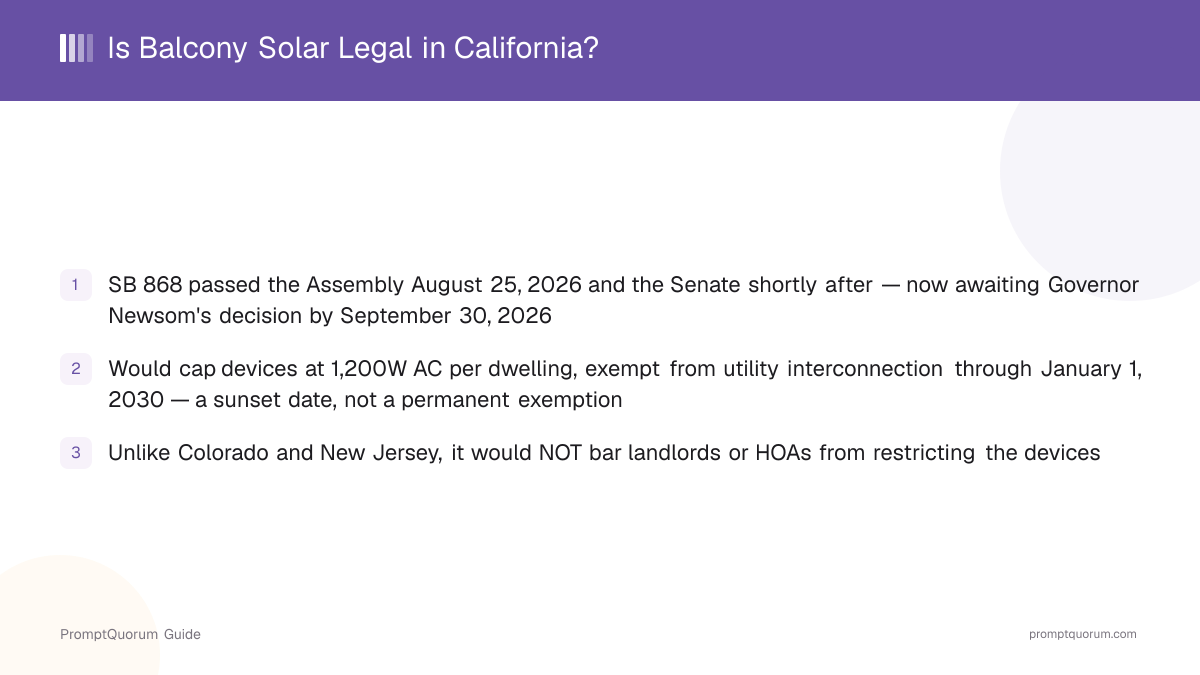
- ▸SB 868 passed the Assembly 73-0 and was signed by Governor Newsom on September 30, 2026 — it takes effect January 1, 2027, so it is not yet in effect
- ▸1,200W total AC output cap per dwelling; qualifying systems are exempt from interconnection agreements through January 1, 2030 unless extended — a sunset date, not a permanent exemption
- ▸Unlike Colorado and New Jersey, it does NOT bar landlords or HOAs from restricting the devices
Key Takeaways
- ✓California's SB 868 is signed but not yet in effect — Governor Newsom signed it on September 30, 2026, and it takes effect January 1, 2027.
- ✓The law caps qualifying systems at 1,200W total AC output per dwelling, requires UL or equivalent NRTL certification and automatic shutoff within seconds of a grid outage, and exempts them from interconnection agreements — but only until January 1, 2030 unless extended.
- ✓The law does NOT preempt landlord leases or HOA restrictions — California's existing Solar Rights Act is written for rooftop systems, not plug-in balcony devices.
- ✓California has the highest average residential electricity rate of any state tracked in this series, at about 33.3¢/kWh — the strongest potential economics once the law is in effect and certified hardware ships.
What Would SB 868 Require in California?
California's SB 868, the Plug and Play Solar Act, passed the state Assembly 73-0 and was signed by Governor Gavin Newsom on September 30, 2026; it takes effect January 1, 2027. It caps qualifying plug-in solar systems at 1,200 watts total AC output per dwelling, requires devices to be UL or equivalent NRTL-certified and to shut off automatically within seconds of a grid outage, and exempts qualifying systems from interconnection agreements — but only through January 1, 2030 unless extended, a sunset date rather than a permanent exemption.
Unlike Colorado and New Jersey, SB 868 does not override landlords or HOAs. A rental agreement that bars balcony fixtures would still bar them, and California's existing Solar Rights Act — which prohibits HOAs from banning solar — is written around roof-mounted systems, not plug-in devices on a shared-wall balcony, so it likely wouldn't extend automatic protection here. Check your own lease or HOA covenant separately once the law takes effect.
| Field | California SB 868 |
|---|---|
| Status | Signed Sep 30, 2026 — takes effect Jan 1, 2027 (not yet in effect) |
| Wattage cap | 1,200W AC per dwelling |
| Utility exemption window | Through Jan 1, 2030 only (sunset date) |
| HOA / landlord | NOT preempted — leases and HOA rules can still restrict |
Is the Economics Story Strong in California?
California has the highest average residential electricity rate of any state tracked in this series, at roughly 33.3¢/kWh — nearly triple Utah's 11.6¢/kWh. Once SB 868 takes effect and compliant hardware reaches the market, the return on an 800W kit should be the strongest of any state in this series, well above the roughly $150–$350/year national range tracked so far — though no California-specific dollar estimate exists yet since the law is not yet in effect.
Certification remains the other gate nationwide: no complete plug-in solar system has confirmed full UL 3700 certification as of write-time. EcoFlow's STREAM Ultra is the closest product to market but is currently listed for sale specifically in Utah.
Now that SB 868 is signed, you'll want real options to compare once certified hardware exists. See the current US home-battery picks for balcony solar or the EcoFlow vs. Anker vs. Zendure ecosystem comparison — plain product links, not a claim that any specific kit is certified or available in California today.
Quick Answers About California Balcony Solar
Is balcony solar legal in California right now?▾
When does SB 868 take effect, and what does it require?▾
Will SB 868 let my HOA or landlord ban balcony solar?▾
Is the 1,200W exemption permanent under the signed law?▾
Want the full breakdown?
Read the complete guide →Related Prompt Bites
- ▸Is Balcony Solar Legal in Utah?
- ▸Is Balcony Solar Legal in Maine?
- ▸Is Balcony Solar Legal in Virginia?
- ▸Is Balcony Solar Legal in Maryland?
- ▸Is Balcony Solar Legal in Colorado?
- ▸Is Balcony Solar Legal in New Hampshire?
- ▸Is Balcony Solar Legal in Vermont?
- ▸Is Balcony Solar Legal in Connecticut?
- ▸Is Balcony Solar Legal in New Jersey?
- ▸Is Balcony Solar Legal in New York?