Is Balcony Solar Legal in New Jersey?
This page contains links to third-party products for reference. PromptQuorum is not enrolled in any affiliate program — these are plain links that earn no commission. Clicking links and your next steps are entirely your own responsibility. These links do not represent any endorsement or verification by PromptQuorum.
Quick Answer
Signed, but not yet in effect. New Jersey's Garden State Balcony Solar Act (S2368/A4836) was signed by Governor Mikie Sherrill on September 1, 2026 and takes effect March 1, 2027 — and unlike most other enacted states, it explicitly bars landlords, HOAs, and condo associations from banning the devices outright.
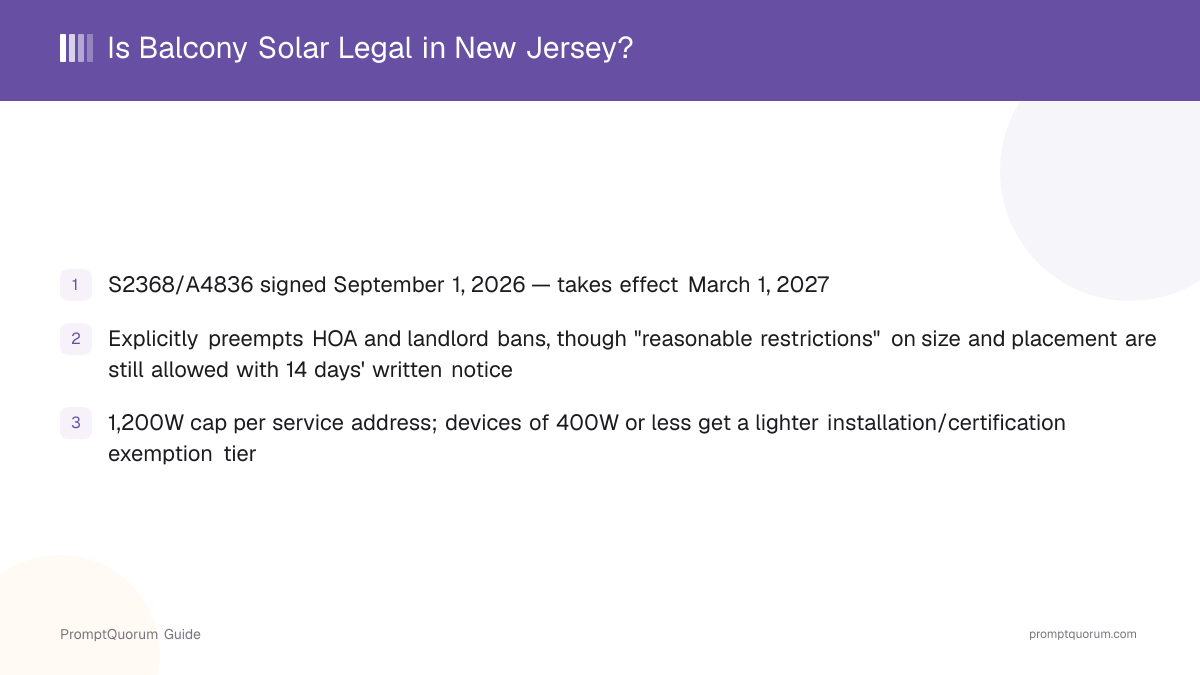
- ▸S2368/A4836 signed September 1, 2026 — takes effect March 1, 2027
- ▸Explicitly preempts HOA and landlord bans, though "reasonable restrictions" on size and placement are still allowed with 14 days' written notice
- ▸1,200W cap per service address; devices of 400W or less get a lighter installation/certification exemption tier
Key Takeaways
- ✓New Jersey's Garden State Balcony Solar Act is signed but doesn't take effect until March 1, 2027 — check the date before assuming it applies today.
- ✓Landlords, HOAs, and condo associations cannot ban the devices outright, though they can set "reasonable restrictions" on size and placement with 14 days' written notice.
- ✓The standard cap is 1,200W; devices of 400W or less qualify for a lighter installation/certification exemption tier.
- ✓No complete system has confirmed full UL 3700 certification yet, same as every other enacted state.
What Will the Garden State Balcony Solar Act Require?
New Jersey's Garden State Balcony Solar Act (S2368/A4836) caps combined portable solar output at 1,200 watts per service address — or per dwelling unit in multi-family housing — connected through a standard 120V AC outlet, with devices at 400W or less qualifying for a lighter installation and certification exemption tier. It was signed by Governor Mikie Sherrill on September 1, 2026 and takes effect March 1, 2027, giving the state Board of Public Utilities time to implement it — check today's date against that effective date before assuming the law already applies to you.
New Jersey is the second state, after Colorado, to explicitly preempt HOA and landlord bans. The law prohibits landlords, HOAs, and condo associations from banning the devices outright, including on a leased balcony or patio — but they can still impose "reasonable restrictions concerning the size, placement, or manner of placement," and residents must give 14 days' written notice plus safety documentation before installing. Maine's law uses a similar two-tier wattage structure — see the Maine balcony solar law for the other example in this series.
| Field | New Jersey S2368/A4836 |
|---|---|
| Signed / Effective | Sep 1, 2026 / Mar 1, 2027 |
| Wattage cap | 1,200W (400W lighter-exemption tier) |
| HOA / landlord bans | Preempted — reasonable restrictions only |
| Notice before installing | 14 days' written notice + safety docs |
Is the Economics Story Strong in New Jersey?
New Jersey's average residential electricity rate is about 23.3¢/kWh — roughly double Utah's 11.6¢/kWh. Once compliant hardware ships and the law is in effect, an 800W kit should land toward the higher end of the roughly $150–$350/year national range this series has tracked, though a New Jersey-specific dollar estimate wasn't in the source tracker's state-by-state savings table.
Certification is the other gate: no complete plug-in solar system has confirmed full UL 3700 certification as of write-time, a nationwide gap that applies regardless of New Jersey's effective date. EcoFlow's STREAM Ultra is the closest product to market but is currently listed for sale specifically in Utah.
Once the law takes effect and certified hardware exists, you'll want real options to compare. See the current US home-battery picks for balcony solar or the EcoFlow vs. Anker vs. Zendure ecosystem comparison — plain product links, not a claim that any specific kit is certified or available in New Jersey today.
Quick Answers About New Jersey Balcony Solar
Is balcony solar legal in New Jersey right now?▾
Can my HOA or landlord in New Jersey ban balcony solar?▾
What's the wattage cap in New Jersey?▾
What does the 400W exemption tier actually change?▾
Want the full breakdown?
Read the complete guide →Related Prompt Bites
- ▸Is Balcony Solar Legal in Utah?
- ▸Is Balcony Solar Legal in Maine?
- ▸Is Balcony Solar Legal in Virginia?
- ▸Is Balcony Solar Legal in Maryland?
- ▸Is Balcony Solar Legal in Colorado?
- ▸Is Balcony Solar Legal in New Hampshire?
- ▸Is Balcony Solar Legal in Vermont?
- ▸Is Balcony Solar Legal in Connecticut?
- ▸Is Balcony Solar Legal in California?
- ▸Is Balcony Solar Legal in New York?