SGLang vs vLLM for Local Model Serving?
vLLM is the safer default for most local serving setups — broader model support and a larger community — while SGLang tends to pull ahead on structured-output-heavy and multi-turn workloads thanks to its RadixAttention prefix caching. Both are open-source, GPU-based serving engines built for throughput, not single-user chat — neither is the right pick if you just want to run one model on a desktop for personal use.
This page contains links to third-party products for reference. PromptQuorum is not enrolled in any affiliate program — these are plain links that earn no commission. Clicking links and your next steps are entirely your own responsibility. These links do not represent any endorsement or verification by PromptQuorum.
Quick Answer
Use vLLM as the default choice: it supports a wider range of model architectures and has a larger ecosystem of integrations. Switch to SGLang if your workload is dominated by multi-turn conversations or structured/constrained generation (JSON, function calling) — its prefix-caching scheduler reuses shared context across requests more aggressively, cutting latency on repeated-context workloads.
- ▸vLLM: broader model support, larger community, safer default pick
- ▸SGLang: stronger on multi-turn and structured-output workloads via prefix caching
- ▸Both require a real GPU-serving use case — not the right tool for single-user desktop chat
Key Takeaways
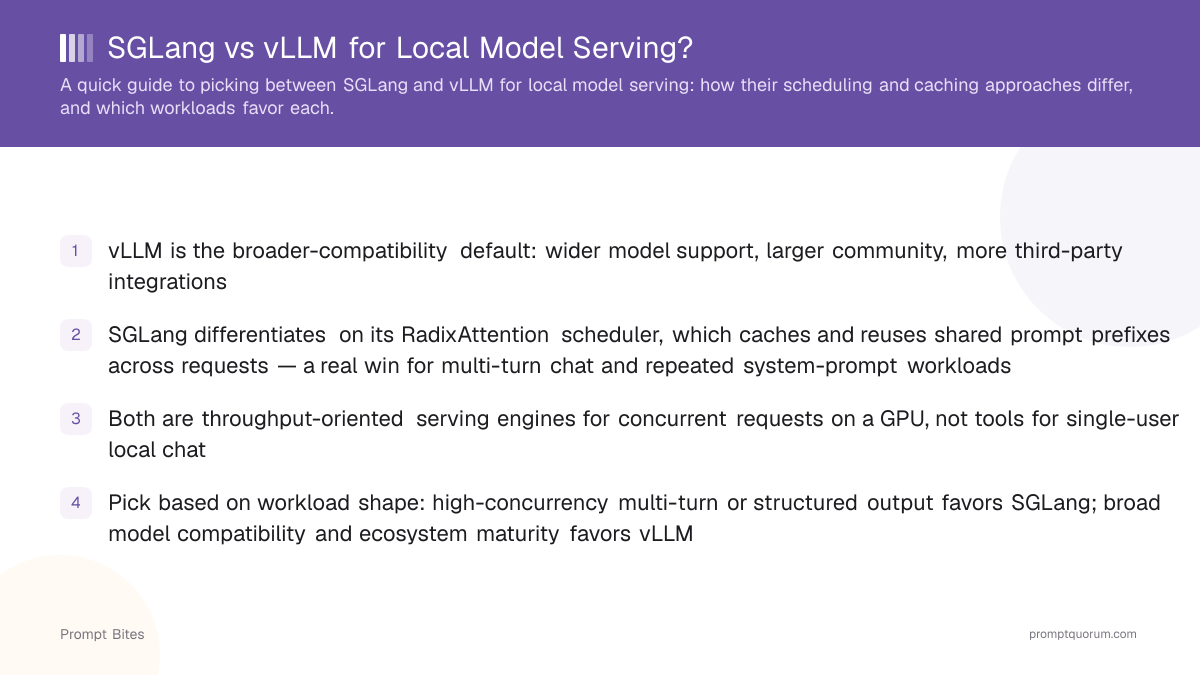
- ✓vLLM is the broader-compatibility default: wider model support, larger community, more third-party integrations
- ✓SGLang differentiates on its RadixAttention scheduler, which caches and reuses shared prompt prefixes across requests — a real win for multi-turn chat and repeated system-prompt workloads
- ✓Both are throughput-oriented serving engines for concurrent requests on a GPU, not tools for single-user local chat
- ✓Pick based on workload shape: high-concurrency multi-turn or structured output favors SGLang; broad model compatibility and ecosystem maturity favors vLLM
- ✓Both expose OpenAI-compatible APIs, so switching later is usually just a base-URL change
How Their Scheduling Approaches Differ
The core difference is how each engine handles shared context across requests. vLLM's PagedAttention manages GPU memory for the KV cache like an operating system manages virtual memory — allocating pages on demand, eliminating the fragmentation that plagues naive batching. This makes vLLM efficient at high concurrency regardless of whether requests share content.
SGLang builds on a similar memory-management idea but adds RadixAttention, a caching layer structured as a prefix tree: when multiple requests share an identical prompt prefix (a repeated system prompt, or turns 1-3 of an ongoing conversation), SGLang reuses the cached computation instead of recomputing it. For workloads with heavy prefix overlap — chatbots with a long fixed system prompt, or agents replaying prior conversation turns — this cuts both latency and GPU memory pressure.
For single-shot, unrelated requests with no shared context, the two engines perform comparably — the RadixAttention advantage only shows up when prefixes actually repeat.
Side-by-Side Comparison
Both are actively maintained, production-grade serving engines — the differences below are about where each design puts its weight, not about one being unfinished.
| Feature | vLLM | SGLang |
|---|---|---|
| Core cache technique | PagedAttention | RadixAttention (prefix tree) |
| Best at | High-throughput, independent requests | Shared-prefix and multi-turn |
| Model architecture support | Widest | Broad and growing |
| Structured/constrained output | Supported (guided decoding) | Stronger native support |
| Community and ecosystem | Larger, more battle-tested | Smaller, fast-growing |
| Multi-GPU (tensor parallel) | Mature | Supported, less mature |
| OpenAI-compatible API | Yes | Yes |
| Ideal for single-user chat | No | No |
Decision Guide: Which Should You Use?
Still unsure? Start with vLLM — both expose OpenAI-compatible APIs, so switching later is usually just a base-URL change.
| Your workload | Recommended engine |
|---|---|
| Broad model support, mostly unique prompts | vLLM |
| Multi-turn chat, long shared system prompts | SGLang |
| Heavy structured output (JSON, function calls) | SGLang |
| Maximum throughput on independent batch jobs | vLLM |
| Single-user personal chat on desktop/laptop | Neither — use Ollama/LM Studio |
Choosing Based on Your Workload
- ▸Choose vLLM if: you need broad model architecture support, want the larger and more mature ecosystem, or your workload is mostly single-shot requests without significant shared context.
- ▸Choose SGLang if: your workload is dominated by multi-turn conversations, agent loops that replay prior context, or structured/constrained generation (JSON schemas, function calling) where its native support is more mature.
- ▸Neither, if: you're running a single model for personal, single-user use on a desktop or laptop — both engines are built for concurrent-request throughput and carry setup overhead that isn't worth it for that case. A frontend like Ollama or LM Studio is the better fit there.
Hardware Reality Check
Both engines shine on real GPUs with enough VRAM for concurrent requests. For serious local serving of larger models at useful concurrency, you generally want a GPU in a high-VRAM tier (24GB or more) — lower-VRAM cards work for lighter concurrent loads or smaller models, but you will hit memory limits faster.
Related Reading
- ▸Ollama vs vLLM vs TGI -- how these serving options compare to a simpler local-first frontend
- ▸Best Local LLM Benchmarking Tools -- measuring throughput and latency on your own hardware