Key Takeaways
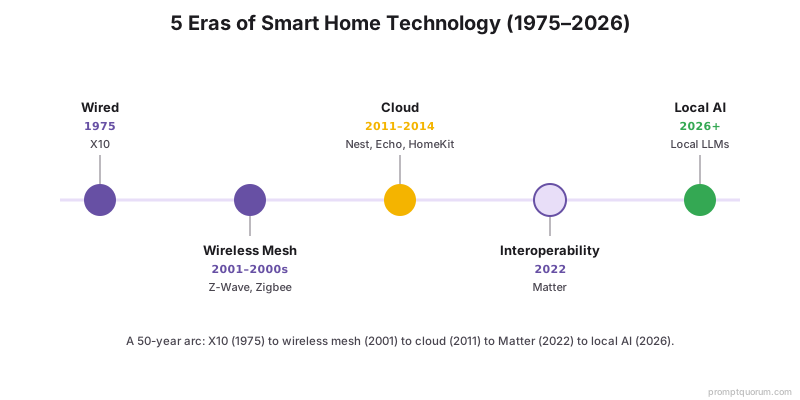
- One-off prototypes such as ECHO IV (1966) came first; X10 (1975) made home automation a product
- X10 (1975) was the first mainstream home-automation system, sending signals over powerlines
- Z-Wave (2004) and Zigbee (mid-2000s) brought low-power wireless mesh networking
- The cloud era arrived with Nest (2011) and Amazon Echo and Apple HomeKit (2014)
- Matter (2022) added a cross-vendor interoperability standard
- In 2026 the trend is swinging back to local control with on-device AI
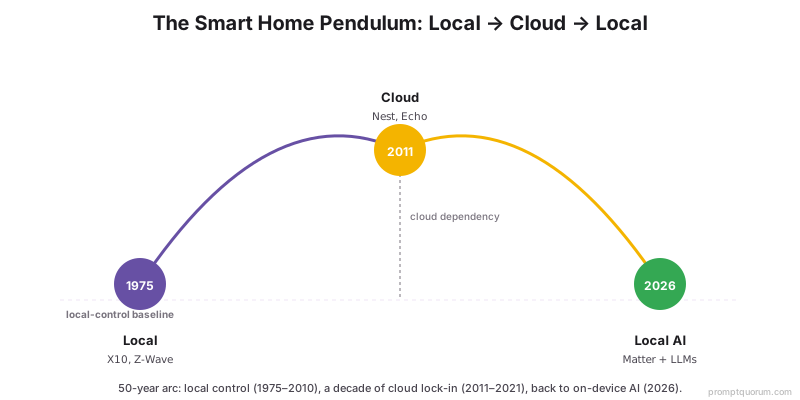
- The pattern is a pendulum: local control, to cloud dependence, and back to local
Before X10: The First Smart Homes (1960s)
The first smart home was ECHO IV, a one-off home computer built in 1966 by Westinghouse engineer Jim Sutherland that controlled household systems such as the TV, thermostat and air conditioning — but it never reached the market. Home automation as a product category only began a decade later.
- ECHO IV (1966): the "Electronic Computing Home Operator" ran household tasks and logged family finances; it was never sold commercially.
- Kitchen Computer (1969): Neiman Marcus listed a Honeywell-based kitchen computer for roughly $10,000 in its catalog; reports say no unit was ever sold.
- Why it matters: both were fully local, single-building machines — the same architecture the local-first revival returns to.
The Wired Era: X10 and Insteon
Home automation began in 1975 with X10, which sent control signals over a home's existing electrical wiring. It was local by necessity — there was no cloud — but limited and prone to interference.
- X10 (1975): developed by Pico Electronics, it let switches and modules communicate over powerlines.
- Insteon: later combined powerline and wireless signalling to improve reliability.
- Local by default: everything ran in the home, foreshadowing today's local-first revival.
Wireless Protocols: Z-Wave and Zigbee
Z-Wave (2004) and Zigbee (mid-2000s) introduced low-power wireless mesh networks built for battery devices and sensors. These remain core local protocols today.
- Z-Wave (2004): a low-power mesh protocol designed for reliable home-control devices. Zensys began developing it in 1999; the first certified products appeared around 2004.
- Zigbee (mid-2000s): an open low-power mesh standard widely used for bulbs and sensors.
- Still relevant: both are local-by-default and underpin modern hubs — see smart home protocols explained.
The Cloud Era: Nest, Echo, and HomeKit
The 2010s shifted smart homes to the cloud: the Nest thermostat (2011), Amazon Echo (2014), and Apple HomeKit (2014) made devices easy but dependent on vendor servers. Convenience rose; privacy and offline reliability fell.
- Nest (2011): the learning thermostat popularised cloud-connected home devices; Google acquired Nest in 2014.
- Amazon Echo (2014): voice control via a cloud assistant became mainstream.
- Apple HomeKit (2014): Apple's more privacy-leaning framework, with some local control.
- The trade-off: ease of setup came with data leaving the home and reliance on company clouds.
Matter and Interoperability
Matter, launched in 2022 by the Connectivity Standards Alliance, is a cross-vendor standard so devices from different brands work together — and it can run locally. It addressed the fragmentation of the cloud era.
- Matter runs over IP and works with Thread and Wi-Fi.
- It enables local control through a local controller, reducing cloud dependence — see Matter local control.
- It made mixing brands far easier than the previous patchwork of apps and bridges.
- Matter 1.5, released in November 2025, added camera support with WebRTC streaming, a unified closures model (shades, gates, garage doors), soil sensors and energy-tariff data.
The 2026 Swing Back to Local
The current shift is back toward local control, driven by privacy concerns, cloud shutdowns bricking devices, and on-device AI now being practical. Local autonomy is becoming the next era rather than a niche.
- Cloud shutdowns that disable devices pushed users toward local-first setups.
- Privacy awareness grew as the scope of cloud data collection became clear — see smart home privacy risks.
- On-device AI lets a local LLM run home control — see the complete local smart home guide.
- Concrete cases: Nest ended service for the Revolv hub in May 2016, Insteon went offline reportedly without notice in April 2022, and Google ended support for 1st- and 2nd-generation Nest Learning Thermostats on October 25, 2025, leaving them manual-only.
What's Next
The next era pairs local control with local AI: a home that runs automations and a natural-language assistant entirely on your own hardware. Matter eases interoperability while local AI adds intelligence without the cloud.
Era | Approx. years | Defining tech | Cloud or local |
|---|---|---|---|
| Prototypes | 1966–1974 | ECHO IV, Kitchen Computer | Local |
| Wired | 1975–2000 | X10, Insteon | Local |
| Wireless mesh | 2004–2010 | Z-Wave, Zigbee | Local |
| Cloud | 2011–2021 | Nest, Echo, HomeKit | Cloud |
| Interoperability | 2022–2025 | Matter, Thread | Both |
| Local AI | 2026+ | Local LLMs, Home Assistant | Local |
Frequently Asked Questions
What was the first smart home technology?
X10, introduced in 1975, is generally considered the first mainstream home-automation technology. It sent control signals over a home's existing electrical wiring, letting switches and modules communicate without new cabling.
When did smart homes go mainstream?
Smart homes reached the mainstream in the 2010s with cloud-connected devices: the Nest thermostat in 2011 and voice assistants like the Amazon Echo in 2014 made the technology accessible to a broad audience.
What is Matter?
Matter is a cross-vendor smart home standard launched in 2022 by the Connectivity Standards Alliance. It lets devices from different brands work together over IP, and it can run locally through a local controller rather than depending on each vendor's cloud.
Why is smart home tech moving back to local?
Privacy concerns, cloud shutdowns that disable devices, and the arrival of practical on-device AI are pushing users back toward local control. A local setup keeps data at home, works offline, and is not at the mercy of a vendor's cloud.
What is the history of home automation?
Home automation began with one-off prototypes in the 1960s, such as ECHO IV in 1966, became a consumer product with X10 powerline control in 1975, went wireless with Z-Wave and Zigbee in the 2000s, moved to the cloud with Nest (2011) and Amazon Echo (2014), gained the Matter standard in 2022, and is now returning to local control with on-device AI.
What was the first smart home?
The earliest documented example is ECHO IV, built in 1966 by Westinghouse engineer Jim Sutherland to control household systems such as the thermostat. It was never sold, so X10 (1975) is usually cited as the first commercially available home automation system.
Which cloud shutdowns left smart home devices without features?
Notable cases are the Revolv hub (service ended by Nest in May 2016), Insteon (offline reportedly without notice in April 2022) and the 1st- and 2nd-generation Nest Learning Thermostats (support ended October 25, 2025, leaving only manual control on the device).