Key Takeaways
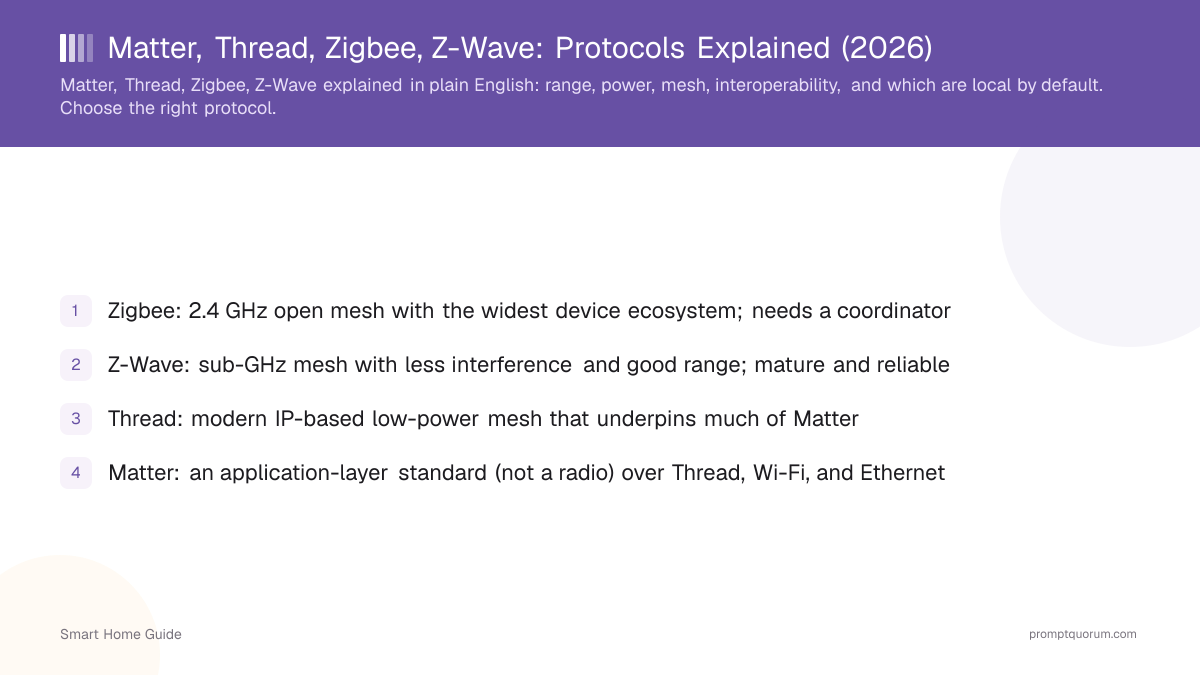
- Zigbee: 2.4 GHz open mesh with the widest device ecosystem; needs a coordinator
- Z-Wave: sub-GHz mesh with less interference and good range; mature and reliable
- Thread: modern IP-based low-power mesh that underpins much of Matter
- Matter: an application-layer standard (not a radio) over Thread, Wi-Fi, and Ethernet
- Zigbee, Z-Wave, and Thread are local by default; Matter runs locally via a local controller
- Choose by device availability and whether you want sub-GHz range (Z-Wave) or broad choice (Zigbee)
- Latest versions: Matter 1.6.1, Thread 1.4, Zigbee 4.0 (with sub-GHz Suzi), and Z-Wave Long Range; Matter 1.6, Zigbee 4.0, and Z-Wave LR are designed to work with existing devices
Why Protocols Matter
The protocol a device uses determines its range, battery life, reliability, and whether it can work without the cloud. Picking compatible protocols avoids a drawer of incompatible gadgets.
- Reliability: mesh protocols relay signals between devices, extending coverage.
- Local control: local protocols work through a hub with no internet — see the complete local smart home guide.
- Compatibility: a hub that speaks your devices' protocols ties them together.
Zigbee
Zigbee is an open 2.4 GHz low-power mesh protocol with the widest range of affordable devices. It needs a coordinator (a USB stick or hub) and relays through mains-powered devices.
- Huge ecosystem of bulbs, sensors, plugs, and switches.
- Shares the 2.4 GHz band with Wi-Fi, so placement matters.
- Local by default through a Zigbee coordinator on your hub.
- Zigbee 4.0 adds sub-GHz operation (branded Suzi) and Zigbee Direct onboarding and stays backward compatible with Zigbee 3.0; sub-GHz needs new hardware.
Z-Wave
Z-Wave is a sub-GHz low-power mesh protocol with less interference and good range, known for reliable home-control devices. It uses a separate frequency band from Wi-Fi and Zigbee.
- Operates in sub-GHz bands (regional frequencies), avoiding 2.4 GHz congestion.
- Strong reputation for reliable locks, sensors, and controls.
- Local by default through a Z-Wave controller.
- Z-Wave Long Range (LR) is claimed by the Z-Wave Alliance to reach several miles line of sight and support up to 4,000 nodes, using a star topology to the hub instead of hopping.
Thread
Thread is a modern IPv6-based low-power mesh that gives each device an IP address and underpins much of Matter. It needs a Thread border router to connect to your network.
- IP-based, so it integrates cleanly with modern networks.
- Requires a Thread border router (built into some hubs and speakers).
- A foundation for Matter devices — see Matter local control.
- Thread 1.4 adds credential sharing so border routers can join an existing Thread network instead of forming a separate one; cross-brand behavior still depends on each platform.
Matter: The Unifier
Matter is an application-layer standard — not a radio — that runs over Thread, Wi-Fi, and Ethernet so devices from different brands interoperate. It can run locally through a local controller, reducing cloud dependence.
- Matter standardises how devices are described and controlled across brands.
- It runs on top of Thread (low-power devices) or Wi-Fi/Ethernet (mains devices).
- Local control is possible with a local Matter controller like Home Assistant.
- Matter 1.6.1 is the current release and remains backward compatible with existing 1.x devices; Matter 1.5 added cameras.
Does Matter Have Range?
Matter has no radio and therefore no range of its own — a Matter device reaches as far as the network it runs on. Wi-Fi and Ethernet devices depend on your router; Thread devices depend on the Thread mesh.
- Matter over Wi-Fi: range is your Wi-Fi coverage, so a weak signal in the garage means an unreliable device.
- Matter over Thread: every mains-powered device relays, so more routers extend reach; battery devices only need to reach the nearest router.
- Matter over Ethernet: no wireless range limit at all.
- For long distances or thick walls, sub-GHz protocols such as Z-Wave are generally the stronger choice, bridged into Matter through a hub.
What to Check in a Smart Home Hub
For reliability and future device support, check which radios the hub has, whether it runs automations locally, and whether its firmware is still being updated. These matter more than the headline spec sheet.
- Radios: Zigbee, Z-Wave, and a Thread border router, built in or as USB add-ons, cover every protocol in this guide; a Matter controller ties them together.
- Local processing: automations should run on the hub without internet so they keep working during outages.
- Update policy: Matter, Thread, and Zigbee keep releasing versions, so a hub with a record of firmware updates or replaceable USB radios ages better.
- Breadth: hubs that combine open radios with a local Matter controller, such as Home Assistant with USB radios, support the widest range of protocols; many closed ecosystem hubs cover only some. See best smart home hubs.
Which Protocol Should You Choose?
Choose Zigbee for the widest affordable device choice, Z-Wave for sub-GHz range and less interference, and Matter-over-Thread for future-proof interoperability. A hub like Home Assistant can speak all of them.
Protocol | Band / range | Power | Mesh | Local by default | Maturity |
|---|---|---|---|---|---|
| Zigbee | 2.4 GHz, medium | Low | Yes | Yes | Mature |
| Z-Wave | Sub-GHz, good | Low | Yes | Yes | Mature |
| Thread | 2.4 GHz, medium | Low | Yes | Yes | Growing |
| Matter | Over Thread/Wi-Fi | Varies | Via Thread | With local controller | Growing |
Frequently Asked Questions
Is Matter a protocol or a standard?
Matter is an application-layer standard, not a radio protocol. It defines how devices are described and controlled and runs on top of transport layers like Thread, Wi-Fi, and Ethernet, which is why it can unify devices from different brands.
Do I need Thread?
Only if you use Thread-based or Matter-over-Thread devices, which need a Thread border router. Many hubs and some speakers include one. Zigbee and Z-Wave devices do not use Thread and need their own coordinator instead.
Zigbee vs Z-Wave — which is better?
Zigbee offers the widest, most affordable device selection on the 2.4 GHz band; Z-Wave uses sub-GHz frequencies with less interference and good range. Choose Zigbee for device choice and Z-Wave for reliability in congested 2.4 GHz environments.
Are these protocols local or cloud?
Zigbee, Z-Wave, and Thread are local by default and work through a hub with no internet. Matter can run locally through a local controller, though some Matter devices may also offer cloud features.
What are smart home protocols?
Smart home protocols are the communication standards devices use to talk to each other and to a hub. Zigbee, Z-Wave, and Thread are wireless radio protocols, while Matter is a standard layered on top that lets different brands work together. The protocol determines range, battery life, and whether a device works without the cloud.
What is the range of Matter?
Matter has no range of its own because it is not a radio. A Matter device reaches as far as the network it runs on: your Wi-Fi coverage, the Thread mesh, or a wired Ethernet connection. For long range, sub-GHz protocols such as Z-Wave are generally stronger.
Which hub supports the widest range of protocols?
A hub with Zigbee, Z-Wave, and Thread radios plus a local Matter controller covers the widest range. Open platforms like Home Assistant achieve this with USB radios, while many ecosystem hubs support only some protocols, so check the spec sheet before buying.