Key Takeaways
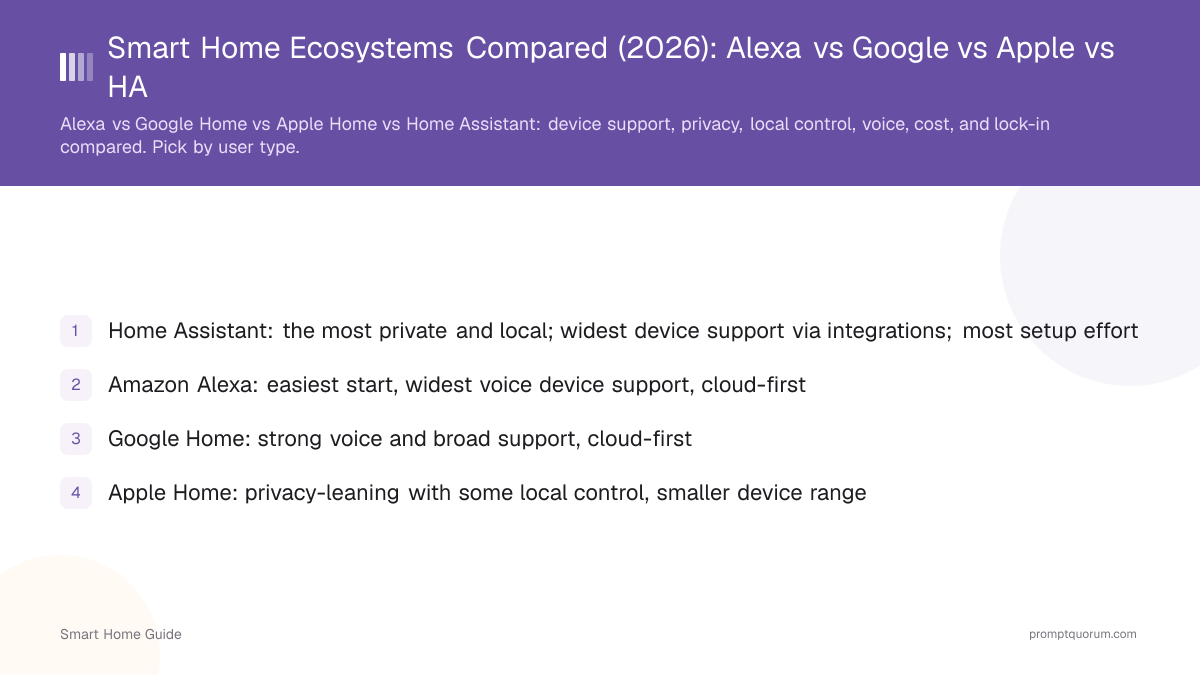
- Home Assistant: the most private and local; widest device support via integrations; most setup effort
- Amazon Alexa: easiest start, widest voice device support, cloud-first
- Google Home: strong voice and broad support, cloud-first
- Apple Home: privacy-leaning with some local control, smaller device range
- Privacy and local control are the decisive differences, not features
- Home Assistant can bridge the others, reducing lock-in
The Four Ecosystems
Amazon Alexa, Google Home, Apple Home, and Home Assistant cover most of the market and split clearly on privacy and local control. Each suits a different priority.
- Amazon Alexa: the widest third-party device and skill support; now runs on the generative-AI Alexa+ assistant, which Amazon has confirmed processes every request in the cloud with no local option.
- Google Home: strong voice assistant and broad device support, cloud-first.
- Apple Home: privacy-focused within the Apple ecosystem, with local control via a home hub.
- Home Assistant: open-source, local-first, the most flexible and private — see the complete local smart home guide.
The Comparison
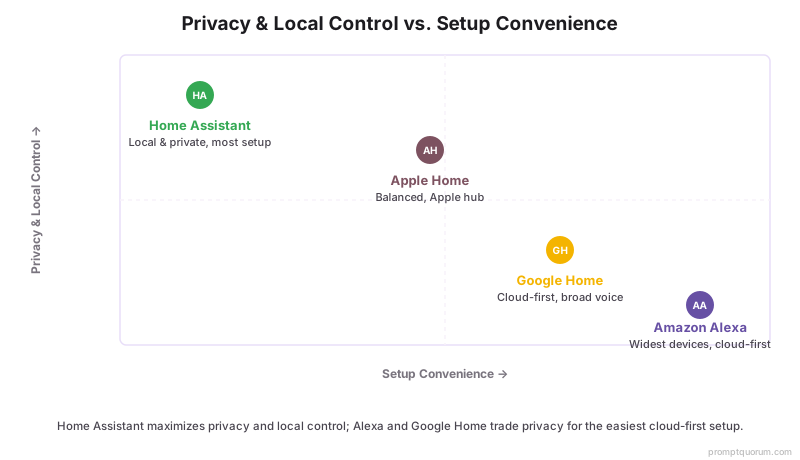
Across the criteria that matter, Home Assistant leads on privacy and local control while Alexa and Google lead on ease and breadth. Use the table to match an ecosystem to your priority.
Criterion | ||||
|---|---|---|---|---|
| Device support | Widest | Broad | Narrower | Widest via integrations |
| Privacy | Cloud data | Cloud data | Stronger | Best (local) |
| Local control | Limited | Limited | Partial | Full |
| Voice | Strong (cloud) | Strong (cloud) | Siri | Local (Assist) |
| Cost | Low hardware | Low hardware | Higher hardware | Hardware + effort |
| Lock-in | High | High | High (Apple) | Low (open) |
Best for Privacy
Home Assistant is the best choice for privacy because control and automations run locally with no vendor data collection. Apple Home is the most private of the mainstream cloud ecosystems.
- Use Home Assistant if privacy is your top priority and you accept more setup.
- Use Apple Home for a privacy-leaning option that is easier than Home Assistant.
- For a local voice assistant and AI brain, see running your smart home on a local LLM.
Best for Ease
Amazon Alexa and Google Home are the easiest to start because they are app-guided and cloud-managed. Choose them if you want minimal setup and accept the privacy trade-off.
- Use Alexa for the widest device and voice-skill support out of the box, now with the Alexa+ generative AI layer for richer conversations.
- Use Google Home if you prefer Google's assistant and services.
- Both trade privacy and offline reliability for convenience — see why a local smart home beats the cloud.
Lock-in and Exit Cost
Cloud ecosystems carry higher lock-in; Home Assistant's open design has the lowest exit cost and can even bridge the others. Consider how hard it is to leave before you commit.
- Alexa, Google, and Apple tie you to their accounts, apps, and supported devices.
- Home Assistant integrates many ecosystems, so you can migrate gradually — see migrating from cloud to local.
- Buying local-capable devices keeps your options open regardless of platform.
Recommendation by User Type
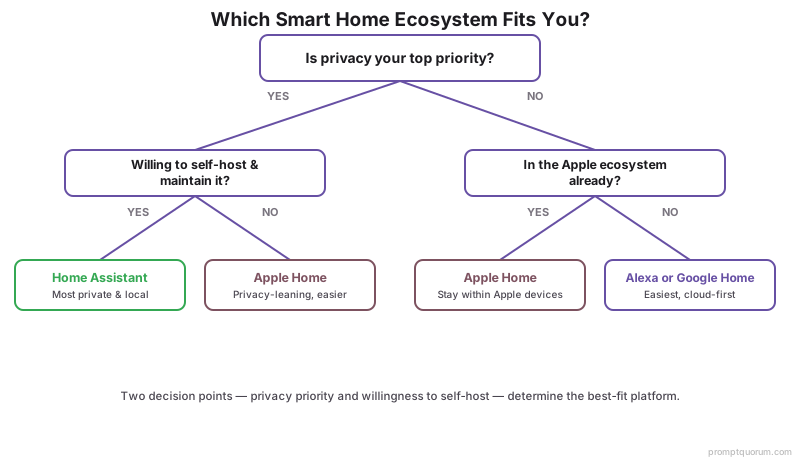
Pick by your priority: privacy and control → Home Assistant; easiest start → Alexa or Google; Apple household → Apple Home. If unsure and privacy matters, start with Home Assistant.
- Privacy-focused / tinkerer: Home Assistant.
- Convenience-first beginner: Amazon Alexa or Google Home.
- Apple household wanting balance: Apple Home.
- Want both voice and privacy? Home Assistant with a local voice assistant — compared head-to-head in Home Assistant vs Alexa vs Google.
Frequently Asked Questions
Which smart home ecosystem is most private?
Home Assistant is the most private because control and automations run locally on your own hardware with no vendor data collection. Among the mainstream cloud ecosystems, Apple Home is the most privacy-focused.
Which ecosystem works offline?
Home Assistant works offline for local devices and automations. Alexa and Google Home depend heavily on the cloud and lose most functions without internet — Amazon has confirmed the Alexa+ generative AI assistant has zero local processing capability; Apple Home retains some local control through a home hub.
Can I mix smart home ecosystems?
Yes, to a degree. Home Assistant can integrate devices and even bridge Alexa, Google, and Apple, which is the most flexible way to mix ecosystems. Mixing cloud ecosystems directly is more limited.
Which ecosystem is easiest for beginners?
Amazon Alexa and Google Home are easiest for beginners because setup is app-guided and cloud-managed. Home Assistant offers more privacy and control but takes more effort to set up.