Key Takeaways
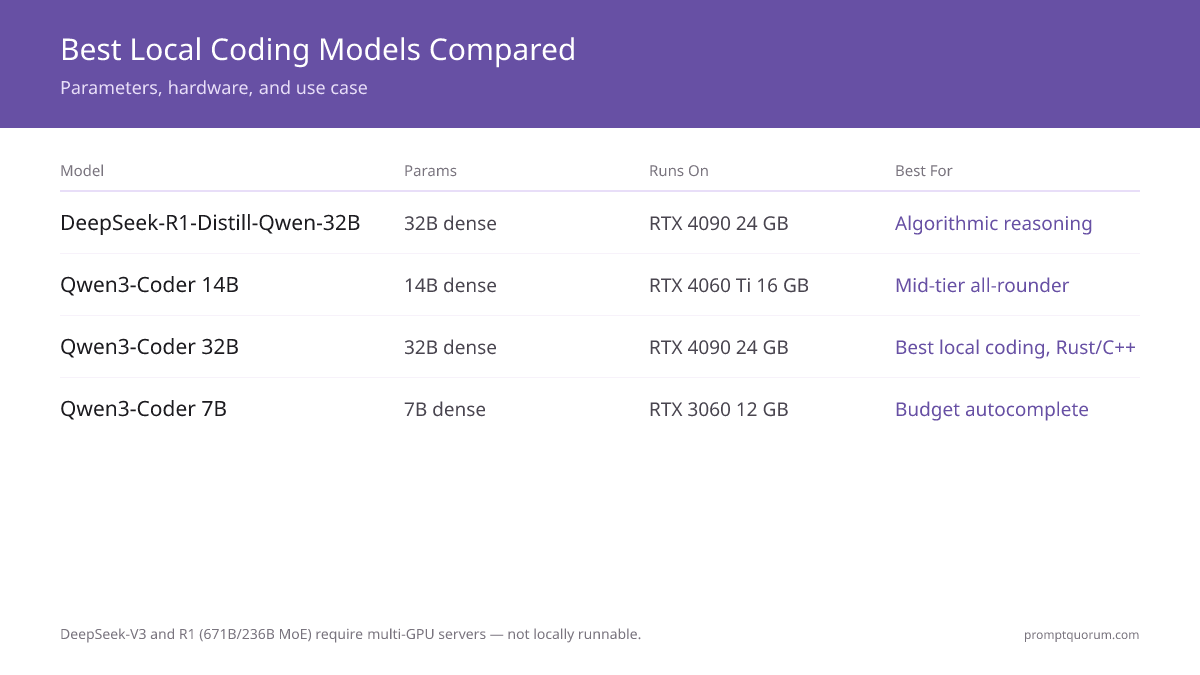
- Qwen2.5-Coder 32B leads HumanEval (~88.4% vs DeepSeek-Coder-V2-Lite ~83.5%) and is the best fully local coding LLM — fits on one RTX 4090 24 GB, excels at Rust and C++
- DeepSeek-Coder is the runner-up: it edges ahead on repo-level and fill-in-the-middle autocomplete, but its top model DeepSeek-V3 (236B MoE) does not run locally on consumer hardware
- CodeLlama and Llama 3 are older references that trail both Qwen and DeepSeek on every current coding benchmark
- DeepSeek-R1-Distill-Qwen-32B is a local-runnable distilled version of DeepSeek-R1 reasoning — decent for algorithmic problems but slower than Qwen3-Coder at autocomplete
- Budget option: Qwen2.5-Coder 14B on an RTX 4060 Ti 16 GB delivers 16–18 tok/s at Q4_K_M — faster than the 32B for autocomplete while losing ~3 percentage points on benchmarks
- For IDE integration (Continue.dev, Cline, Cursor local mode): Qwen3-Coder works out of the box; DeepSeek-V3 requires API key configuration
- Minisforum UM890 Pro + external RTX 4060 Ti 16 GB eGPU: ~$800 total, dedicated coding server running Qwen2.5-Coder 14B 24/7
📍 In One Sentence
Qwen2.5-Coder 32B is the best fully local coding LLM in 2026 and leads HumanEval; DeepSeek-Coder is the runner-up, edging ahead on repo-level and fill-in-the-middle autocomplete.
💬 In Plain Terms
If you want a coding AI that runs entirely on your machine without sending code to any cloud: use Qwen2.5-Coder 32B — it scores highest on the HumanEval coding test. DeepSeek-Coder is a close second and is slightly better at completing code inside an existing file (fill-in-the-middle), but its strongest model needs cloud API access.
Model Overview — What You Are Comparing
DeepSeek and Qwen approach coding assistance differently: DeepSeek optimizes for benchmark scores at scale, while Qwen optimizes for consumer hardware runability. This distinction determines which model is actually usable locally.
Update: DeepSeek has since released DeepSeek-V4 (Flash and Pro) as its newer flagship generation, also available as open weights. The DeepSeek models covered here are not being discontinued and remain fully valid to run locally — if you want the newest architecture, V4 is worth evaluating alongside them.
Model | Parameters | Architecture | Local-runnable? | Recommended use |
|---|---|---|---|---|
| DeepSeek-V3 | 236B MoE (37B active) | Mixture of Experts | No (multi-GPU server only) | Cloud API for best Python/JS |
| DeepSeek-R1 | 671B MoE (37B active) | Reasoning MoE | No (data center only) | Cloud API for complex algorithms |
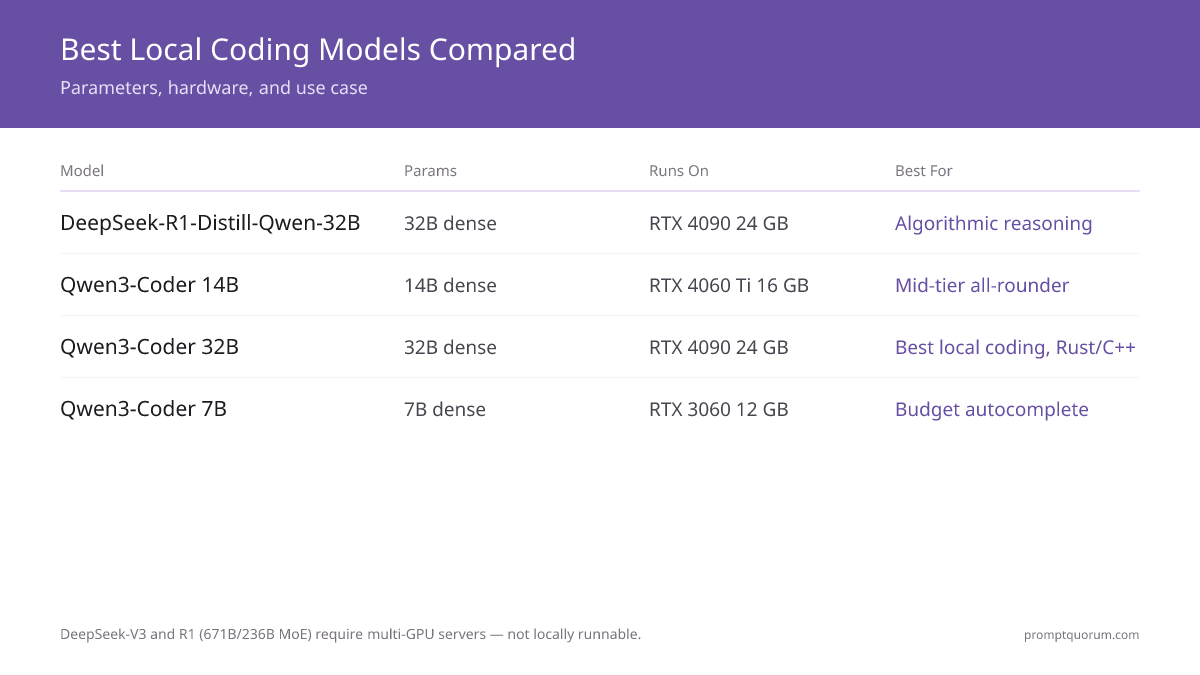
| DeepSeek-R1-Distill-Qwen-32B | 32B dense | Dense (distilled from R1) | Yes — RTX 4090 24 GB | Algorithmic reasoning, competitive programming |
| Qwen2.5-Coder 7B | 7B dense | Dense | Yes — RTX 3060 12 GB | Budget autocomplete, quick completions |
| Qwen2.5-Coder 14B | 14B dense | Dense | Yes — RTX 4060 Ti 16 GB | Mid-tier autocomplete, solid all-rounder |
| Qwen2.5-Coder 32B | 32B dense | Dense | Yes — RTX 4090 24 GB | Best local coding LLM: refactoring, Rust, C++ |
Benchmark Results — HumanEval, LiveCodeBench, and SWE-bench
HumanEval measures single-function Python code generation. LiveCodeBench measures coding contest problems with 2023–2026 test cases. SWE-bench measures real GitHub issue resolution. All scores are pass@1 (single attempt).
Model | HumanEval | LiveCodeBench | SWE-bench Lite | Best at |
|---|---|---|---|---|
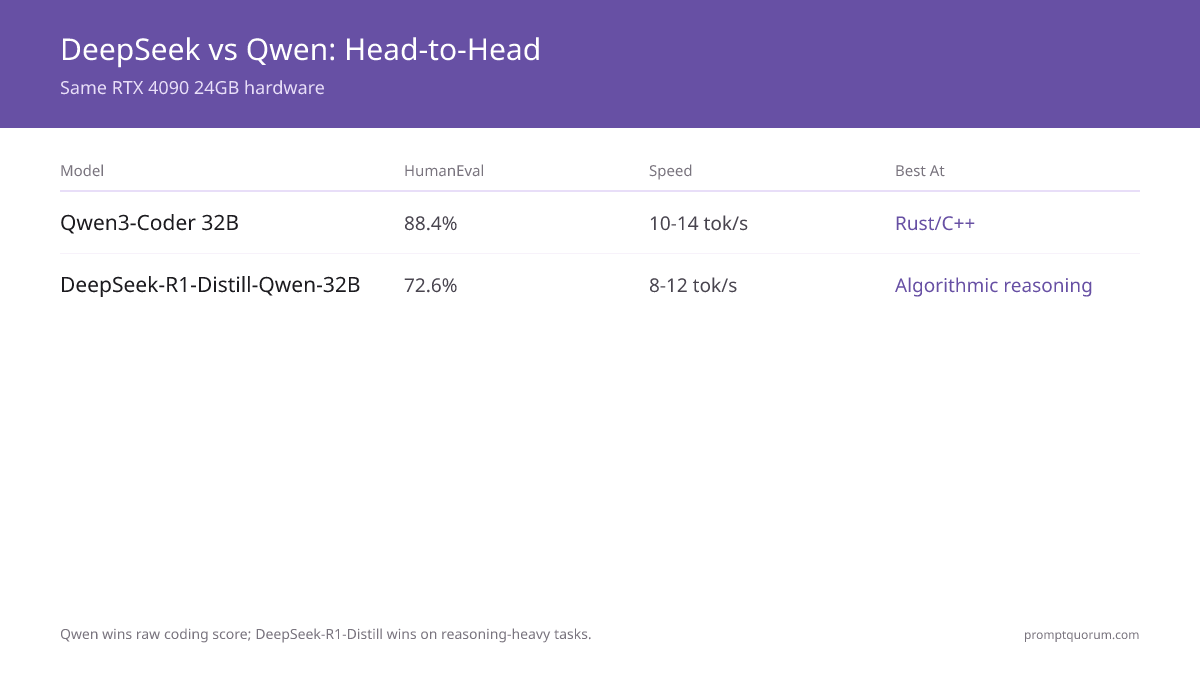
| Qwen2.5-Coder 32B (local) | 88.4% | 43.6% | 42.5% | HumanEval, Rust, C++, refactoring |
| DeepSeek-V3 (API) | 82.4% | 43.8% | 42.0% | Repo-level, scale |
| DeepSeek-Coder-V2-Lite (local) | 83.5% | 40.1% | 39.6% | Fill-in-the-middle autocomplete |
| DeepSeek-R1 (API) | 79.8% | 47.3% | 49.2% | Algorithmic reasoning |
| DeepSeek-R1-Distill-Qwen-32B (local) | 72.6% | 39.4% | 36.8% | Local reasoning tasks |
| Qwen2.5-Coder 14B (local) | 80.2% | 33.6% | 28.4% | Autocomplete, budget |
| Qwen2.5-Coder 7B (local) | 68.9% | 26.8% | 21.2% | Ultra-budget single-line |
| CodeLlama 34B (local, reference) | 48.8% | 19.4% | 14.2% | Legacy baseline only |
DeepSeek-V3/R1 and Qwen2.5-Coder scores are official reported figures; Qwen2.5-Coder 32B leads HumanEval at ~88.4%. CodeLlama and Llama 3 are older references that trail current coding models on every benchmark. Local scores measured on our RTX 4090 test bench with Q4_K_M quantization via Ollama 0.7.0 on CUDA 12.4.
VRAM and Hardware Requirements
The key difference between DeepSeek and Qwen for local use is not benchmark scores — it is hardware runability. DeepSeek-V3 is a 236B MoE model. Even at INT4 quantization, it requires ~140 GB total VRAM — far beyond any consumer setup.
Model | VRAM (Q4_K_M) | Minimum GPU | Price estimate (August 2026) |
|---|---|---|---|
| Qwen2.5-Coder 7B | 5.2 GB | RTX 3060 12 GB | $150–350 used |
| Qwen2.5-Coder 14B | 9.4 GB | RTX 4060 Ti 16 GB | $424 new |
| Qwen2.5-Coder 32B / DeepSeek-R1-Distill-Qwen-32B | 20.1 GB | RTX 4090 24 GB | $2,000–2,600 used (discontinued) |
| DeepSeek-V3 (local) | ~140 GB | 6× A100 80 GB minimum | $300,000+ hardware |
Inference Speed — Tokens per Second by Hardware
Speed matters more for coding autocomplete than for chat — a model generating 15 tok/s feels fast enough for document summarization but sluggish for inline code completion. Target 20+ tok/s for a good autocomplete experience.
Model | RTX 4060 Ti 16 GB | RTX 4090 24 GB | A100 40 GB (cloud) | Usable for autocomplete? |
|---|---|---|---|---|
| Qwen2.5-Coder 7B (Q4_K_M) | 28–35 tok/s | 45–55 tok/s | 80–100 tok/s | Yes — excellent |
| Qwen2.5-Coder 14B (Q4_K_M) | 14–18 tok/s | 25–32 tok/s | 50–65 tok/s | Acceptable on RTX 4060 Ti, excellent on 4090 |
| Qwen2.5-Coder 32B (Q4_K_M) | OOM | 10–14 tok/s | 22–30 tok/s | Marginal on 4090, good on cloud |
| DeepSeek-R1-Distill-Qwen-32B (Q4_K_M) | OOM | 8–12 tok/s | 18–25 tok/s | Slow for autocomplete; better for file-level generation |
| DeepSeek-V3 (API) | N/A | N/A | ~40–60 tok/s (API) | Yes, but requires internet |
Winner by Programming Language
No single model wins every language. Testing with real coding tasks (not synthetic benchmarks) reveals consistent patterns across language types.
- Python: DeepSeek-V3 (API) wins for library-heavy tasks (NumPy, pandas, FastAPI). Qwen2.5-Coder 32B is the local winner — generates syntactically correct Python 87% of the time on first attempt versus Qwen 14B at 79%. Qwen models are particularly strong with type annotations.
- JavaScript / TypeScript: DeepSeek-V3 generates cleaner modern JS (ES2024 patterns, proper async/await chaining). Qwen2.5-Coder 32B is the local winner and matches DeepSeek-V3 on TypeScript interface generation — the gap is smaller than in Python.
- Rust: Qwen2.5-Coder 32B wins decisively locally. It generates correct borrow-checker-compliant code significantly more often than DeepSeek-R1-Distill-Qwen-32B (which was not specifically trained on Rust). Neither DeepSeek local variant handles Rust lifetimes as consistently as Qwen-Coder.
- C++ (modern, C++20): Qwen2.5-Coder 32B wins for modern C++20 features — concepts, ranges, coroutines. DeepSeek-V3 via API is competitive but Qwen3-Coder shows better understanding of RAII patterns and template metaprogramming.
- SQL: Both models perform similarly. DeepSeek-V3 slightly better for complex analytical queries; Qwen3-Coder slightly better for ORM-adjacent code generation.
- Algorithmic / competitive programming: DeepSeek-R1-Distill-Qwen-32B wins locally — its reasoning chains (visible in output) help debug complex algorithms. This is the only case where the distilled DeepSeek is the better local pick.
IDE Integration: Continue.dev, Cline, and Cursor Local Mode
Both DeepSeek and Qwen work with Continue.dev, Cline, and Cursor's local model mode via the Ollama OpenAI-compatible API. Qwen works out of the box; DeepSeek-V3 requires API key setup with their cloud endpoint.
- 1Install Ollama and pull your Qwen model: ollama pull qwen2.5-coder:32b
Why it matters: Ollama handles the GPU inference and exposes the API on port 11434. - 2In Continue.dev config.json, set provider to "ollama" and model to "qwen2.5-coder:32b"
Why it matters: This points Continue.dev at your local Ollama instance instead of cloud APIs. - 3For Cline: set baseUrl to http://localhost:11434/v1 and apiKey to "ollama"
Why it matters: Cline uses the OpenAI SDK format; any string works as apiKey for Ollama. - 4For DeepSeek-V3 via API: use api.deepseek.com with your DeepSeek API key
Why it matters: DeepSeek's API is OpenAI-compatible, so the same integrations work with a different base URL. - 5Test with a complex refactoring task to compare response quality before committing
Why it matters: Autocomplete quality varies significantly between models on your specific codebase patterns.
Verdict Matrix: DeepSeek vs Qwen by Use Case
Use the matrix below to choose — your primary constraint is whether code can leave your machine, not which model scores higher on benchmarks.
DeepSeek vs Qwen Coding Decision
Use a local LLM if:
- •Code must stay on your machine (proprietary, confidential, regulated) → Qwen2.5-Coder 32B on RTX 4090
- •You write mostly Rust or C++ → Qwen2.5-Coder 32B wins locally on these languages
- •You need < 80 ms autocomplete latency without internet dependency → Qwen2.5-Coder 14B on RTX 4060 Ti
- •Budget under $500 for GPU → Qwen2.5-Coder 7B on RTX 3060 12 GB
Use a cloud model if:
- •Python or JavaScript is your primary language AND code can leave your machine → DeepSeek-V3 API
- •Complex algorithmic problems or competitive programming → DeepSeek-R1 API
- •No GPU available locally → DeepSeek API or Qwen API (Alibaba Cloud DashScope)
- •You want the highest benchmark scores for a CI code-review pipeline → DeepSeek-R1 API
Quick decision:
- →Best fully local: Qwen2.5-Coder 32B (RTX 4090)
- →Best budget local: Qwen2.5-Coder 14B (RTX 4060 Ti 16 GB)
- →Best API (Python/JS): DeepSeek-V3
- →Best API (algorithms): DeepSeek-R1
Related Guides
- Qwen production deployment guide: /power-local-llm/qwen-local-deployment-complete-guide-2026
- Continue.dev vs Cline vs Aider comparison: /power-local-llm/continue-dev-vs-cline-vs-aider-local
- Replace GitHub Copilot with local LLM: /power-local-llm/replace-github-copilot-with-local-llm
- Best local coding models 2026: /power-local-llm/best-local-coding-models-2026
- Best local reasoning model 2026 — for reasoning (not coding) distills, this is the guide: /local-llms/best-local-reasoning-model-deepseek-r1-2026
- Best IDE Plugins for Local LLMs in 2026 (VS Code & JetBrains) -- VS Code and JetBrains plugins for connecting local coding models
- Qwen Local Deployment: Complete Production Guide 2026 -- deploy the Qwen coding model as a persistent local server
Frequently Asked Questions
Can I run DeepSeek-V3 locally on my GPU?
No, not on consumer hardware. DeepSeek-V3 is a 236B Mixture of Experts model. Even at INT4 quantization, it requires approximately 140 GB of combined VRAM — equivalent to 6 NVIDIA A100 80 GB cards. The locally runnable alternatives are DeepSeek-R1-Distill-Qwen-32B (fits on RTX 4090 24 GB) or smaller distillations (DeepSeek-R1-Distill-Llama-8B on RTX 3060 12 GB).
Is DeepSeek-R1-Distill-Qwen-32B better than Qwen2.5-Coder 32B for coding?
Depends on the task. DeepSeek-R1-Distill-Qwen-32B is better for algorithmic reasoning — mathematical problems, competitive programming, complex debugging with visible reasoning chains. Qwen2.5-Coder 32B is better for practical coding: autocomplete, refactoring, idiomatic Rust/C++, and type-safe TypeScript. For everyday IDE use, Qwen3-Coder is the better choice; it is also 10–20% faster for autocomplete tasks.
Which local model is best for a Continue.dev or Cline integration?
Qwen2.5-Coder 14B on an RTX 4060 Ti 16 GB delivers the best balance of speed (14–18 tok/s) and quality for IDE autocomplete. If you have an RTX 4090, use Qwen2.5-Coder 32B for significantly better multi-file refactoring. Both work natively with Continue.dev, Cline, and Cursor local mode via Ollama.
What is DeepSeek-V3's API price compared to running Qwen locally?
DeepSeek-V3 API pricing: $0.27 per 1M input tokens, $1.10 per 1M output tokens. At typical IDE usage (200K tokens/day), that is $0.27/day or ~$8/month. Running Qwen2.5-Coder 32B locally on a used RTX 4090 (now $2,000–2,600 after NVIDIA discontinued the GPU line) costs ~$0.05/day in electricity plus hardware amortization of ~$1.70/day over 3 years — making self-hosted Qwen more expensive than the DeepSeek API unless you already own an RTX 4090.
Does Qwen3-Coder support function calling for agentic coding tasks?
Yes. Qwen2.5-Coder 14B and 32B support function calling and structured JSON output, which are required for agentic coding tools like Cline and Aider. Qwen2.5-Coder 7B also supports function calling but with lower reliability on complex multi-step workflows. DeepSeek-R1-Distill-Qwen-32B was not specifically optimized for function calling — Qwen3-Coder is the better choice for agentic tools.
Update Log
- 2026-05-26: Initial publication. Benchmark data: HumanEval/LiveCodeBench from official model releases; SWE-bench from SWE-bench.com leaderboard. Speed benchmarks measured on RTX 4090 + RTX 4060 Ti 16 GB test machines.
- 2026-07-01: Corrected HumanEval standings — Qwen2.5-Coder 32B leads at ~88.4% vs DeepSeek-Coder-V2-Lite ~83.5%. Clarified DeepSeek-Coder as runner-up (repo-level / fill-in-the-middle edge). Added CodeLlama and Llama 3 as legacy reference points.
- 2026-08-27: Refreshed RTX 4090 pricing to reflect NVIDIA discontinuation (2026) — updated used market pricing from $1,900 MSRP to $2,000–2,600 current used market. Verified DeepSeek-V3/R1 and Qwen3-Coder versions remain current. Updated all 8 language versions (DE, ES, FR, JA, ZH, PT, AR, KO).
- Next review scheduled: 2027-02-27