Key Takeaways
- Lemonade is open source under Apache License 2.0; the source repository is github.com/lemonade-sdk/lemonade
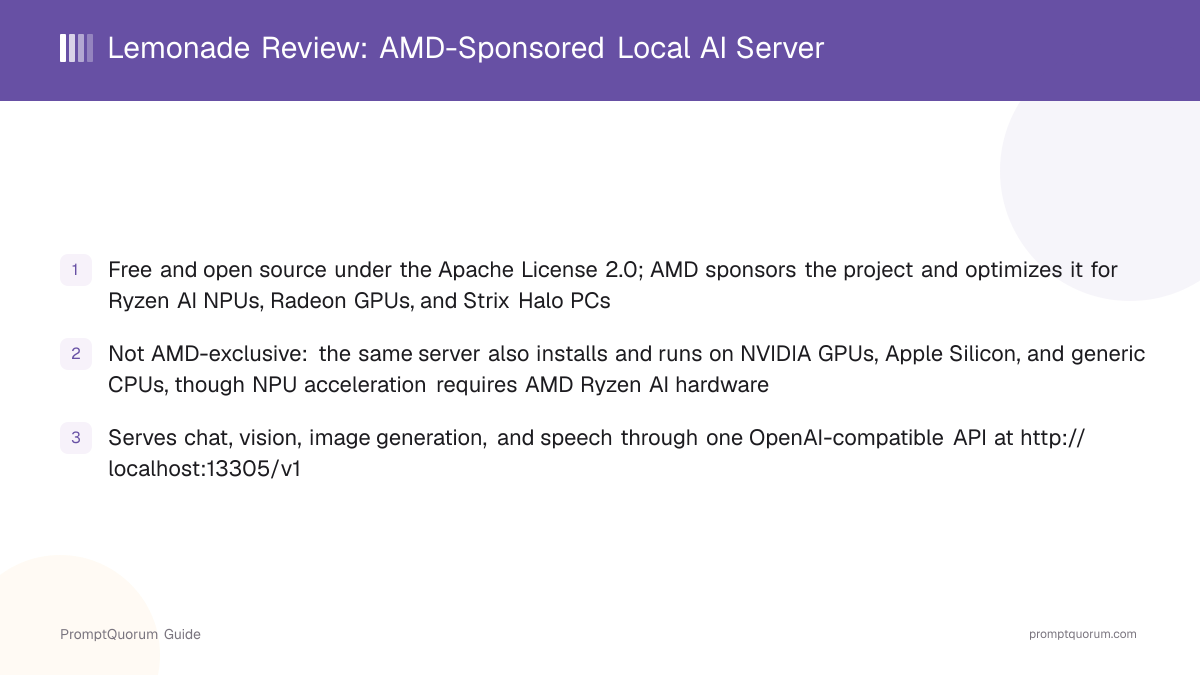
- Sponsored by AMD; per the GitHub README, AMD engineers work on the project "to get the most from Ryzen AI, Radeon, and Strix Halo PCs" — described in the same README as community-built, not an AMD-owned product
- NPU acceleration is specific to AMD Ryzen AI hardware (XDNA2 NPU); the server itself also installs and runs on NVIDIA GPUs (CUDA), Apple Silicon (Metal), and generic x86_64/ARM64 CPUs
- Runs three inference backends depending on hardware and model: llama.cpp (CPU, Metal, CUDA, Vulkan, ROCm), FastFlowLM for NPU acceleration, and ONNX Runtime GenAI for certain model types
- Serves chat, vision, image generation, speech-to-text, and text-to-speech through one OpenAI-compatible API at
http://localhost:13305/v1 - Installs via a Windows MSI installer, Linux packages (Ubuntu, Debian, Fedora, Arch, Snap), Docker, or
pip install lemonade-sdkfor the Python SDK - Roughly 5,700 GitHub stars and 497 forks as of this review
📍 In One Sentence
Lemonade is a free, open-source local AI server (Apache 2.0) sponsored by AMD, offering an OpenAI-compatible API and NPU-accelerated inference on AMD Ryzen AI hardware, while still installing and running on NVIDIA, Apple Silicon, and generic CPU systems.
💬 In Plain Terms
If you own an AMD Ryzen AI laptop or desktop, Lemonade can run models on the dedicated NPU chip instead of the CPU or GPU, which usually means lower power draw for the same chat or vision task. If you don't have AMD hardware, Lemonade still runs — it just falls back to CPU or your GPU's own acceleration path, the same as most other local AI servers.
📌Note: This review is the deep-dive companion to Lemonade's entry in the Local LLM Software Directory — see that page for how Lemonade compares at a glance to dozens of other local AI tools.
What Is Lemonade?
Lemonade is a local AI server: a background process that loads a model once and serves it to any application over an OpenAI-compatible API, rather than a single-purpose chat window. Its own GitHub description frames it as helping "users discover and run local AI apps by serving optimized LLMs right from their own GPUs and NPUs." It ships a GUI, a CLI, and the API server in one package, so the same install works for someone who just wants a chat window and someone who wants to point their own code at a local endpoint.
- Core function: load a model once, then serve chat, vision, image, and speech requests to any OpenAI-API-compatible client over HTTP
- Inference engines: llama.cpp for CPU/Metal/CUDA/Vulkan/ROCm, FastFlowLM (FLM) for AMD NPU acceleration, and ONNX Runtime GenAI for certain model types — Lemonade selects among them automatically based on the model and hardware detected
- Sponsor and organization: AMD sponsors the project (contact listed as lemonade@amd.com in the repository) and contributes engineering effort; the GitHub organization hosting the code is lemonade-sdk
- Canonical repository: github.com/lemonade-sdk/lemonade — the active home of Lemonade's source code, releases, and issue tracker; a related but distinct repository, lemonade-sdk/ryzenai-server, covers an older Ryzen-AI-specific server component, so verify you are looking at the main
lemonaderepository for the current project
Does Lemonade Require AMD Hardware?
No — Lemonade installs and runs on non-AMD hardware, but one specific acceleration path is AMD-only. This distinction matters the same way it does for AMD's other local-AI tooling: the software is open and cross-platform, while a named hardware feature is scoped to AMD's own silicon.
Hardware | Runs Lemonade? | Gets NPU Acceleration? |
|---|---|---|
| AMD Ryzen AI (XDNA2 NPU) | Yes | Yes, via FastFlowLM |
| AMD Radeon GPU / Strix Halo iGPU | Yes | No (GPU acceleration via ROCm instead) |
| NVIDIA GPU | Yes, via CUDA | No |
| Apple Silicon | Yes, via Metal | No |
| Generic x86_64 / ARM64 CPU | Yes, via llama.cpp CPU backend | No |
This table reflects Lemonade's documented backend support (github.com/lemonade-sdk/lemonade) as of this review. "NPU acceleration" specifically means routing inference through the FastFlowLM backend to a Neural Processing Unit; every other row still runs Lemonade's full feature set (chat, vision, image, speech) — it just uses the CPU, a GPU's own compute cores, or Metal/CUDA instead of a dedicated NPU chip. Do not assume Lemonade is unusable without AMD hardware, and do not assume every AMD chip gets NPU acceleration — only Ryzen AI processors with an XDNA2 NPU do.
How to Install Lemonade
Lemonade ships four install paths: a Windows MSI installer, native Linux packages, a Docker image, and a Python package for the SDK. Links and commands below are from the official GitHub README and lemonade-server.ai — always verify against those pages directly, since release URLs and package names can change between versions.
Platform | Install Method |
|---|---|
| Windows | lemonade.msi installer |
| Linux (Ubuntu 24.04+) | Launchpad PPA — see lemonade-server.ai/docs/guide/install/ubuntu |
| Linux (Debian, Fedora, Arch) | Native package per distro — see lemonade-server.ai install guides |
| macOS | PKG installer — see lemonade-server.ai install guides |
| Any platform (Python) | pip install lemonade-sdk for the Python SDK and CLI |
| Any platform (container) | Docker image — see lemonade-server.ai/docs/guide/install/docker |
After installing, lemonade run <model-name> downloads and starts serving a model from the CLI, and lemonade launch claude and similar commands connect Lemonade to compatible client applications. The local API server listens at http://localhost:13305/v1 (also reachable at /api/v1) and accepts any string as the API key — a placeholder value such as lemonade satisfies clients that require a non-empty key field, since Lemonade does not enforce real API-key authentication by default.
What Can You Do With Lemonade?
Lemonade's feature set centers on serving models through one OpenAI-compatible endpoint, with hardware-aware backend selection handled automatically. Details below are drawn from Lemonade's own GitHub README and documentation.
- Chat and text generation — run open-weight chat models locally and query them through the OpenAI-compatible
/v1/chat/completionsendpoint, the same request format used by countless existing tools and scripts - Vision — serve vision-language models capable of describing or answering questions about images, through the same API
- Image generation — generate images locally via a bundled Stable-Diffusion-based backend
- Speech — transcribe audio to text (speech-to-text, via a Whisper-based backend) and synthesize speech from text (text-to-speech, via a Kokoro-based backend)
- Embeddings — serve text-embedding requests through the OpenAI-compatible embeddings endpoint, for retrieval and search use cases
- Automatic backend selection — Lemonade picks among llama.cpp, FastFlowLM, and ONNX Runtime GenAI based on the model format and the hardware it detects, so most users never choose a backend manually
- Zero telemetry — per Lemonade's own positioning on lemonade-server.ai, the server does not phone home usage data by design
Who Should Use Lemonade?
Lemonade fits people who specifically want to use an AMD NPU for local inference, plus anyone who wants a lightweight, OpenAI-compatible local server regardless of hardware brand.
Lemonade vs. Ollama, LM Studio, and Docker Model Runner
Lemonade overlaps with several other local AI servers that expose an OpenAI-compatible API — the difference is hardware-specific optimization, backend choice, and sponsor.
Tool | Sponsor/Maker | License | Best For |
|---|---|---|---|
| Lemonade | AMD-sponsored, community-built | Apache 2.0 | AMD Ryzen AI NPU acceleration, cross-platform fallback |
| Ollama | Ollama Inc. | MIT | Broad model library and community, simplest CLI workflow |
| LM Studio | Element Labs | Free, closed-source app | Polished GUI for browsing, downloading, and chatting with models |
| Docker Model Runner | Docker, Inc. | Free with Docker Desktop | Teams already standardized on Docker tooling and workflows |
All four tools expose an OpenAI-compatible API and can serve open-weight models locally. Lemonade is the only one of the four with a documented, AMD-NPU-specific acceleration backend (FastFlowLM); the other three route inference through CPU, GPU (CUDA/Metal/ROCm), or Docker's own runtime instead.
Common Mistakes When Evaluating Lemonade
Frequently Asked Questions
Is Lemonade free?
Yes. Lemonade is free and open source under the Apache License 2.0, with portions of bundled third-party components licensed separately as listed in the repository's NOTICE.md file. There is no paid tier.
Does Lemonade require AMD hardware?
No. Lemonade installs and runs on NVIDIA GPUs, Apple Silicon, and generic x86_64/ARM64 CPUs through its llama.cpp backend. Only NPU-accelerated inference, via the FastFlowLM backend, is specific to AMD Ryzen AI processors with an XDNA2 NPU.
What license does Lemonade use?
Apache License 2.0, per the LICENSE file in the official GitHub repository (github.com/lemonade-sdk/lemonade), with some bundled components under their own licenses as listed in NOTICE.md.
Does Lemonade have an OpenAI-compatible API?
Yes. Lemonade serves a local, OpenAI-compatible API at http://localhost:13305/v1, covering chat completions, vision, image generation, speech, and embeddings endpoints. Any OpenAI-compatible client library can point at this address.
How do you install Lemonade?
Via a Windows MSI installer, native Linux packages (Ubuntu, Debian, Fedora, Arch), a Docker image, or pip install lemonade-sdk for the Python SDK and CLI. All four paths are documented on lemonade-server.ai.
Who develops Lemonade?
Lemonade is a community-built, open-source project sponsored by AMD. AMD engineers contribute optimizations for Ryzen AI, Radeon, and Strix Halo hardware, but the project describes itself as built for every PC, not as an AMD-exclusive product.
How popular is Lemonade?
Lemonade's GitHub repository shows roughly 5,700 stars and about 497 forks as of this review.
What are the main alternatives to Lemonade?
Ollama (MIT, a broad, well-established model library and community), LM Studio (free closed-source app with a polished GUI), and Docker Model Runner (bundled with Docker Desktop) are the closest local-server alternatives with OpenAI-compatible APIs.