What Is tgpt?
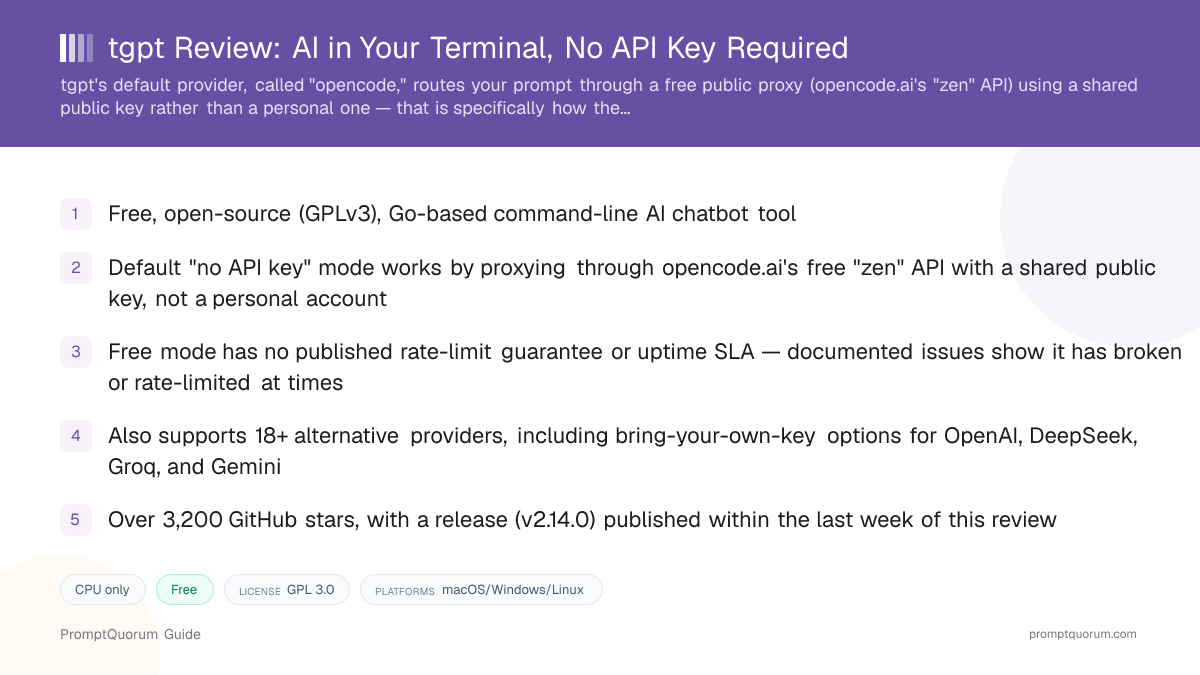
tgpt is a free, open-source, cross-platform command-line AI chatbot tool written in Go, built by a maintainer known by the GitHub handle aandrew-me. Its own repository tagline describes it as "AI Chatbots in terminal for free."
- Product type: a single-binary command-line tool, cross-platform (Linux, macOS, Windows, FreeBSD)
- Maintainer: aandrew-me (GitHub handle)
- Repository created: April 17, 2023
- License: GNU General Public License v3.0 (GPLv3), confirmed via the repository's LICENSE file
- Scale: over 3,200 GitHub stars and 340+ forks, as of this review, with a release (v2.14.0) shipped within the last week of this check
How Does the "No API Key" Mode Actually Work?
tgpt's default provider, "opencode," routes your prompt through a free public proxy at opencode.ai's "zen" API, using a shared public API key rather than a personal one — that is the entire mechanism behind "no API key needed."
- Default provider: "opencode," using a free model (deepseek-v4-flash-free, per the project's own documentation) via opencode.ai's "zen" API
- No published rate-limit numbers or uptime guarantee exist for this free mode — it is a best-effort public proxy, not a personal, quota-backed account
- tgpt's own public issue tracker documents recurring problems with free backends over the project's history, including rate-limit errors, 429 responses, and 502 gateway errors on various free providers
- To handle this, tgpt includes a
--rotateflag that can automatically try a fallback provider if one fails - Several other keyless free providers are also selectable (
pollinations,powerbrain,isou,koboldai,aihorde), alongside free-with-signup options (groq,gemini) and paid bring-your-own-key options (openai,deepseek,minimax,atlascloud)
What Does tgpt Actually Do?
tgpt offers interactive chat, quick one-shot queries, shell command generation, code-only output, and even basic image generation, all from a single Go binary.
- Interactive chat mode (
-i/--interactive), with multiline support (-m/--multiline) - Quick queries (
-q/--quiet) for one-shot answers without entering interactive mode - Shell command generation (
-s/--shell), similar in spirit to shell-gpt's core feature - Code-only output mode (
-c/--code) - Image generation (
-img/--image), via providers including pollinations, magicstudio, and anyapi, per its own documentation - Interactive web-search find mode and tool-calling (web search, file read/write, grep, glob, exec) plus MCP server integration, per its own source and documentation
- Multi-provider switching via
--provider, including bring-your-own-key options
Platform, Pricing, and Licensing
Platform
- What tgpt states:
- Cross-platform: Linux, macOS, Windows, and FreeBSD, distributed as a single Go binary.
Cost (default mode)
- What tgpt states:
- Free, using a shared public proxy with no personal API key required — no published rate-limit guarantee or SLA.
Cost (alternative modes)
- What tgpt states:
- Bring-your-own-key options for OpenAI, DeepSeek, Groq, Gemini, and others, where you pay that provider directly.
Licensing
- What tgpt states:
- GNU General Public License v3.0 (GPLv3), confirmed via the repository's LICENSE file.
GPLv3 carries copyleft obligations that differ from permissive licenses like MIT or Apache 2.0 — review the license terms directly if you plan to redistribute or build commercial products incorporating tgpt's code.
Install tgpt
tgpt installs free via a shell script, package managers, or Go.
Source | Link |
|---|---|
| GitHub repository (source code, GPLv3) | github.com/aandrew-me/tgpt |
| Install (Linux/macOS) | curl -sSL https://raw.githubusercontent.com/aandrew-me/tgpt/main/install | bash -s /usr/local/bin |
| Install (Homebrew) | brew install tgpt |
| Install (Go) | go install github.com/aandrew-me/tgpt/v2@latest |
| Install (Windows PowerShell) | irm https://raw.githubusercontent.com/aandrew-me/tgpt/refs/heads/main/install-win.ps1 | iex |
Review any install script before piping it to a shell, as with any curl-to-bash install method — check the script contents directly on GitHub first if you want to verify it before running it.
Who Should Use tgpt?
tgpt fits developers who want to try terminal AI immediately without setting up an account or API key first, or who want a simple fallback-capable tool.
Use tgpt if you
- Want to try AI in your terminal immediately, without signing up for or configuring an API key first
- Are comfortable with a best-effort, non-guaranteed free backend for casual or low-stakes use
- Want a single, dependency-free Go binary that installs easily across platforms
- Want the option to switch to your own API key later for more reliable, provider-backed usage
Look elsewhere if you
- Need guaranteed uptime or a published rate limit for production or business-critical use — the default free mode offers neither
- Need multi-file autonomous coding agent behavior — tgpt is a chat/shell/code-snippet tool, not an agentic coding tool
- Are uncomfortable with GPLv3's copyleft terms for a project you plan to redistribute or build commercial products on top of
- Need enterprise support or an SLA — this is an independently maintained open-source project with no company behind it found for this review
What tgpt Is Not Good For
tgpt's default free mode is not a good fit for production or business-critical reliability needs, given its documented rate-limit and gateway-error history.
- Not guaranteed reliable in its default free mode — tgpt's own issue tracker documents repeated rate-limit and gateway errors on free backends over its history
- Not an autonomous coding agent — it generates chat responses, shell commands, and code snippets, not multi-file project changes
- Not free of copyleft obligations — GPLv3 requires derivative works and certain distributions to also be GPLv3-licensed; review the terms before building commercial products on top of it
- Not backed by a company or vendor support — treat it as an independently maintained open-source project
- Not confirmed to have consistent feature parity across every provider — tool-calling and MCP support depend on which backend you select
Common Mistakes When Evaluating tgpt
Most confusion about tgpt comes from outdated claims about its default provider, or misunderstanding how its free mode technically works.
Mistake 1: Assuming the default provider is still "Phind"
Older, pre-2026 articles describe Phind as tgpt's default free provider. The current default, confirmed directly from source code, is a provider called "opencode." Verify current defaults directly in the repository rather than repeating outdated claims.
Mistake 2: Assuming "no API key needed" means unlimited or guaranteed access
The free default mode works by proxying through a shared public backend with no published rate-limit guarantee. Treat it as best-effort, not as a personal, quota-backed account.
Mistake 3: Not understanding GPLv3's obligations before redistributing
GPLv3 is a copyleft license with different obligations than permissive licenses like MIT or Apache 2.0. Review the license terms directly before incorporating tgpt into a commercial or redistributed product.
Mistake 4: Assuming every provider supports every feature
Tool-calling and MCP integration depend on which backend provider you select. Check current per-provider feature support in tgpt's documentation before assuming full feature parity everywhere.
Competitors and Alternatives
tgpt is most often compared to shell-gpt and aichat — its main differentiator is working without any API key or account setup by default.
Tool | Best known for | Link |
|---|---|---|
| shell-gpt | Python CLI focused on shell command generation with a confirmation step | shell-gpt review |
| aichat | Rust CLI with 20+ providers, RAG, and function calling built in | aichat review |
| Aider | Terminal-native, git-centric full AI pair programmer | Aider review |
| GitHub Copilot CLI | GitHub's own terminal AI command assistant (requires a paid subscription) | github.com/features/copilot |
This list reflects tools commonly compared to tgpt, not an independent PromptQuorum ranking — verify each tool's current features and reliability before choosing.
Frequently Asked Questions
What is tgpt?
tgpt (github.com/aandrew-me/tgpt) is a free, open-source (GPLv3), Go-based command-line AI chatbot tool that works without requiring your own API key by default.
How does tgpt work without an API key?
Its default provider, "opencode," routes your prompt through a free public proxy (opencode.ai's "zen" API) using a shared public key rather than a personal account — this is the specific mechanism, not a bypass of any provider's terms.
Is tgpt's free mode reliable?
There is no published rate-limit guarantee or uptime SLA for the default free mode. tgpt's own issue tracker documents repeated rate-limit and gateway errors on free backends over its history, which is why a --rotate fallback flag exists.
Can I use my own API key with tgpt?
Yes, tgpt supports bring-your-own-key options for providers including OpenAI, DeepSeek, Groq, and Gemini, via the --provider flag.
Who maintains tgpt?
A developer known by the GitHub handle aandrew-me, with the repository created April 17, 2023.
What license is tgpt released under?
GNU General Public License v3.0 (GPLv3), confirmed via the repository's LICENSE file.
Does tgpt generate shell commands like shell-gpt?
Yes, tgpt's -s/--shell flag generates OS-aware shell commands from natural-language requests, similar in spirit to shell-gpt's core feature.
Does tgpt support image generation?
Yes, via its -img/--image flag, using providers including pollinations, magicstudio, and anyapi, per its own documentation.
Is tgpt an autonomous coding agent?
No, tgpt generates chat responses, shell commands, and code snippets — it does not perform multi-file, autonomous project changes.
Has PromptQuorum independently tested tgpt's claims?
This review is based on tgpt's own GitHub repository, its README, its in-repo documentation, and its public issue tracker, rather than hands-on benchmarking by PromptQuorum.