Key Takeaways
- Free and open-source; the GitHub repository reports an Apache-2.0 license, and this review found no separate pricing page linked from the README
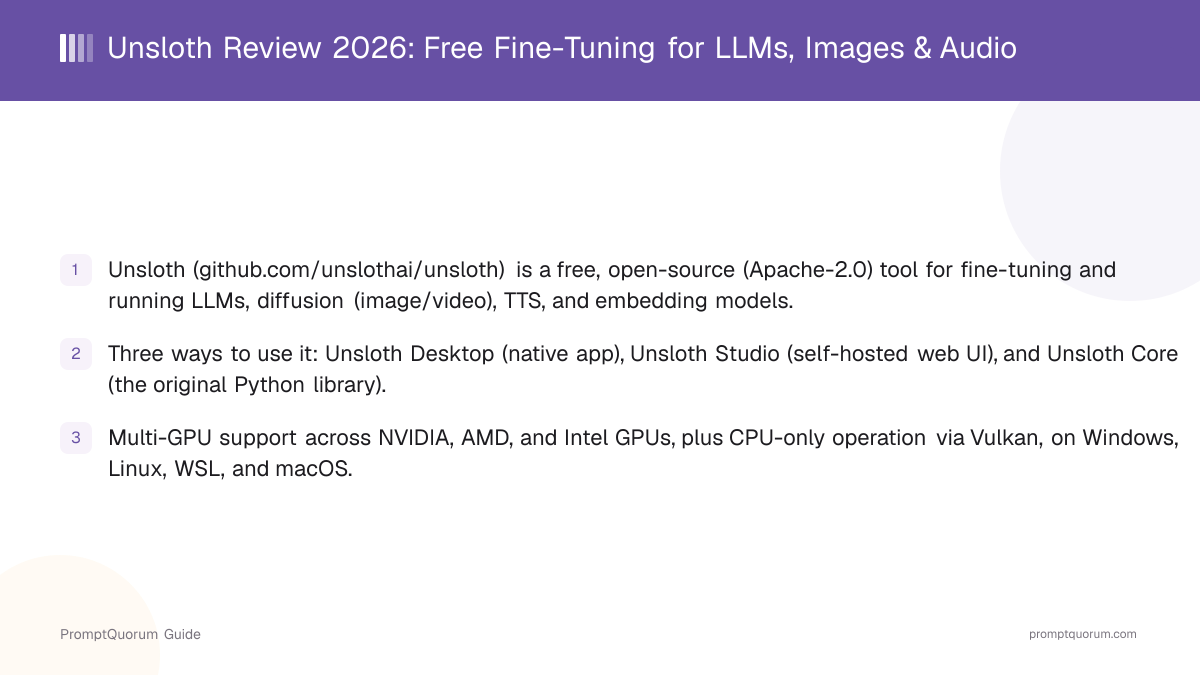
- Three ways to use it: Unsloth Desktop (native app for Windows/macOS/Linux, recommended by the project itself), Unsloth Studio (self-hosted web UI, also runnable via Docker), and Unsloth Core (the original Python library,
pip install unsloth) - Trains AND runs LLMs, diffusion (image/video) models, text-to-speech models, and embedding models — per the project's own feature list, this goes beyond text-only fine-tuning
- Supports LoRA, QLoRA, full fine-tuning, pretraining, reinforcement learning (GRPO, DPO), and FP8 training methods
- Multi-GPU support across NVIDIA, AMD, and Intel GPUs, plus CPU-only operation via a Vulkan backend, on Windows, Linux, WSL, and macOS
- Can connect trained or downloaded models to coding agents (Claude Code, Codex, and others) via a one-command
unsloth startintegration, and exposes an OpenAI/Anthropic-compatible API - Developed by Unsloth AI, a US-based organization per its GitHub profile; the repository was created in November 2023 and the
unslothPyPI package has shipped 241 releases since its first upload in August 2024
📍 In One Sentence
Unsloth is a free, open-source (Apache-2.0) tool that trains and runs LLMs, diffusion (image/video), text-to-speech, and embedding models on your own hardware, available as a native desktop app, a self-hosted web UI, or a Python library.
💬 In Plain Terms
If you want to teach an AI model your own data — text, images, or voice — instead of using a generic pretrained model, Unsloth is the tool that does that training, on your own computer or GPU, for free. It used to be a Python library for developers only; it now also has a point-and-click desktop app.
📌Note: This review is the deep-dive companion to Unsloth's entry in the Local LLM Software Directory — see that page for how Unsloth compares at a glance to dozens of other local AI tools.
What Is Unsloth?
Unsloth is a tool for fine-tuning and running AI models on hardware you control, rather than through a cloud training API. Its own GitHub README opens by calling it "the first desktop app to run and train models," which reflects a real shift: the project started in 2023 as a Python library for speeding up LLM fine-tuning, and has since grown into a three-part product covering a native desktop app, a self-hosted web UI, and the original library underneath both.
- Core function: fine-tune a base model on your own data (text, image, audio, or embedding data) using techniques like LoRA and QLoRA, then run or export the result
- Not text-only: per the README's feature list, Unsloth explicitly supports diffusion (image and video) models, text-to-speech models, and embedding models, alongside LLMs
- Three products under one project: Unsloth Desktop (native app), Unsloth Studio (web UI, self-hosted or via Docker), and Unsloth Core (the
unslothPython package) - Developer: Unsloth AI, listed as a US-based organization on its GitHub profile, with the description "Run and train AI models locally"
- Canonical repository: github.com/unslothai/unsloth, created in November 2023 per GitHub's own repository metadata
Unsloth's Release History
Unsloth does not publish a single dated changelog the way some desktop apps do, so the verifiable history below comes from two official sources instead: GitHub's own repository metadata, and the unsloth package's release history on the Python Package Index (PyPI).
- The GitHub repository was created on November 29, 2023, per GitHub's repository metadata
- The
unslothpackage's first release on PyPI was uploaded on August 4, 2024 (version 2024.8), per PyPI's official release history - As of this review, PyPI lists 241 total releases of the
unslothpackage, with the most recent (version 2026.9.4) uploaded on September 9, 2026 — a release cadence of roughly once every few days over the package's lifetime - The project's scope expanded substantially over that period: it began as a text-LLM fine-tuning speedup library and, per its current README, now also covers diffusion, text-to-speech, and embedding models, plus a native desktop app and self-hosted web UI that did not exist in the project's earlier, library-only form
What Can You Do With Unsloth?
Unsloth's feature set spans training (fine-tuning a model on your data) and running (using a trained or downloaded model), across four model types. Here is what each part actually does, per Unsloth's own GitHub README.
- Fine-tuning across four model types — LLMs, diffusion (image/video) models, text-to-speech models, and embedding models, using LoRA, QLoRA, full fine-tuning, or pretraining
- Reinforcement learning — GRPO and DPO are both supported for RL-based fine-tuning, alongside the more common supervised fine-tuning methods
- Run and serve models — beyond training, Unsloth can run GGUF, MLX, and diffusion models directly, and expose them through an OpenAI-compatible local API server
- Agent integration — the
unsloth startcommand connects a local model to coding agents including Claude Code, OpenAI Codex, and others (per the README's own list) with a single command - Remote and LAN access — Unsloth Studio can be exposed over your home network or, via a Cloudflare tunnel, accessed securely from outside your network, including from a phone
- Dataset building — a "Data Recipes" feature builds training datasets directly from PDFs, CSVs, and DOCX files, rather than requiring a pre-formatted dataset
- Export and deploy — trained models can be exported to GGUF, NVFP4, FP8, and other formats for use in other local-AI tools
- Free training notebooks — Unsloth publishes free Google Colab notebooks covering specific models and techniques (Llama, Qwen, gpt-oss, GRPO, TTS, embeddings, and vision fine-tuning)
Usage Examples: Three Ways to Use Unsloth
These are concrete workflows built from Unsloth's documented features above — not hypothetical use cases.
Install Unsloth: Desktop, Studio, and Core
Unsloth is available three ways, per its own GitHub README — the Desktop app is what the project itself recommends for most people. Links below are direct GitHub release URLs and official install scripts; always verify against the README directly, since release URLs can change between versions.
Install method | Command or link |
|---|---|
| Unsloth Desktop — Windows | Unsloth-Desktop-Windows.exe |
| Unsloth Desktop — macOS | Unsloth-Desktop-MacOS.dmg |
| Unsloth Desktop — Linux (.deb) | Unsloth-Desktop-Ubuntu.deb |
| Unsloth Desktop — Linux (AppImage) | Unsloth-Desktop-Linux.AppImage |
| Unsloth Studio — macOS/Linux/WSL | curl -fsSL https://unsloth.ai/install.sh | sh then unsloth studio |
| Unsloth Studio — Windows | irm https://unsloth.ai/install.ps1 | iex then unsloth studio |
| Unsloth Studio — Docker | docker run -d --gpus all --ipc=host -p 8000:8000 unsloth/unsloth — see Docker Hub for tags |
| Unsloth Core — Linux/WSL (pip via uv) | uv pip install unsloth --torch-backend=auto |
AMD and Intel GPU users need extra setup steps beyond the default install — see Unsloth's own AMD guide and Intel guide. A dedicated Docker Hub tag, unsloth/unsloth:core, installs Unsloth Core (Jupyter notebooks) without the Studio web UI — see Docker Hub for the current tag list.
Unsloth Pricing: Is Unsloth Really Free?
As far as this review could verify, yes — Unsloth has no paid tier. The GitHub repository reports an Apache-2.0 license via GitHub's own API, which applies to the codebase as a whole, and the project's README does not link to a pricing page or describe any paid feature. PromptQuorum was unable to load unsloth.ai directly during this review (the site returned an access-denied response to automated requests) — if a specific pricing decision matters to you, check the live site yourself rather than relying solely on this review.
- No subscription or paid tier documented in the GitHub repository or its README
- No account or sign-up required to download Unsloth Desktop or install Unsloth Core
- Free Google Colab notebooks are provided for training without owning a GPU, subject to Colab's own free-tier GPU limits (set by Google, not Unsloth)
- The Apache-2.0 license applies to the source code; it does not by itself guarantee that every associated service (for example, a future hosted offering) will always be free — verify current terms on unsloth.ai directly
Unsloth vs. Axolotl vs. MLX-LM
Unsloth, Axolotl, and MLX-LM are the three local fine-tuning tools PromptQuorum's own fine-tuning framework comparison covers in depth — this section summarizes the key difference for readers coming from this review specifically.
Aspect | Unsloth | Axolotl | MLX-LM |
|---|---|---|---|
| License | Apache-2.0 | Apache-2.0 | MIT |
| Interface | Desktop app, web UI, or Python library | YAML-config-driven, no desktop app | Python library / CLI, no desktop app |
| Model types | LLM, diffusion, TTS, embedding | LLM-focused | LLM-focused |
| Hardware | NVIDIA, AMD, Intel, CPU, Vulkan | NVIDIA-centric CUDA stack | Apple Silicon only |
| Multi-node training | Not documented in README | Yes — Torchrun and Ray | Via mx.distributed |
| Best for | Broadest single-machine option, including non-text models | Scaling past one machine | Lean, Apple-native work on a Mac |
If your training run needs more than one machine, or you specifically need DPO/ORPO/KTO/GRPO/reward-modelling method coverage as wide as possible, see the full comparison for why Axolotl is the better fit there. See the dedicated MLX-LM review if you are Apple-Silicon-only and want the leanest native option instead of Unsloth's broader (but heavier) desktop app.
Who Should Use Unsloth?
Whether Unsloth fits depends on whether you want one free tool that covers both training and running models across text, image, and audio, rather than a narrower single-purpose tool.
Unsloth vs. Other Fine-Tuning Tools
Unsloth is one of several tools for fine-tuning models on your own hardware. Here is how it sits next to other options in that space — see the Local LLM Software Directory for the full catalog, and the dedicated Unsloth vs. Axolotl vs. MLX-LM comparison above for the closest head-to-head.
- Axolotl — an Apache-2.0 fine-tuning framework whose documented strength is multi-node training and the widest alignment-method surface of the three; see the dedicated comparison section above and PromptQuorum's full fine-tuning framework comparison.
- MLX-LM — Apple's own MIT-licensed, Apple-Silicon-native library for running and fine-tuning LLMs; see the MLX-LM review for a dedicated look.
- Together.ai and Fireworks.ai — cloud fine-tuning APIs that charge per training token instead of requiring you to own a GPU; PromptQuorum's fine-tuning framework comparison covers Together.ai's pricing directly.
- Ollama and LM Studio — local inference tools for *running* models rather than training them; a common pattern is fine-tuning with Unsloth, exporting to GGUF, then running the result in Ollama or LM Studio. See the Ollama review and LM Studio review.
Common Mistakes When Evaluating Unsloth
Most confusion about Unsloth comes from an outdated mental model of it as a text-only Python library, or from assuming its own speed/VRAM claims are independently verified.
Frequently Asked Questions
What is Unsloth?
Unsloth (unsloth.ai, source at github.com/unslothai/unsloth) is a free, open-source (Apache-2.0) tool for fine-tuning and running LLMs, diffusion (image/video), text-to-speech, and embedding models on your own hardware, available as a desktop app, a self-hosted web UI, or a Python library.
Is Unsloth free?
As far as this review could verify from GitHub's repository metadata and the project's README, yes — there is no documented paid tier. PromptQuorum could not load unsloth.ai directly during this review (the site blocked the automated request), so verify current pricing on the live site if a decision depends on it.
Can Unsloth fine-tune images, not just text?
Yes. Unsloth's own GitHub README lists diffusion (image and video) models alongside LLMs, text-to-speech models, and embedding models as supported for both training and inference.
What license does Unsloth use?
Apache-2.0, per GitHub's own repository metadata (checked via the GitHub API for this review).
Do I need to know Python to use Unsloth?
No, not necessarily. Unsloth Desktop is a native point-and-click app for Windows, macOS, and Linux. Unsloth Core, the original Python library, is still available for developers who want script-level control.
What hardware does Unsloth support?
Per its GitHub README: Multi-GPU setups, NVIDIA, AMD, and Intel GPUs, CPU-only operation via a Vulkan backend, on Windows, Linux, WSL, and macOS.
Is Unsloth Studio the same as Unsloth Desktop?
No. Unsloth Desktop is a native installed app. Unsloth Studio is a self-hosted web UI you run via an install script or Docker and access through a browser — both sit on top of the same Unsloth Core engine.
Can Unsloth connect to Claude Code or other coding agents?
Yes, via the unsloth start command, which connects a local model to agents including Claude Code, OpenAI Codex, and others through Unsloth's OpenAI/Anthropic-compatible API, per the project's README.
How does Unsloth compare to Axolotl?
Unsloth covers more model types (LLM, diffusion, TTS, embedding) and more hardware backends (including AMD and Intel), while Axolotl documents multi-node training and a wider alignment-method surface. See the dedicated comparison section above and PromptQuorum's full fine-tuning framework comparison.
Who develops Unsloth?
Unsloth AI, listed as a US-based organization on its GitHub profile. The GitHub repository was created in November 2023.