Key Takeaways
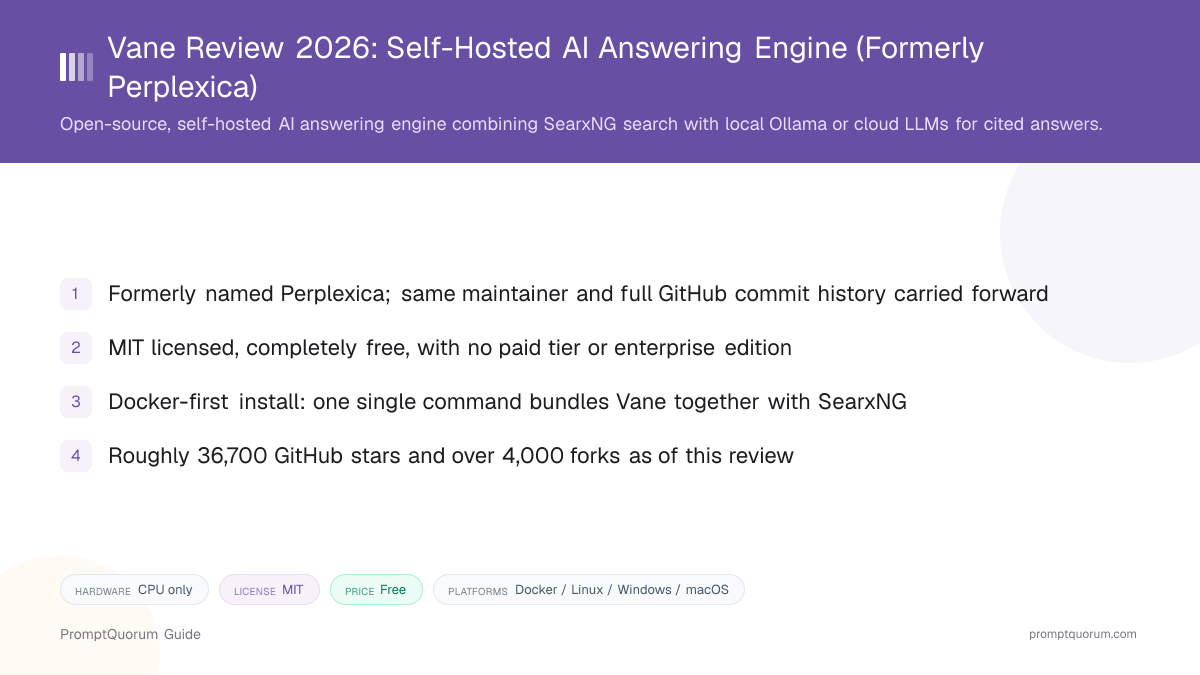
- Vane is open source under MIT; source repository at github.com/ItzCrazyKns/Vane
- Previously published under the name Perplexica; per third-party sources, the rename to Vane is reported to have happened around March 2026 — same maintainer, same GitHub history, not a fork or a different product
- Combines a self-hosted SearxNG meta-search backend with local models via Ollama, or cloud providers — OpenAI, Anthropic Claude, Google Gemini, and Groq
- Recommended install: one Docker command bundling Vane and SearxNG together; a slim image connects to an existing SearxNG instance instead
- Ships three search modes (Speed, Balanced, Quality), source picking (web, discussions, academic papers), widgets, image/video search, file uploads, domain-restricted search, and a developer API — per Vane's own README
- Free with no paid tier; roughly 36,700 GitHub stars and over 4,000 forks as of this review
📍 In One Sentence
Vane is a free, MIT-licensed, self-hosted AI answering engine — the renamed continuation of the project formerly called Perplexica — that pairs a self-hosted SearxNG search backend with local Ollama models or cloud providers to return cited answers.
💬 In Plain Terms
Instead of typing a question into Google or Perplexity and trusting a company you don't control with your search history, you run Vane on your own machine or server. It searches the web through your own SearxNG instance and lets you pick which AI model — local or cloud — writes the answer, with links back to the sources it used.
📌Note: This review is the deep-dive companion to Vane's entry in the Local LLM Software Directory — see that page for how Vane compares at a glance to dozens of other local AI tools.
What Is Vane?
Vane is a privacy-focused AI answering engine that runs entirely on your own hardware, per its own GitHub description. It is an open-source alternative to hosted answer engines like Perplexity: you ask a question, Vane searches the web (and, if you choose, your own documents), and an AI model writes a cited answer from what it found — without sending your queries to a third-party search or answer provider you don't control.
- Core function: takes a natural-language question, runs it against a self-hosted SearxNG meta-search backend, and has an AI model synthesize a cited answer from the results
- Model access: connects to local models through Ollama, or to cloud providers — OpenAI, Anthropic Claude, Google Gemini, and Groq — plus local OpenAI-API-compatible servers including AMD's Lemonade, per Vane's own README
- Developer: maintained by ItzCrazyKns on GitHub, with a public Discord community and one paid sponsor (Exa, a web-search API for LLMs) listed in the README
- Canonical repository: github.com/ItzCrazyKns/Vane — the active home of Vane's source code, issue tracker, and Docker images
Is Vane the Same Project as Perplexica?
Yes. Vane is the renamed continuation of the open-source project originally published as Perplexica, not a separate fork or a competing product. The same maintainer, GitHub commit history, and Discord community carried forward under the new name.
- Perplexica launched as an open-source, self-hostable alternative to Perplexity — an AI-powered search engine pairing SearxNG with local or cloud LLMs
- The project was renamed to Vane; per third-party sources (setup guides and community discussions describing the switch), this is reported to have happened around March 2026
- The GitHub repository's own topic tags still list "perplexica" alongside "vane," and one of the project's one-click deploy buttons (Sealos) still points at a template named
perplexica— both consistent with a rename rather than a new, unrelated project - The maintainer (ItzCrazyKns) and the Discord community are the same across both names
How Do You Self-Host Vane?
Vane has no packaged desktop installer — it is a self-hosted web application, and Docker is the officially recommended install path, per Vane's own README. The all-in-one Docker image bundles Vane with SearxNG so there is nothing else to configure first.
- 1Run the recommended Docker command.
Why it matters: `docker run -d -p 3000:3000 -v vane-data:/home/vane/data --name vane itzcrazykns1337/vane:latest` pulls and starts Vane with a bundled SearxNG instance in a single step; the `-v` flag persists your settings and uploaded files across restarts. - 2Alternative: deploy with the project's docker-compose.yaml for a repeatable, config-as-code setup.
Why it matters: The compose file (verified against the repository as of this review) defines the same image, port mapping, and named `vane-data` volume as the one-line command, which is easier to version-control and redeploy than a bare `docker run`. - 3If you already run your own SearxNG instance, use the slim image instead:
docker run -d -p 3000:3000 -e SEARXNG_API_URL=http://your-searxng-url:8080 -v vane-data:/home/vane/data --name vane itzcrazykns1337/vane:slim-latest.
Why it matters: Per Vane's README, your SearxNG instance must have JSON format and the Wolfram Alpha search engine enabled in its settings, or Vane cannot parse its responses. - 4Open
http://localhost:3000and complete the first-run setup screen.
Why it matters: This is where you add a model provider — either an Ollama server address for local inference, or an API key for a cloud provider — before Vane can answer questions. - 5Non-Docker option: install SearxNG separately (with JSON format and Wolfram Alpha enabled), then
git clone,npm i,npm run build, andnpm run start.
Why it matters: Vane's own README recommends Docker specifically because it simplifies managing environment variables and dependencies that the manual path handles by hand.
What Can You Do With Vane?
Vane's feature set centers on turning a search query into a cited, synthesized answer instead of a page of links. Details below are drawn from Vane's own GitHub README.
- Multi-provider model support — use local models through Ollama, or connect OpenAI, Anthropic Claude, Google Gemini, Groq, and local OpenAI-API-compatible servers (including AMD's Lemonade), per Vane's own feature list
- Three search modes — Speed Mode for quick answers, Balanced Mode for everyday searches, and Quality Mode for deeper research, per the README
- Source picking — search the web, discussions, or academic papers, with more sources described as in progress
- Web search via SearxNG — queries route through a self-hosted meta-search instance rather than a single search provider, keeping the query itself off a third-party search company's servers
- Widgets — inline UI cards for weather, calculations, stock prices, and similar quick lookups, shown when relevant
- Image and video search, plus file uploads — ask questions about PDFs, text files, and images directly
- Domain-restricted search, smart query suggestions, a "Discover" feed of trending content, locally-stored search history, and a developer API for integrating Vane's search into other applications
Is Vane Free?
Vane itself is free and open source under the MIT license, with no paid tier, subscription, or enterprise edition, per its own LICENSE file.
Cost Item | Price | Notes |
|---|---|---|
| Vane software | Free (MIT) | No paid tier or enterprise edition |
| Self-hosting infrastructure | Your own hardware or server costs | No GPU required by Vane itself; cost depends on the model backend you attach |
| Cloud model usage (optional) | Billed by the provider | Only applies if you connect OpenAI, Anthropic, Gemini, or Groq instead of a local Ollama model |
The project accepts voluntary donations (an Ethereum address is listed in the README) and lists one paid sponsor (Exa); neither changes the fact that the software itself carries no license fee.
Who Should Use Vane?
Vane fits people and teams who want a cited, search-backed AI answer engine they fully control, rather than a hosted product like Perplexity.
Vane vs. Onyx, MaxKB, AnythingLLM, and Khoj
Vane overlaps with several other self-hosted search and RAG tools — the difference is what each one is built to search: the open web, internal company tools, or your own files.
Tool | Primary Focus | License | Best For |
|---|---|---|---|
| Vane | Open-web AI answering engine | MIT | Perplexity-style cited web search, self-hosted |
| Onyx | Enterprise search + RAG | MIT (CE) + proprietary (EE) | 50+ connectors to Slack, Confluence, Google Drive, and more |
| MaxKB | RAG + agent platform | GPL-3.0 | Docker-deployed knowledge-base chatbots |
| AnythingLLM | Document chat | MIT | Lightweight self-hosted chat over your own files |
All four connect to local models via Ollama. Vane's main differentiator among these is that it searches the open web by default through a self-hosted SearxNG backend, rather than being built primarily around indexing your own uploaded documents or internal company data sources the way Onyx, MaxKB, and AnythingLLM are.
Common Mistakes When Evaluating Vane
Frequently Asked Questions
Is Vane free?
Yes. Vane is free and open source under the MIT license, with no paid tier or enterprise edition. Only optional cloud model usage (OpenAI, Anthropic, Gemini, Groq) carries a cost, billed by that provider.
Is Vane the same as Perplexica?
Yes. Vane is the renamed continuation of the project originally published as Perplexica — the same maintainer (ItzCrazyKns) and GitHub history carried forward. Third-party sources report the rename happened around March 2026.
What license does Vane use?
MIT, per the LICENSE file in the official GitHub repository (github.com/ItzCrazyKns/Vane).
Does Vane support local models like Ollama?
Yes. Vane connects to local models through Ollama, and to cloud providers — OpenAI, Anthropic Claude, Google Gemini, and Groq — through the same setup screen, per its own README.
How do you install Vane?
The recommended method is a single Docker command: docker run -d -p 3000:3000 -v vane-data:/home/vane/data --name vane itzcrazykns1337/vane:latest, which bundles Vane and SearxNG together. A slim image and a manual, non-Docker install are also documented.
Does Vane need a GPU?
Not by itself. Vane orchestrates search and answer generation; GPU requirements, if any, come from whichever model backend you attach (for example, a local Ollama model), not from Vane itself.
Who develops Vane?
Vane is maintained by ItzCrazyKns on GitHub, with a public Discord community and one listed paid sponsor (Exa) as of this review.
How popular is Vane?
Vane's GitHub repository shows roughly 36,700 stars and over 4,000 forks as of this review.
What are the main alternatives to Vane?
Onyx (MIT/proprietary, enterprise search with 50+ connectors), MaxKB (GPL-3.0, RAG and agent platform), AnythingLLM (MIT, lightweight document chat), and Khoj (self-hosted personal AI assistant) are the closest self-hosted alternatives, though each targets a different primary use case than Vane's open-web search focus.