Key Takeaways
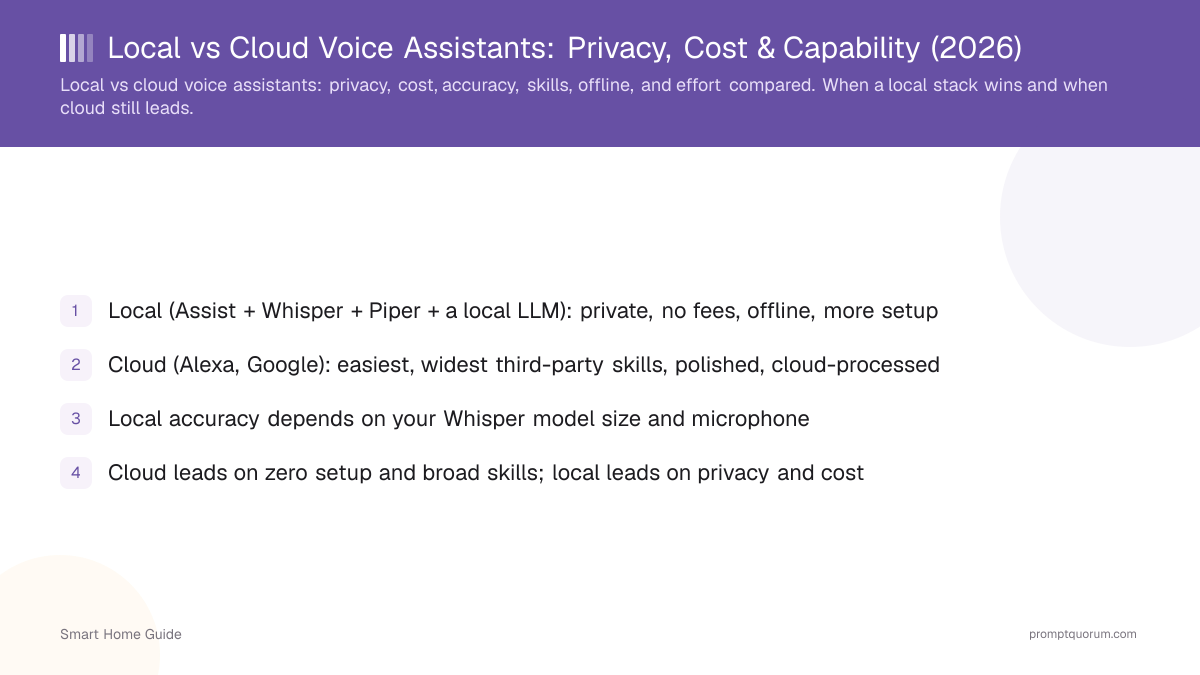
- Local (Assist + Whisper + Piper + a local LLM): private, no fees, offline, more setup
- Cloud (Alexa, Google): easiest, widest third-party skills, polished, cloud-processed
- Local accuracy depends on your Whisper model size and microphone
- Cloud leads on zero setup and broad skills; local leads on privacy and cost
- A GPU-equipped mini PC narrows the latency gap for local
- Choose local for privacy and control, cloud for convenience
The Two Approaches
A local assistant runs speech, understanding, and responses on your hardware; a cloud assistant runs them on a vendor server. That single difference drives the trade-offs.
- Local: Home Assistant Assist + Whisper (STT) + Piper (TTS) + an optional local LLM — see build a fully local voice assistant.
- Cloud: Alexa or Google process your voice on their servers.
- The choice mirrors the broader local-vs-cloud decision — see why local beats cloud.
The Comparison
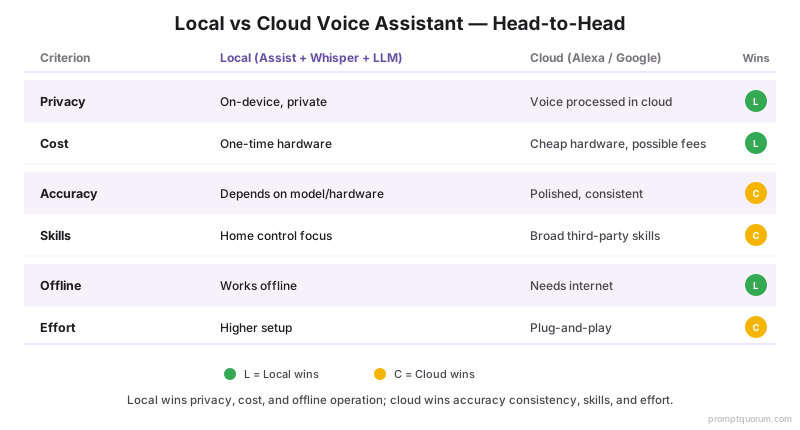
Local wins privacy, cost, and offline; cloud wins skills and effort. Use the table to match your priority.
Criterion | Local (Assist + Whisper + LLM) | Cloud (Alexa / Google) |
|---|---|---|
| Privacy | On-device, private | Voice processed in cloud |
| Cost | One-time hardware | Cheap hardware, possible fees |
| Accuracy | Depends on model/hardware | Polished, consistent |
| Skills | Home control focus | Broad third-party skills |
| Offline | Works offline | Needs internet |
| Effort | Higher setup | Plug-and-play |
The Privacy and Cost Case for Local
Local voice keeps recordings on your hardware and avoids subscriptions, which is the strongest reason to choose it. It also works during internet outages.
- No voice recordings sent to a vendor — see smart home privacy risks.
- No subscription; you pay one-time hardware.
- Add a local LLM for natural-language understanding — see running your smart home on a local LLM.
Where Cloud Still Wins
Cloud assistants still win on zero-effort setup, consistent accuracy, and the breadth of third-party skills. If you want shopping, broad app integrations, and no configuration, cloud leads.
- Out-of-box setup with no hardware to manage.
- Wide third-party skill ecosystems beyond home control.
- Consistent recognition without tuning a model or microphone.
Recommendation
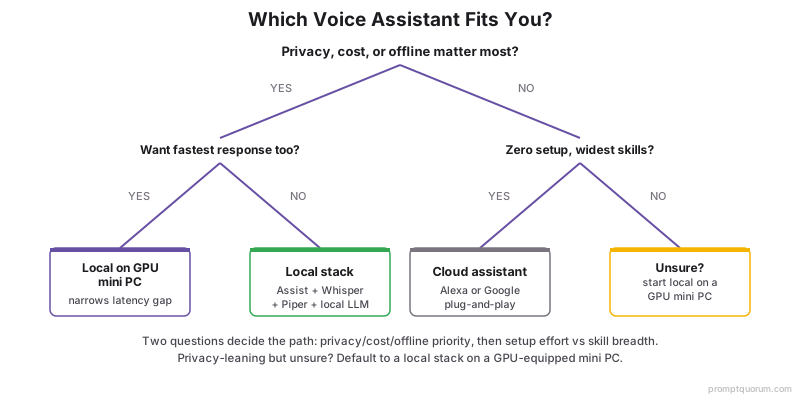
Choose local if privacy, cost, or offline operation matter; choose cloud if you want zero setup and the widest skills. If unsure and you value privacy, start local with a mini PC.
- Privacy / offline / no fees: local stack.
- Zero setup / broadest skills: Alexa or Google.
- Unsure but privacy-leaning: start local on a GPU-equipped mini PC — see best mini PCs for Home Assistant + local AI.
Frequently Asked Questions
Is local voice as good as cloud now?
For home control and natural-language commands, a local stack with a good Whisper model and a local LLM is highly capable. Cloud assistants still lead on consistent accuracy out of the box and on broad third-party skills beyond home control.
Is a local voice assistant fully offline?
Yes. Speech-to-text, text-to-speech, intent handling, and an optional local LLM all run on your hardware, so a local voice assistant works with no internet. Only remote access from outside the home needs connectivity.
What is the cost difference?
Local voice has a one-time hardware cost and no subscription, while cloud assistants have cheap hardware but may attach fees to premium features. Over time, local is typically cheaper and keeps your voice data private.
How much setup effort does local voice take?
More than a cloud assistant: you install Home Assistant, add Whisper and Piper, connect them over Wyoming, and optionally add a local LLM. It is a weekend project rather than a few taps, but it is well-documented.