Key Takeaways
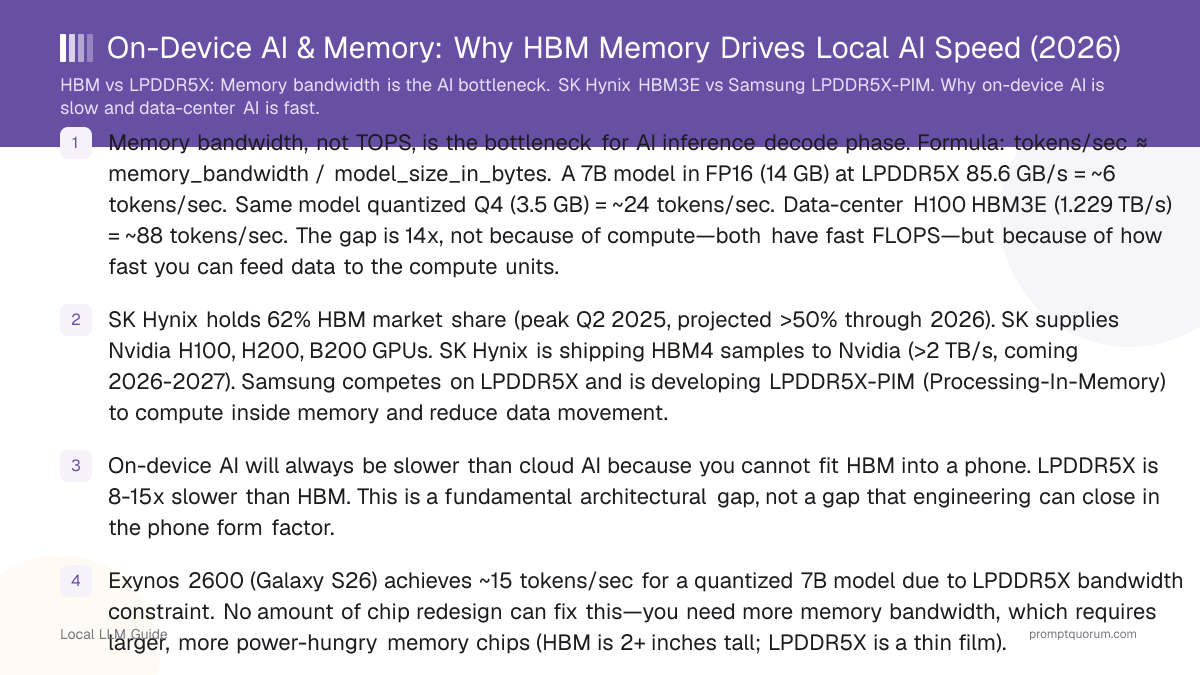
- Memory bandwidth, not TOPS, is the bottleneck for AI inference decode phase. Formula: tokens/sec ≈ memory_bandwidth / model_size_in_bytes. A 7B model in FP16 (14 GB) at LPDDR5X 85.6 GB/s = ~6 tokens/sec. Same model quantized Q4 (3.5 GB) = ~24 tokens/sec. Data-center H100 HBM3E (1.229 TB/s) = ~88 tokens/sec. The gap is 14x, not because of compute—both have fast FLOPS—but because of how fast you can feed data to the compute units.
- SK Hynix leads HBM shipments (roughly 50–62% share depending on the 2026 quarter measured) and supplies Nvidia H100, H200, B200 GPUs. HBM4 (>2 TB/s) is now in mass production, not just a roadmap item: SK Hynix is targeting its 16-layer, 48 GB HBM4 variant for Q3 2026, while Samsung shipped the industry's first 12-layer HBM4E samples at 3.6 TB/s per stack in May 2026, ahead of SK Hynix on that specific spec.
- Samsung validated LPDDR5X-PIM (Processing-In-Memory) as real, tested silicon at Hot Chips 2026 (August 25, 2026) — not a lab concept. Running Llama-3.1-8B on an edge AI accelerator SoC, it hit 81.3 tokens/sec versus 27.0 tokens/sec on standard LPDDR5X: a measured 3.01x inference speedup with up to 8x the internal bandwidth in PIM mode. The chip is pin-compatible with standard LPDDR5X (same 561-ball package), so it is a drop-in upgrade, not a redesign.
- On-device AI will still be slower than cloud AI for large models — you cannot fit HBM into a phone — but the gap on phones just narrowed. LPDDR5X-PIM does not match HBM bandwidth; it reduces data movement instead, which is why the throughput gain (3x) is smaller than the raw bandwidth gap (14x) but still meaningful for real workloads.
- Exynos 2600 (Galaxy S26) still ships with standard LPDDR5X, achieving ~8–15 tokens/sec realistic for a quantized 7B model. LPDDR5X-PIM is validated but not yet in a shipping phone SoC — expect it to appear in edge AI accelerators first, then phones in later hardware cycles.
- The memory-bandwidth bottleneck still explains why fine-tuning or distillation doesn't help: you still have to load every parameter into memory on every forward pass. Smaller models help (3B, 1B), and quantization remains the baseline solution for phones — PIM is an additional lever, not a replacement for it.
Why Memory Bandwidth Determines AI Speed
During the decode phase of LLM inference, the GPU/NPU must load the entire model into memory, perform one forward pass per token, and write the output. The bottleneck: how fast can you feed parameters to the compute units? This is memory bandwidth, not compute TOPS.
Simplified formula: tokens/sec = memory_bandwidth / (model_size_in_bytes × bytes_per_precision). For FP16 (2 bytes per parameter), a 7B model = 14 GB. At LPDDR5X 85.6 GB/s: 85.6 GB/s ÷ 14 GB = ~6 tokens/sec theoretical maximum. In practice, 3–5 tokens/sec due to compute and cache overhead.
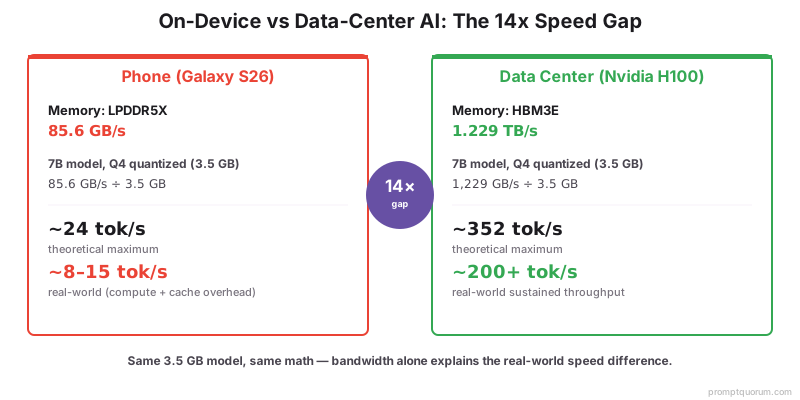
Quantization changes the equation dramatically. Q4 (4-bit, 0.5 bytes per parameter) shrinks a 7B model to 3.5 GB. 85.6 GB/s ÷ 3.5 GB = ~24 tokens/sec theoretical. Real-world ~8–15 tokens/sec, a 3–4x improvement.
Data-center H100 with HBM3E (1.229 TB/s) can sustain 100+ tokens/sec for the same model, because HBM is 14x faster. This is why frontier models (70B, 405B) run only in data centers—you need HBM bandwidth.
Inference is different from training. Training is compute-bound (you do 1000+ passes to update weights). Inference (especially once a model is prompt-cached) is a single forward pass, pure memory-bandwidth bound. This is why inference on phones is so much slower than on servers—you cannot engineer your way out of the bandwidth gap.
📍 In One Sentence
LLM decode is memory-bandwidth-bound: tokens/sec = bandwidth / model_size. On-device 85.6 GB/s vs data-center 1.229 TB/s = 14x gap.
💬 In Plain Terms
Think of a factory assembly line: compute is the workers, memory is the supply chain. Workers are fast, but if supplies arrive slowly, they get bottlenecked. More workers (more FLOPS) doesn't help if supplies (data) arrive at the same rate. Phones lack "fast supply chains" (HBM).
Memory Bandwidth Comparison: LPDDR5X vs HBM
Memory Type | Bandwidth | Used In | Tokens/sec (7B FP16) | Tokens/sec (7B Q4) |
|---|---|---|---|---|
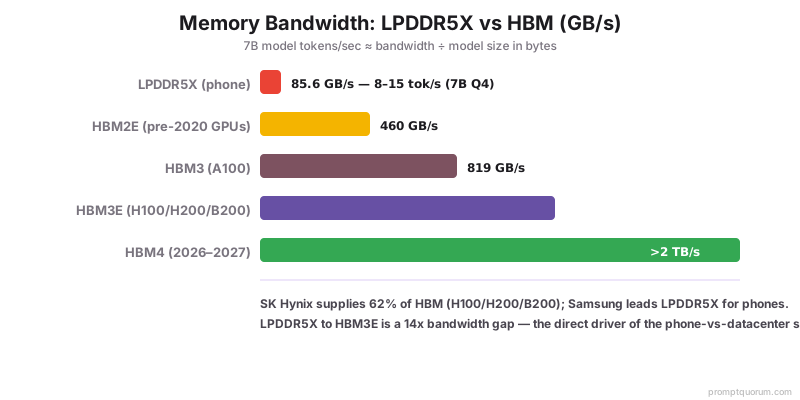
| LPDDR5X 10.7 Gbps | 85.6 GB/s (x64 bus) | Galaxy S26, Snapdragon 8 Elite Gen 5, most phones | ~6 tokens/sec (theory); ~3–5 realistic | ~24 tokens/sec (theory); ~8–15 realistic |
| HBM2E | ~460 GB/s per stack | Older GPUs (P100, V100 pre-2020) | ~33 tokens/sec (theory) | ~131 tokens/sec (theory) |
| HBM3 19.2 Gbps | ~819 GB/s per stack | Nvidia A100, 80GB variant | ~59 tokens/sec (theory) | ~234 tokens/sec (theory) |
| HBM3E 21.4 Gbps | 1.18–1.229 TB/s per stack | Nvidia H100, H200, B200 (2+ stacks common) | ~88 tokens/sec (theory); ~60–80 realistic | ~352 tokens/sec (theory); ~200+ realistic |
| HBM4 (SK Hynix, 16-layer) | >2 TB/s per stack, 48 GB | Nvidia next-gen GPUs (mass prod. Q3 2026) | ~143 tokens/sec (theory) | ~571 tokens/sec (theory) |
| HBM4E (Samsung, 12-layer) | 3.6 TB/s per stack | Samples shipped May 2026 (ahead of SK Hynix) | ~257 tokens/sec (theory) | ~1,029 tokens/sec (theory) |
| LPDDR5X-PIM (Samsung, validated) | 85.6 GB/s + up to 8x internal (PIM mode) | Shown at Hot Chips 2026 / edge AI SoC, pin-compatible | Not measured for 7B FP16 | Llama-3.1-8B: 81.3 vs 27.0 tok/sec (3.01x) |
| LPDDR6 (announced) | ~200+ GB/s (estimated) | Phones (2027–2028) | ~14 tokens/sec (theory) | ~57 tokens/sec (theory) |
Samsung and SK Hynix: Who Makes What
SK Hynix — HBM Volume Leader: SK leads HBM shipments, with reported share ranging roughly 50–62% across different 2026 quarters and measurement methodologies (revenue vs. bit-share vs. quarter). SK supplies HBM3E to Nvidia for H100, H200, and B200 GPUs, and is targeting mass production of its 16-layer HBM4 (48 GB, >2 TB/s) for Q3 2026. HBM revenue remains critical for SK's data-center division.
Samsung — HBM4E Speed Lead, LPDDR5X-PIM Validated: Samsung shipped the industry's first 12-layer HBM4E samples on May 29, 2026, at 3.6 TB/s per stack — ahead of SK Hynix's HBM4 spec on that metric, though SK still ships more total HBM volume. On the phone side, Samsung presented LPDDR5X-PIM at Hot Chips 2026 (August 25, 2026) as validated, tested silicon: an edge AI accelerator SoC ran Llama-3.1-8B at 81.3 tokens/sec versus 27.0 tokens/sec on standard LPDDR5X (3.01x), with up to 8x internal bandwidth in PIM mode. The chip uses the same 561-ball package as standard LPDDR5X, so it is a drop-in replacement, not a new form factor.
Competitive Dynamics: Samsung continues to sample HBM (HBM3E, now HBM4E) but has historically trailed SK on yield and total HBM volume. Samsung's positioning for LPDDR5X-PIM is explicit: a complement to HBM, not a replacement — targeting smartphones, AI PCs, and edge accelerators where HBM's cost, power draw, and packaging complexity are prohibitive, rather than trying to match HBM bandwidth directly.
Both companies supply Nvidia: SK Hynix and Samsung both provide HBM for Nvidia GPU VRAM; standard DRAM (LPDDR/DDR) covers host/CPU memory. Neither supplies the compute (Nvidia designs the GPU cores). The ecosystem stays specialized: design, memory, compute are separate.
Timeline: HBM4 is in mass production now (SK Hynix targeting Q3 2026 for its 16-layer part; Samsung already sampling 12-layer HBM4E). LPDDR5X-PIM is validated silicon, ahead of the 2027-2028 production estimate given at last refresh — expect it in edge AI accelerators before phones. LPDDR6/LPDDR6X-PIM is Samsung's next target, with an initial JEDEC spec hoped for later in 2026.
On-Device AI Limits on the Galaxy S26
The Galaxy S26 Exynos 2600 with LPDDR5X 85.6 GB/s defines the practical ceiling for on-device LLM inference. A quantized 7B model at Q4 reaches ~8–15 tokens/sec realistic performance. This is suitable for latency-sensitive tasks (autocomplete, real-time transcription, simple tasks) but impractical for long conversations.
Model size limits: A 7B model is practical (3–4 hour latency per 100-token response). A 13B model at Q4 (~6.5 GB) hits 85.6 GB/s ÷ 6.5 GB = ~13 tokens/sec, barely an improvement. A 70B model at Q4 (~35 GB) hits 85.6 GB/s ÷ 35 GB = ~2 tokens/sec—unusable.
Quantization is essential: FP16 (2 bytes/param) is impractical. Q4 (0.5 bytes/param) is the sweet spot—4x smaller models with acceptable quality loss. Q3 (3-bit) saves more space but loses quality; Q5 loses less quality but gains little bandwidth improvement.
Speed vs quality tradeoff: 7B Q4 is ~8–15 tokens/sec (acceptable for some use cases). 3B Q4 is ~24–36 tokens/sec (excellent for simple tasks). 1B Q4 is ~60+ tokens/sec (real-time, Pixel 3 era performance on modern hardware).
Practical use cases: autocomplete, real-time code suggestion, on-device transcription, local summarization. Not practical: long conversations, complex reasoning, multi-turn dialogue without caching.
The bottleneck is bandwidth, not compute or weight size. Even if you reduce model parameters to 0, the memory still needs to transfer them, and the bandwidth is fixed. This is why on-device AI is architecturally limited—you cannot engineer yourself out of 85.6 GB/s on a phone form factor.
- Use LPDDR5X 85.6 GB/s bandwidth to estimate max tokens/sec: divide by model size in GB
- 7B Q4 (3.5 GB): ~24 tokens/sec theory; ~8–15 realistic (practical)
- 13B Q4 (6.5 GB): ~13 tokens/sec theory; ~4–8 realistic (slow)
- 1B Q4 (~500 MB): ~171 tokens/sec theory; ~50–100 realistic (fast)
- Quantization is mandatory: Q4 is the baseline for usable on-device models
- Trade off model size against latency; no model size fits the "good enough" window below 5 tokens/sec
Data Center vs. Phone: The 14x Bandwidth Gap
A Nvidia H100 GPU with HBM3E (1.229 TB/s) is 14x faster at inference throughput than a Galaxy S26 (LPDDR5X 85.6 GB/s). This gap is not due to compute FLOPS (both are fast), but pure memory bandwidth. The H100 can do 100+ tokens/sec; the S26 does 8–15 tokens/sec for the same 7B Q4 model.
Why the gap exists: HBM is physically different. LPDDR5X is a thin film sitting next to the CPU (power-efficient for phones). HBM is a stack of memory chips directly bonded to the GPU using through-silicon vias (TSVs), creating massive bandwidth. HBM stacks are 2+ inches tall; impossible to fit in a phone.
Why it can't be closed: Phones are thermally and power-constrained. HBM consumes significant power (~100+ W for a full stack). LPDDR5X is ~5–10 W. Phones run on batteries; data centers have unlimited power/cooling. You cannot physically fit HBM bandwidth into a phone without destroying battery life.
Consequence: On-device AI will always be slower than cloud AI for large models. This is not a technology gap that will close—it's a physical constraint (power, thermal, form factor). Smaller models, aggressive quantization, and clever caching are the solutions, not hoping for better memory.
The flip side: on-device is private, offline-capable, and zero-latency for privacy-sensitive tasks. The 14x speed penalty is the price of privacy. Data-center AI trades speed for privacy loss.
Update: Samsung validated LPDDR5X-PIM at Hot Chips 2026 (August 25, 2026) — 3.01x measured throughput (27.0 → 81.3 tokens/sec on Llama-3.1-8B) on a pin-compatible chip, well ahead of the 2027-2028 timeline this page previously cited. LPDDR6 (still 2027-2028) targets ~200 GB/s, ~6x slower than HBM3E. Together, PIM now and LPDDR6 later meaningfully narrow the phone-vs-data-center gap without closing it — the 14x raw bandwidth gap becomes closer to 4-6x in practice once PIM ships in phone SoCs.
Memory Roadmap: HBM4 and LPDDR6
HBM4 / HBM4E (SK Hynix + Samsung, now in mass production): >2 TB/s per stack for SK Hynix's 16-layer HBM4 (targeting Q3 2026 mass production); 3.6 TB/s per stack for Samsung's 12-layer HBM4E, already sampling since May 2026. Arriving first in Nvidia next-gen GPUs (post-B200). Still irrelevant for phones — it will push data-center inference even faster while phones stay bandwidth-starved.
LPDDR5X-PIM (Samsung, validated August 2026): Processing-In-Memory embeds compute inside the DRAM die. Instead of only loading every model weight from memory, the chip computes some operations (matrix multiplies) inside memory itself, eliminating round-trips. This moved from "developing" to "demonstrated, tested silicon" at Hot Chips 2026: 3.01x measured inference speedup (27.0 → 81.3 tokens/sec on Llama-3.1-8B) with up to 8x internal bandwidth in PIM mode, on a pin-compatible chip. It will not match HBM bandwidth, but it is real and ahead of the prior 2027-2028 production estimate.
LPDDR6 / LPDDR6X-PIM (2027-2028): ~200+ GB/s estimated for plain LPDDR6 (x64 bus, 12.8 Gbps) — roughly 2.3x LPDDR5X bandwidth. For a 7B Q4 model: 200 GB/s ÷ 3.5 GB ≈ 57 tokens/sec theoretical (up from 24), ~20–35 tokens/sec realistic. Samsung is already looking past LPDDR5X-PIM to LPDDR6X-PIM, and hopes for an initial JEDEC specification later in 2026. LPDDR6 itself is expected in the Galaxy S27/S28 era.
Reality: Even with LPDDR5X-PIM shipping and LPDDR6 on the roadmap, phones will still be several times slower than data centers for inference — Samsung itself positions PIM as a complement to HBM for cost/power-constrained devices, not a bandwidth-parity solution. This is a physical-design gap (form factor, power, heat), not one that a single generation of memory closes.
For on-device AI, late 2026: Exynos 2600 + standard LPDDR5X is still the shipping baseline for Galaxy S26. LPDDR5X-PIM is validated but has not yet appeared in a shipping phone SoC — expect edge AI accelerators to get it first. Track the next Exynos/Snapdragon generation for whether PIM reaches phones before LPDDR6 does.
Frequently Asked Questions
What is LPDDR5X memory bandwidth?
LPDDR5X at 10.7 Gbps on a x64 bus delivers 85.6 GB/s — the memory speed used in the Galaxy S26, Snapdragon 8 Elite Gen 5, and most 2026 flagship phones. That's roughly 5.4x to 14x slower than data-center HBM (HBM2E at 460 GB/s up to HBM4/HBM4E at 2-3.6 TB/s per stack), which is why on-device AI inference is much slower than data-center inference for the same model size. Samsung's LPDDR5X-PIM variant, validated August 2026, closes part of that gap — it ran Llama-3.1-8B at 3.01x the tokens/sec of standard LPDDR5X in Samsung's own Hot Chips 2026 demonstration.
Why is memory bandwidth the bottleneck for AI inference?
Because the decode phase (generating each token) requires loading the entire model into memory for one forward pass. The compute units finish quickly, but memory can't feed them data fast enough. FLOPS are not the bottleneck; data delivery is.
What's the tokens/sec formula for on-device AI?
Simplified: tokens/sec = memory_bandwidth / (model_size × bytes_per_precision). For a 7B FP16 model (14 GB) at 85.6 GB/s: 85.6 ÷ 14 = ~6 tokens/sec. Quantized Q4 (3.5 GB): 85.6 ÷ 3.5 = ~24 tokens/sec. Real-world ~40–60% of theoretical.
Does SK Hynix dominate HBM?
SK Hynix leads HBM shipments, with reported share ranging roughly 50–62% depending on the 2026 quarter and measurement method. SK supplies Nvidia H100, H200, B200 GPUs and is targeting mass production of its 16-layer HBM4 for Q3 2026. Samsung has closed some of the gap: it shipped 12-layer HBM4E samples at 3.6 TB/s per stack in May 2026, ahead of SK Hynix on that specific spec, though SK still ships more total HBM volume.
Can Samsung catch up to SK Hynix in HBM?
Samsung is closer than it was: its 12-layer HBM4E samples (3.6 TB/s, shipped May 2026) beat SK Hynix's HBM4 bandwidth spec on paper, though SK still leads on total shipped volume and yield track record. For phones, Samsung isn't trying to match HBM bandwidth at all — it validated LPDDR5X-PIM (computing inside memory) instead, shown at Hot Chips 2026.
When does LPDDR6 ship?
Still estimated 2027-2028 in the Galaxy S27/S28 era, unchanged since last refresh. ~200+ GB/s (2.3x LPDDR5X). It will roughly double on-device token throughput but stays 3–6x slower than HBM3E data-center GPUs. LPDDR5X-PIM, by contrast, is already validated silicon — it will likely reach edge devices before LPDDR6 does.
Why can't you put HBM in a phone?
Physical constraints: HBM stacks are 2+ inches tall (form factor). HBM power consumption (~100+ W) kills battery life. LPDDR5X is thin-film, 5–10 W. Phones need to fit pockets and last 24 hours. This has not changed with HBM4/HBM4E — the new generations are faster but not smaller or lower-power.
Will LPDDR5X-PIM close the gap with HBM?
Partially, and it is now measured, not projected. Samsung showed a real chip at Hot Chips 2026 (Aug 25, 2026) running Llama-3.1-8B at 81.3 tokens/sec vs. 27.0 tokens/sec on standard LPDDR5X — a 3.01x gain, with up to 8x internal bandwidth in PIM mode. That still falls well short of the 14x raw bandwidth gap to HBM3E, but it is a bigger real-world improvement than the "~50%" estimate this page previously cited, and the chip is pin-compatible so it can be adopted without a system redesign.
Is compute FLOPS relevant for on-device AI?
Not as much as people think. Decode is memory-bound, not compute-bound. A slower compute unit with faster memory beats a faster compute unit with slower memory. This is why Exynos 2600 (2nm) > Snapdragon 8 Elite Gen 5 (3nm) for inference: Exynos bandwidth and cache are better tuned.
Can I run a 70B model on Galaxy S26?
Technically yes; practically no. 70B Q4 (~35 GB) gives 85.6 GB/s ÷ 35 GB = ~2 tokens/sec. That's 1 token per second—unusable for any interactive task. Stick to 7B or smaller.
What's the best model size for on-device?
7B Q4 is the Goldilocks zone: 8–15 tokens/sec, acceptable quality. 3B Q4 is faster (24–36 tokens/sec) but lower quality. 1B Q4 is ultra-fast (50+ tokens/sec) but very limited. 13B+ is too slow.
Will LPDDR5X-PIM be in the Galaxy S27?
Unclear, but more likely than previously assumed. Samsung showed LPDDR5X-PIM at Hot Chips 2026 in August 2026 as a validated, tested chip (3.01x throughput gain), pin-compatible with standard LPDDR5X. It is not yet built into any shipping phone SoC — edge AI accelerators are likely to get it first, and the Galaxy S27 (2027) could follow.
Can memory bandwidth for AI inference be increased?
Yes, but within limits. LPDDR6 (~200 GB/s, 2027-2028) and the now-validated LPDDR5X-PIM (3.01x measured throughput gain, August 2026) both improve on-device inference noticeably. But physical constraints prevent HBM-class bandwidth in phones. The 14x raw-bandwidth gap narrows to roughly 4-6x in practice rather than disappearing.