Key Takeaways
- MRAM (Magnetoresistive RAM): Non-volatile memory using magnetic tunnel junctions (MTJ). No refresh required, no standby power drain. Byte-addressable like DRAM.
- In-memory computing: Perform multiply-accumulate (MAC) operations directly inside the memory array. Eliminates data movement between CPU/GPU and memory — the #1 energy cost in inference.
- Current status: Samsung SAIT demonstrated on Nature paper (2022) with 98% accuracy on image tasks. SemiFive + ICYTech achieved 8nm eMRAM tape-out (May 2026). No consumer products yet.
- The catch: Tape-out ≠ silicon returned ≠ shipped product — the SemiFive/ICYTech chip has not shipped. New academic test chips (IEEE JSSC, 2026) have since published the first real MRAM compute-in-memory efficiency numbers — up to 492.8 TOPS/W — but these are lab silicon, not the SemiFive product. Consumer phones/PCs unlikely before 2029–2031.
- Alternative: Google TurboQuant (ICLR 2026) compresses KV cache to 3 bits with zero accuracy loss — a software-only approach to the same problem, available now.
📍 In One Sentence
MRAM and in-memory computing could reshape on-device AI by running neural-network calculations directly inside memory instead of shuttling data back and forth, but the technology is still in the R&D and early-prototype phase, with realistic consumer deployment 3-5+ years away.
💬 In Plain Terms
Today's chips waste a lot of energy just moving data between memory and the processor. MRAM tries to fix that by doing some of the computation right where the data is stored. It's a promising idea with real lab demonstrations behind it, but it's not in any phone or laptop yet -- think of it as an early-stage technology to watch, not something you can buy.
What Is MRAM?
MRAM stores data using magnetic properties instead of electric charge (like DRAM) or trapped electrons (like Flash). The core unit is a magnetic tunnel junction (MTJ): a thin insulating layer sandwiched between two magnetic layers. A small current sets the junction to high or low resistance — high = "1", low = "0".
Key properties:
- Non-volatile: Data persists without power. No refresh cycle required.
- Byte-addressable: Like DRAM, individual bytes can be read/written. Unlike Flash (page-based).
- Zero standby power: DRAM needs ~0.5–1 mW per gigabyte just to keep data alive (refresh current). MRAM needs none.
- High endurance: Commercial MRAM achieves 10^10 to 10^14 write cycles. DRAM/SRAM are ~10^16 (effectively unlimited). NAND Flash is 10^3–10^5. MRAM is vastly better than Flash, comparable to DRAM.
- Process integration: Samsung, TSMC, and others can embed MRAM directly into logic dies at 28nm, 14nm, and smaller nodes.
The Memory Bottleneck in On-Device AI
Modern AI inference is dominated by a single problem: the von Neumann bottleneck. Compute (CPU/GPU) and memory are physically separate. Every neural network operation requires data to shuttle back and forth — weights, activations, KV caches in transformers.
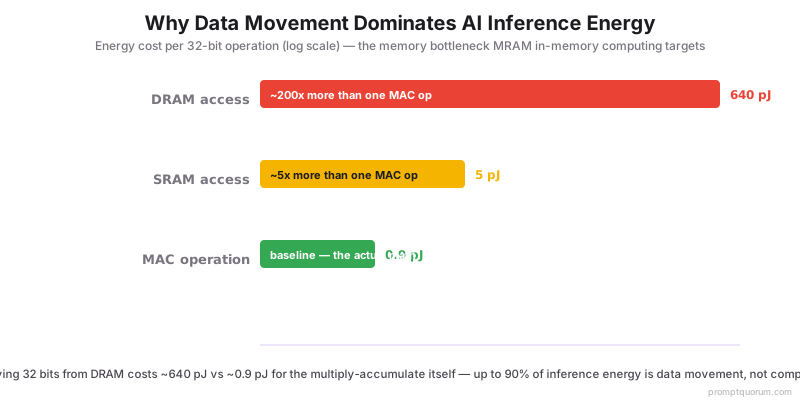
This data movement is extraordinarily expensive compared to the actual math:
On a typical local LLM inference workload, data movement accounts for up to 90% of total energy consumption. Compute itself — the actual neural network math — is almost a rounding error. This creates a perverse incentive: bigger, faster CPUs/GPUs don't help if the memory bus is the wall.
For on-device AI on phones, laptops, and edge devices running on battery, this bottleneck is the primary obstacle to longer inference time without draining the battery.
Operation | Energy cost | Relative |
|---|---|---|
| 32-bit DRAM access | ~640 pJ | ~200× more than a MAC op |
| 32-bit on-chip SRAM access | ~5 pJ | ~5× more than a MAC op |
| 32-bit floating-point multiply-accumulate (MAC) | ~0.9 pJ | baseline (1×) |
How In-Memory Computing Attacks the Problem
In-memory computing (also called processing-in-memory or PIM) solves this by moving the compute into the memory array itself. Instead of loading weights and activations into a separate ALU, the MAC operation happens directly in the crossbar of memory cells.
How it works:
- Neural network weights are stored as MRAM cells (or other analog-compatible memory).
- Input activations are applied as row voltages.
- The memory array's analog properties compute the matrix-vector multiply in a single pass — the core operation in transformer inference.
- Results are read out and quantized back to digital.
Where MRAM Stands Today
Samsung SAIT Nature Paper (January 2022):
- Published demonstration of a 64×64 MRAM crossbar array performing in-memory computing.
- Accuracy achieved: 98% on handwritten digit classification (MNIST), 93% on face detection.
- Power efficiency: directionally confirmed to benefit from eliminating data movement, but specific quantified power reduction vs DRAM not disclosed in public materials.
- Limitation: Highly specialized for classical ML tasks (digit classification, object detection). Not yet demonstrated on large transformer inference.
- SemiFive + ICYTech PNM MRAM Edge Chip (May 2026):
- Successfully achieved tape-out on Samsung Foundry 8nm (8LPU) with embedded MRAM.
- Tape-out = design submitted for manufacturing. Silicon has not yet returned, benchmarks have not been published, and the product has not shipped.
- Claimed capability: On-device inference for models up to 2 billion parameters without network connectivity.
- Target: Text summarization, translation, conversational reasoning on edge AI, humanoid robots, automotive.
- First commercialization targeted for Asia; no North American timeline announced.
- New since June 2026 — academic compute-in-memory silicon: The IEEE Journal of Solid-State Circuits published two MRAM-based compute-in-memory test chips in 2026: a 64Mb STT-MRAM near-memory-compute macro built in 28nm CMOS reaching 316 TOPS/W at 1-bit precision, and a separate STT-MRAM sparsity-adaptive compute-in-memory macro reaching 492.8 TOPS/W.
- These are university/lab research chips, not commercial products, and are not directly comparable to the SemiFive/ICYTech edge SoC (different node, different scope) — but they are the first publicly quantified power-efficiency numbers for MRAM in-memory compute, filling the gap this article previously flagged as undisclosed.
MRAM vs HBM vs DRAM vs LPDDR5: Trade-Offs
What MRAM offers that HBM doesn't:
- Non-volatility: weights survive power-off, enabling instant-on inference without reloading from disk.
- Zero refresh power: eliminates the standby current overhead.
- Direct die integration: no separate memory package required.
- Suitable for intermittently-powered edge nodes and wearables.
- What HBM offers that MRAM (currently) doesn't:
- Vastly higher bandwidth: HBM4 provides 1.6 TB/s vs MRAM's embedded bandwidth (unspecified, likely in the 10–100 GB/s range).
- Proven density at scale for training large models.
- No reliance on specialized MTJ process integration.
- Available today in production AI accelerators.
Memory Type | Peak Bandwidth | Non-Volatile | Standby Power | Form Factor | Best For | Status for AI |
|---|---|---|---|---|---|---|
| HBM4 (High Bandwidth Memory) | ~1.6 TB/s per stack | No | High (refresh) | Stacked on interposer | AI training, high-end inference | Production, proven at scale |
| LPDDR5X (mobile DRAM) | 68–77 GB/s | No | High (refresh) | Wirebonded package | Edge AI, mobile inference | Current standard for phones/tablets |
| MRAM (embedded eMRAM) | Not yet published | Yes | Near-zero | Embedded in SoC die | Always-on edge AI, specialized workloads | R&D, tape-out (May 2026), not consumer yet |
| Standard DRAM | ~100–200 GB/s | No | Medium (refresh) | DIMM, SO-DIMM | General computing, inference on desktops | Production, everywhere |
Bottom line: MRAM and HBM are not competitors today. HBM targets high-bandwidth AI accelerators (GPUs, TPUs in data centers). MRAM targets edge inference and specialized in-memory compute where non-volatility and SoC integration matter more than raw bandwidth.
The Software Alternative: TurboQuant KV-Cache Compression
While hardware researchers work on MRAM in-memory computing, software engineers are attacking the memory bottleneck from a different angle: compression.
Google TurboQuant (ICLR 2026, published March 2026):
- Compresses KV (key-value) cache in transformer inference to 3 bits — down from typical 16-bit or 8-bit formats.
- 6× reduction in KV cache memory footprint. On long-context inferences, KV cache can consume 30–50% of VRAM.
- Zero accuracy loss on benchmarks including needle-in-haystack evaluations (long-context retrieval).
- Up to 8× speedup in computing attention logits on H100 GPUs (4-bit TurboQuant vs 32-bit unquantized).
- No training or fine-tuning required. Drop-in replacement for existing inference pipelines.
- How it works: Two-stage process — PolarQuant (quantize in polar coordinates using Lloyd-Max centroids) + QJL (Quantized Johnson-Lindenstrauss transform, adds error-correction to preserve inner-product accuracy at extreme compression).
- Multiple independent open-source implementations exist. Official Google code release expected Q2 2026.
- Why it matters: Software-only memory reduction is available *today*, requires no new hardware, and works on any NVIDIA/AMD GPU or CPU with standard inference libraries. It's a pragmatic solution to the memory bottleneck while waiting for MRAM maturity.
If MRAM Reaches Consumer Devices
Consumer smartphone and PC adoption of MRAM would reshape on-device AI in three ways:
- Instant-on inference: Phone boots, AI model weights are already in non-volatile MRAM on the SoC, no reload from storage needed. Instant start for voice assistants, real-time translation, on-device reasoning.
- Battery longevity: No standby refresh drain on the memory subsystem. For always-on AI features (background listening, privacy-preserving analytics), energy savings are multiplicative.
- Larger models on fixed power budget: If in-memory computing achieves 2–10× energy efficiency over LPDDR5 + compute separation, phones could run 5B–10B models with the same battery impact as today's 1B–2B models.
Timeline & Honest Outlook
What is confirmed (by published roadmaps and announcements):
- What is NOT confirmed:
- No major smartphone OEM (Apple, Qualcomm, MediaTek) has announced MRAM integration.
- MRAM bandwidth and density specs for consumer VRAM-scale (8–16 GB) are not publicly available.
- Power efficiency gains for large-model inference (30B+) have not been measured in silicon.
- Cost parity with LPDDR5 or HBM is not on any published roadmap.
- Realistic timeline:
- 2026–2028: Edge AI SoCs (robots, automotive, IoT) with small MRAM in-memory compute units. Limited 2B-scale models. Asia-first deployment.
- 2028–2030: Potential smartphone integration as a non-volatile cache or specialized AI accelerator tile (not main memory replacement).
- 2030+: Mainstream consumer phone deployment as DRAM replacement would require solving density, bandwidth, and cost challenges that are not yet solved. Not expected before 2031–2035.
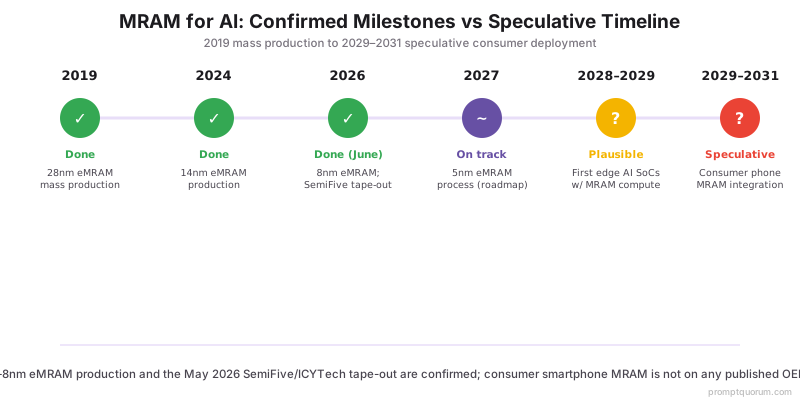
Year | Milestone | Status |
|---|---|---|
| 2019 | Samsung mass-produces eMRAM at 28nm | ✓ Done |
| 2024 | Samsung 14nm eMRAM production | ✓ Done |
| 2026 | Samsung 8nm eMRAM production; SemiFive/ICYTech tape-out | ✓ Done (June 2026) |
| 2027 | Samsung 5nm eMRAM process available (roadmap) | On track |
| 2028–2029 | Potential first edge AI SoCs with MRAM in-memory compute shipping (SemiFive, others) | Plausible but unconfirmed |
| 2029–2031 | Possible consumer smartphone MRAM integration (non-volatile cache or specialized AI die) | Speculative |
Frequently Asked Questions
Is MRAM available to buy now for my PC or phone?
No. MRAM is in production for industrial microcontrollers, automotive chips, and enterprise storage. For consumer AI, it is R&D only. The SemiFive/ICYTech chip is still at tape-out stage — silicon not yet returned or benchmarked. Consumer deployment realistically 3–5+ years away.
Will MRAM replace my GPU's VRAM?
Unlikely in the near term. MRAM excels at low standby power and non-volatility, which matter on battery-constrained edge devices. HBM solves a different problem: maximum bandwidth for data-center training and large-batch inference. For consumer phones and specialized edge AI, MRAM may become a component (embedded cache or accelerator tile). VRAM for a gaming GPU or data-center accelerator will remain HBM or GDDR for the foreseeable future.
What's the difference between in-memory computing and vector database?
Different layers. Vector databases store embeddings and retrieve them by similarity (used in RAG pipelines). In-memory computing performs the neural network's core operation (matrix-vector multiply) inside memory itself, eliminating data shuttling. You could use both together: in-memory compute for the inference engine, vector DB for retrieval.
Can I use TurboQuant compression on my local LLM running today?
Not yet in mainstream inference libraries, but implementations exist. TurboQuant is academic work (ICLR 2026). Ollama, LM Studio, and other consumer-facing tools have not yet integrated it. Check GitHub for community implementations. The core idea — aggressively quantizing KV cache — is reproducible in custom inference code.
Does MRAM work with transformers?
Samsung demonstrated it on classical ML tasks (digit classification, face detection). Transformer-scale inference (7B+ models) in MRAM in-memory compute has not been published. It's plausible but unproven. The SemiFive chip claims 2B-parameter capability; we'll have real benchmarks when silicon returns and ships.
Is MRAM the same as 3D XPoint (Intel Optane)?
No. 3D XPoint was Intel's proprietary storage-class memory technology (now discontinued). MRAM is a different non-volatile memory technology with different physics (magnetic vs phase-change). Both target the same problem space — fast, durable, non-volatile storage — but use different approaches.
How much power does MRAM save compared to DRAM?
For standby (no refresh): MRAM saves ~0.5–1 mW per gigabyte. For active inference with in-memory compute: Samsung's press release claims "substantial" reduction due to eliminating data movement, but Samsung has not disclosed specific quantified savings. The first real quantified numbers come from academic test chips published in 2026 (IEEE JSSC): a 64Mb STT-MRAM near-memory-compute macro reaching 316 TOPS/W and a separate sparsity-adaptive compute-in-memory macro reaching 492.8 TOPS/W. These are lab silicon, not the SemiFive/ICYTech product — commercial silicon numbers will come when that chip ships and is benchmarked independently.
Will MRAM replace DRAM?
Not as main memory in the foreseeable future. MRAM's strengths are non-volatility and zero standby power, which suit embedded caches and low-power edge accelerators. DRAM and HBM still hold decisive advantages in density, bandwidth, and cost per bit — Samsung's HBM4 is in mass production at multi-terabyte-per-second bandwidth, and LPDDR6 pushes 30–35 Gbps per pin for edge devices. The realistic role for MRAM is a complementary non-volatile tile or in-memory-compute unit, not a DRAM replacement.
Did Qualcomm solve the memory bottleneck in 2026?
Qualcomm announced HBC (High-Bandwidth Compute) under its Dragonfly brand at its 2026 Investors Day — a near-memory architecture that stacks a compute accelerator beneath the LPDDR memory using through-silicon vias (TSV), claiming roughly 6x bandwidth-per-watt versus HBM and 200x capacity-per-watt versus SRAM. Microsoft has since confirmed it will deploy HBC on Azure, and Qualcomm has booked orders from Meta and Microsoft for the Dragonfly AI250/AI300 accelerators — real commercial traction for the roadmap, not a shipped product yet. Three distinctions still matter: HBC is near-memory (compute beside memory), not MRAM in-memory computing (compute inside the memory array); it targets data-center AI accelerators, not phones; and first-generation HBC (AI250) commercial sampling is scheduled for mid-2027, with HBC Gen 2 (AI300) targeted for 2028 — so nothing has shipped. It is a different approach to the same memory-wall problem, not an MRAM breakthrough.