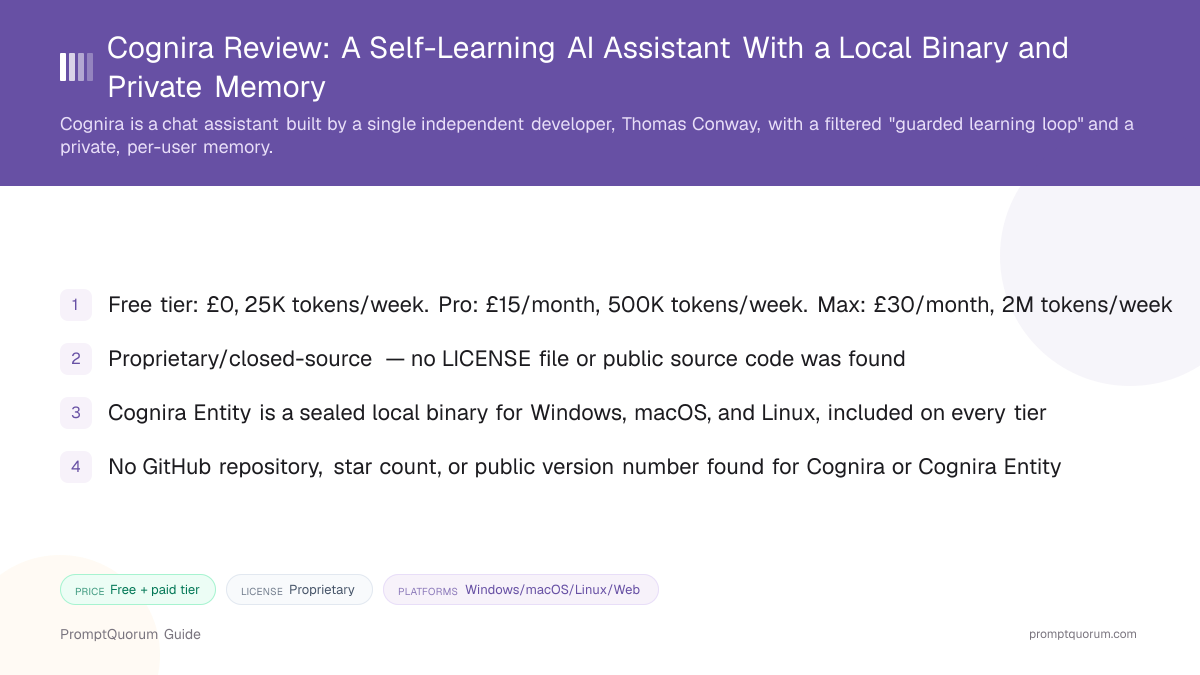
What Is Cognira?
Cognira is made by Thomas Conway, who describes it on cognira.dev as "a solo, independent build, not a lab or a startup with a marketing team." The site arrived as a rebrand of his earlier product, Conway AI (conw.ai), and the move between the two domains was still under way when this review was checked, so expect some pages to change.
- Model: a proprietary 12-billion-parameter model the site calls "Cognira Retrain 12B"
- Two ways to use it: chat in the browser, or the local app described below
- Everything here about the product itself is the vendor's own description; no third party has reviewed it
How Cognira Learns and Remembers
Two mechanisms define the product. Both are described on cognira.dev; neither could be tested independently.
- Guarded learning loop — your corrections and ratings are screened for unsafe or badly formatted content, and any resulting change must pass checks before it goes live. A single conversation cannot alter how the assistant behaves for everyone
- Private memory — tell it a preference, a fact or a word and it is stored straight away. When a later answer draws on that item, the reply names it, and a one-tap "Forget" removes it
- Not offered — plugins, integrations, voice and agent-style actions did not appear anywhere on the site
Local vs. Hosted: What Cognira Entity Actually Is
Cognira Entity is the downloadable app: a sealed binary for Windows, macOS and Linux. Whether it counts as truly local depends on two statements that point in different directions.
- The claim: the site says "inference, memory, and optional weight-level retraining all stay on your disk. Nothing leaves." Taken literally, the model runs on your machine rather than calling a server
- The packaging: Entity sits inside the same weekly-token plans as the hosted chat. That looks more like an account-linked, metered client than an offline tool of the Ollama or LM Studio kind
- The hosted side: the web chat is served from one 16 GB iMac using Apple's MLX framework. MLX belongs to that service only, so Entity is not limited to Apple Silicon
- The gap: the documentation page returned a 404, so nothing public shows whether Entity works with no account and no network
Pricing and Getting Started
Start at cognira.dev by creating an account — even the free plan needs one, and the Entity download appears once you are signed in. Prices are in pounds sterling on the pricing page.
- Every plan includes the full model, private memory and Entity; the allowance is the only difference
- Allowances reset on Mondays and count what you type as well as what the model writes
- Paid plans renew monthly; there is no lifetime option, and no team, enterprise or refund terms were published
Plan | Price | Tokens per week |
|---|---|---|
| Free | £0 | 25K |
| Pro | £15/month | 500K |
| Max | £30/month | 2M |
If the numbers on the live pricing page differ from this table, the live page wins.
What We Could Not Verify
Several things a careful buyer would normally check do not exist publicly, so this review cannot confirm them.
- License: closed-source. No LICENSE file or user agreement was found
- Code: no GitHub repository, so the binary's behavior cannot be inspected
- Version: no version number, changelog or release history for either the chat or Entity
- Model: architecture and training are known only through the vendor's own wording
- Data handling: no independent description of what the hosted service stores or sends
Who Should Use Cognira?
The question is whether a persistent, editable memory is worth trusting to an unaudited product from one person.
A good fit if you
- Are tired of re-explaining your preferences each session
- Are fine with closed software from a solo developer
- Want to try a local app without paying first
Look elsewhere if you
- Need an audited, open-source tool
- Need proven offline use with no account
- Need a vendor with a long track record, since this one has just rebranded
- Want voice, plugins or agent actions
Cognira vs. Other Personal AI Assistants
These are the closest personal-memory assistants in the Local LLM Software Directory.
- Khoj — open-source, with long-term memory and document search over local models; its code can be audited. Khoj review
- Second Me — an open-source effort to train a persistent personal memory model, with a public repository. Second Me review
- Aori — a personal agent aimed at carrying out tasks rather than remembering conversations. Aori review
- Jarvis — a Mac-only assistant from a similarly small team. Jarvis review
Frequently Asked Questions
How do I try Cognira without committing?
Sign up for the free plan, teach it one preference, check that it shows up in your memory list, then download Entity and compare how the two behave.
Can I use Cognira with sensitive or regulated data?
Not on the evidence available: nothing independent describes how the hosted service handles data, so read the vendor's own terms first and keep confidential material out until you have.
Should I pick Cognira or Khoj?
Choose Khoj if you want code you can audit and run yourself; choose Cognira if you would rather have memory working in a browser with no setup and accept a closed product.
How do I check whether Entity really works offline?
Install it, disconnect from the network, and send a message. If it replies, inference is local; if it asks you to sign in or fails, it depends on the account.