What Is Oriveo?
Oriveo's own homepage describes it as a way to "use many AI models from one interface" with API keys you already have, aimed at people who pay for several AI providers and want to stop switching between separate apps for each one.
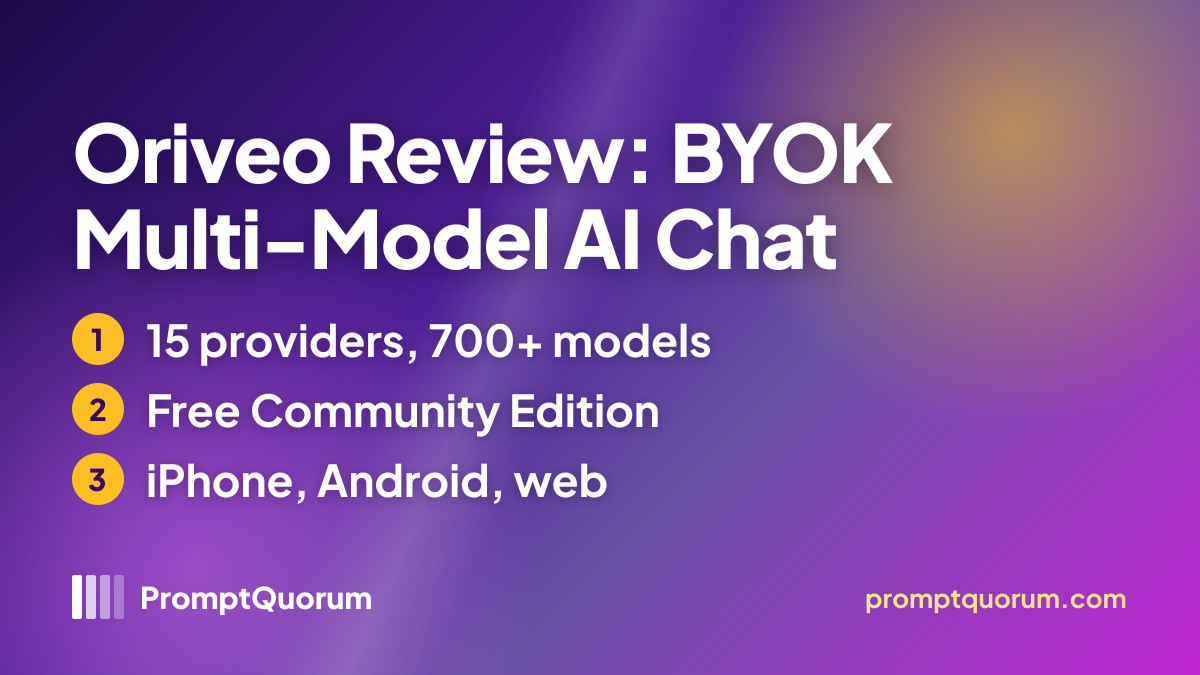
- Add keys from 15 built-in providers, or connect any OpenAI-, Anthropic-, or Gemini-compatible endpoint through a feature called "Relay" — together these surface 700+ models in one picker, per the homepage
- The three clients (iOS, Android, web) share one codebase, built from SwiftUI/GRDB, Jetpack Compose/Room, and Next.js/React respectively, per oriveoai.com/open-source
- Oriveo states on its own homepage that it is independent and "not affiliated with or endorsed by" OpenAI, Anthropic, Google, or the other model providers it connects to
- Oriveo runs no AI model of its own — it is a client that calls whichever provider API, Oriveo-managed model, or local server you point it at; see How Oriveo Works below
License, Editions, and Pricing
Per oriveoai.com/open-source and oriveoai.com/pricing, checked 2026-11-18, Oriveo separates two different questions that are easy to conflate: which edition of the client you run, and how you pay for the AI requests it sends.
- Community Edition (free, open source): licensed AGPL-3.0-or-later, source at github.com/oriveo/oriveo. Per its own comparison table, it is the full client — BYOK chat, Relay and local-model-server connections, notes/folders/Skills/attachments, on-device spend tracking — minus an Oriveo account, cross-device cloud sync, Usage Insights/budget alerts, any model Oriveo itself pays for, and analytics/crash reporting
- Official app, Free plan ($0, forever): the commercial build of the same client code. Includes BYOK, Relay, and both AI-usage paths below, plus 2 custom assistants/chat folders/pinned chats each; no cloud sync, no Usage Insights
- Official app, Pro ($9.99/month or $59.99/year) and Lifetime ($149.99 one-time): software entitlements only — 20 GB cross-device cloud sync, 50 MB attachments (vs. 25 MB on Free), unlimited custom assistants/folders/pinned chats, Usage Insights with budget alerts, and a larger Library allowance. None of the three plans include AI usage itself
- Oriveo Free (AI usage, no account): a daily allowance routed to free, open-source models via OpenRouter, available on every plan including no account at all
- Oriveo AI (AI usage, paid, managed): a separate service requiring sign-in, with 3 free requests per week; further usage draws from a prepaid "AI Balance" billed at each model's list price with no added markup from Oriveo
- BYOK (AI usage, your own keys): bring keys from the 15 built-in providers or any OpenAI-compatible endpoint via Relay — the provider bills you directly, with 0% markup from Oriveo, and this path works on every plan, including the free Community Edition
- No company name, registered address, or headquarters is published on any page checked for this review — the privacy policy's only related line directs readers to email the company for "the applicable operating entity and mailing information"
How Oriveo Works
Per oriveoai.com/faq and oriveoai.com/open-source, checked 2026-11-18, Oriveo is a routing client: every request leaves the app for either a cloud provider, an Oriveo-managed model, or a server on your own network.
- Cloud providers (BYOK or Oriveo AI) — the default path for the 15 built-in providers and the managed "Oriveo AI" models
- Relay — connects any additional OpenAI-, Anthropic-, or Gemini-compatible HTTP endpoint, which is also how a self-hosted inference server reachable over the internet can be added manually
- Local servers on your own network — per the FAQ, Oriveo does not run models on the phone itself; instead it connects to llama.cpp, Ollama, LM Studio, vLLM, or Open WebUI already running on your own computer. iOS and Android find these servers automatically over mDNS on the same Wi-Fi network, and the FAQ states those local calls carry no credentials
- Memory — a plain-text list of remembered facts the user can read, edit, or turn off entirely, per the homepage
- Notes, folders, Skills, and attachments — organizational features available in every edition, including the free Community Edition, per the open-source comparison table
Get Oriveo
The easiest way to try Oriveo needs no installation at all: open app.oriveoai.com in a browser, which supports a no-account guest mode. Native iPhone and Android apps, and the open-source Community Edition, are also available.
Option | How to get it |
|---|---|
| Open in the browser (no install) | app.oriveoai.com — works in guest mode, no account needed |
| iPhone | App Store |
| Android | Google Play |
| macOS | Stated as "in development" on the download page; not yet released |
| Community Edition (build from source) | github.com/oriveo/oriveo — see README for build steps, no prebuilt binaries |
| Website | oriveoai.com |
| Privacy policy | oriveoai.com/privacy |
The official app is currently version 1.5.0, per its own changelog, checked 2026-11-18. The GitHub repository's Releases tab is behind this — its latest tagged release is v1.1.0 (September 23, 2026) — but the main branch itself has commits as recent as November 12, 2026, so the Community Edition's source is actively developed even though its own version tags lag the official app's number. Building the Community Edition from source requires a working Node.js, Xcode, or Android SDK toolchain — this is a developer setup, not a one-click install.
Privacy: What Stays On Your Device
Per oriveoai.com, checked 2026-11-18, Oriveo's default data model keeps most things local, with sync as an opt-in extra available only on the paid official app.
- API keys are stored locally on-device or in-browser by default and are not saved as account records; the homepage notes some web BYOK, Relay, or compatibility paths may pass a key through Oriveo's own routing only to complete the selected request
- Chats stay on-device unless cloud sync is explicitly turned on, which is a Pro/Lifetime-only option
- Guest mode works with no account on both the web app and, per the homepage, more broadly across the product
- Calls to a local model server on your own network carry no credentials, per oriveoai.com/faq
- Analytics and crash reporting are off entirely in the Community Edition, per oriveoai.com/open-source; the web client's bundled Sentry error-reporting code stays inactive unless the person running it supplies their own Sentry DSN
Who Should Use Oriveo?
Whether Oriveo fits depends mainly on whether you already have (or want) your own provider API keys, and whether the Community Edition's missing account/cloud-sync layer is an acceptable trade-off for paying nothing.
Use Oriveo if
- You already pay for two or more AI providers and want one app, on your phone and the web, to switch between their models without separate logins
- You want to try a large catalog of models for free before committing, via the no-account Oriveo Free allowance or a guest-mode web session
- You sometimes want to point the same chat client at a model already running on your own computer instead of a cloud provider
- You are comfortable with a free client that has no account and no cross-device sync, in exchange for a fully open Community Edition
Wait, or look elsewhere, if
- You need fully offline, on-device model inference — Oriveo itself runs no model; every answer comes from a cloud provider, an Oriveo-managed model, or a server you run separately
- You need cross-device cloud sync or spending-insight dashboards without paying — those are Pro/Lifetime-only
- You need a stated company name, headquarters, or jurisdiction behind the product — none is published on any page this review checked
- You want a macOS app today — it is listed only as "in development," per the official download page
Oriveo vs. Other Multi-Model Chat Clients
Oriveo sits in a crowded field of bring-your-own-key chat clients that let a user plug in their own provider keys instead of subscribing to one company's models. Here is how it compares to others covering the same ground — see the Local AI Directory for the full catalog.
- AnyLLM — an Android-only BYOK chat app with a freemium in-app-purchase model; unlike Oriveo it has no desktop/web client and no open-source edition. See the AnyLLM review.
- Solair AI — a free, iOS-only BYOK chat app; narrower in platform reach than Oriveo's iPhone/Android/web spread and, unlike Oriveo, has no published open-source Community Edition. See the Solair AI review.
- Msty — a freemium desktop (Mac/Windows/Linux) app that combines BYOK cloud providers with built-in local-model support; unlike Oriveo it has no iPhone/Android client at all. See the Msty review.
- LibreChat — a free, fully open-source, self-hosted web chat client supporting many providers; unlike Oriveo, LibreChat has no native mobile apps and requires the user to run and maintain a server, with no managed-hosting tier of its own. See the LibreChat review.
Frequently Asked Questions
Is the Oriveo Community Edition a limited trial of the real app?
No, it is the same client code as the official app. Unlike the App Store or Google Play builds, though, the Community Edition ships no prebuilt binary — you build it yourself from source (Node.js for web, Xcode for iOS, the Android SDK for Android).
Does the Community Edition include Oriveo Free or Oriveo AI model access?
No. Those two hosted-model paths are models Oriveo itself pays for, which the open-source comparison table excludes from the Community Edition; the Community Edition covers BYOK, Relay, and local-server connections only.
Do I have to pay anything just to use Oriveo?
No. The official app's Free plan costs nothing and already includes bring-your-own-key access and the no-account daily model allowance; the paid tiers only add cloud sync and usage dashboards, not model access itself.
Is Oriveo affiliated with OpenAI, Anthropic, or Google?
No. Oriveo states on its own homepage that it is independent and not affiliated with or endorsed by OpenAI, Anthropic, Google, or any other model provider it connects to.