What Is Msty?
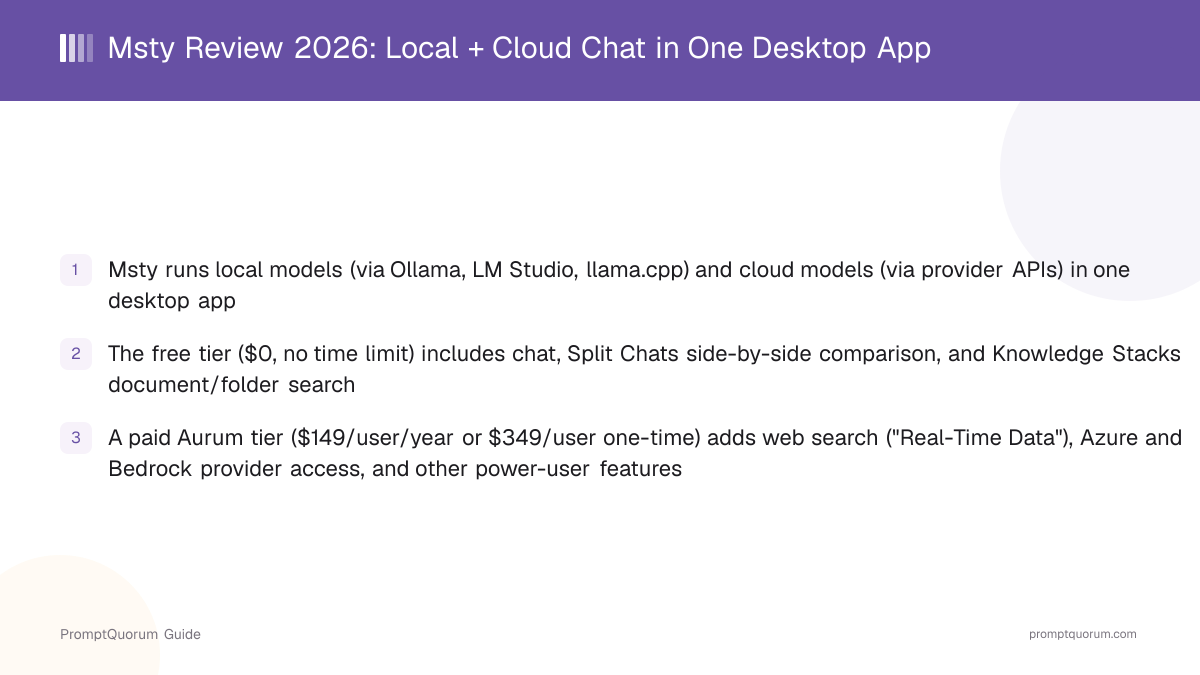
Msty is a desktop chat application built to run local and cloud AI models from the same interface. You can connect it to a local model server such as Ollama, LM Studio, or llama.cpp, and separately connect cloud provider API keys (for example, OpenAI), then chat with either — or both — without switching apps. The company's official site now calls the product "Msty Studio" and frames it as a "private AI workspace," one of four products under the Msty name.
- Core function: a chat interface that talks to local model runtimes and cloud provider APIs from one window
- Positioning, per Msty's own site: "Privacy first" (the company states the app works without product telemetry), "Local choice" (use local or online models as needed), and "Your control" (models, credentials, and files stay within boundaries the user manages)
- Developer: CloudStack, LLC, led by Ashok Gelal (co-founder and CEO) and Adam Miedema (COO), per msty.ai/about
- Current branding: "Msty Studio" is one of four products — Studio (the chat workspace this review covers), Go (a separate autonomous-agent app), Nexus (a model routing/gateway layer), and Stack (a knowledge-governance layer marked "coming soon" as of this review)
- The historical domain msty.app now redirects to msty.ai — both refer to the same company and product line
Msty's Project History and Version Milestones
Msty shipped its first public version, 0.0.1, on January 3, 2024, with basic chat, organization, and model-configuration features, according to the official changelog. The project added its now-signature features in quick succession over the following months, then continued shipping updates through 2025 and into the current Msty Studio branding.
- 1v0.0.1 — January 3, 2024: Initial release
Why it matters: The first public build: basic chat, conversation organization, and model configuration. - 2v0.3 — March 2024: Linux support and vision model support
Why it matters: Msty expanded from an initial platform base to Linux, and added support for vision-capable local models. - 3v0.6 — March 30, 2024: Split chat and conversation branching
Why it matters: This introduced the ability to branch conversations and save layout presets — the feature that grew into what Msty now calls Split Chats. - 4v0.7 — April 15, 2024: Prompts Library overhaul
Why it matters: Added organized prompt categorization, search, and context-relevant suggestions — the basis of today's Prompts Library. - 5v0.8 — May 20, 2024: Knowledge Stacks (RAG)
Why it matters: Introduced retrieval-augmented generation: users could create multiple Knowledge Stacks from uploaded documents and folders, with citation tracking. - 6v1.0 — July 9, 2024: Real-Time Data and search
Why it matters: Added web-search grounding ("Real-Time Data") and in-app search, alongside continued Knowledge Stacks development. - 7v1.8 — March 12, 2025: Full-text search, Mermaid diagrams, Claude 3.7 thinking support
Why it matters: Added full-text search across chats, modular rendering with Mermaid diagram support, and support for Claude 3.7's extended-thinking output, plus customizable chat width. - 8v1.9 — April 28, 2025: RTL language support and expanded model support
Why it matters: Added right-to-left language rendering, GPU handling improvements, more syntax-highlighted languages, and support for newer cloud models including GPT-4.1 and the o3/o4-mini family. - 9Studio 2.9.6 — current build referenced on the official download page
Why it matters: The most recent build noted by Msty adds Nexus Smart Route image support and more reliable YouTube transcript imports, reflecting the app's integration with the newer Msty Nexus routing layer.
What Can You Do With Msty?
Msty's feature set centers on one idea: put local models, cloud models, your own documents, and reusable prompts in the same chat surface. Here is what each named feature actually does, per Msty's own product page.
- Model Choice — connects local inference engines (MLX, llama.cpp, Ollama) and hosted cloud providers "in one organized hub," so you are not locked into a single backend
- Split Chats — runs two or more models side by side on the same prompt so you can compare tone, depth, and accuracy without losing conversation context
- Knowledge Stacks — Msty's RAG (retrieval-augmented generation) feature: point it at documents, notes, or folders and it retrieves relevant source chunks to ground its answers, with citations back to the source
- Agent Mode — lets a chat move beyond single prompt/response turns into multi-step, tool-aware execution for a defined task
- Crew Conversations — brings multiple configured "persona" assistants into a single thread so they can respond to the same conversation from different angles
- Media Studio — generates images and drafts video concepts from within the same app, rather than through a separate tool
- Prompts Library (also called Prompt Studio in current documentation) — roughly 230 installable default prompts plus the ability to create, organize, and import custom prompts
- Real-Time Data — optional web-search grounding via Google, Brave, or Ecosia, with query customization, domain restriction, and date filtering; this is gated to the paid Aurum tier, not included free
Usage Examples: Three Ways to Use Msty
These are concrete workflows built from Msty's documented features above — not hypothetical use cases.
Compare a local model and a cloud model on the same question
Connect a local model through Ollama (for example, a Llama or Qwen model you already have pulled) and a cloud model through your OpenAI API key. Open a Split Chats layout, send the same prompt to both, and read the two responses side by side. This is useful for deciding whether a task genuinely needs a larger cloud model or whether a local model already handles it — without re-typing the prompt twice.
Chat with a folder of documents using Knowledge Stacks
Point a Knowledge Stack at a folder of PDFs, Markdown files, or Word documents — Msty's documented supported formats include PDF, .docx, RTF, Markdown, TXT, CSV, JSON, JSONL, and EPUB, plus Obsidian vault import and bulk folder import. Ask questions about the content and Msty retrieves the relevant chunks and cites which source they came from, rather than requiring you to re-paste content into the chat manually.
Build a reusable prompt for a repeated task
If you run the same kind of request often — say, summarizing meeting notes into action items — save it as a custom prompt in the Prompts Library instead of retyping instructions each time. You can also start from one of Msty's roughly 230 built-in prompts and adjust it, rather than writing a template from scratch.
Download Msty for macOS, Windows, and Linux
Msty is available on macOS, Windows, and Linux, with separate builds for Apple Silicon and Intel Macs. Direct download links below are from the official Msty Studio download page — always verify against that page directly, since build URLs can change between releases.
Platform | Requirement | Download |
|---|---|---|
| macOS (Apple Silicon) | macOS 11+, M1/M2/M3/M4 | .dmg (arm64) |
| macOS (Intel) | macOS 11+, Intel | .dmg (x64) |
| Windows | Windows 10/11 (x64) | .exe (x64) |
| Linux (AppImage) | x64 | .AppImage (x64) |
| Linux (.deb) | Debian/Ubuntu (x64) | .deb (amd64) |
No hardware minimum beyond the OS versions above is published on the download page itself — actual usability depends entirely on which local model you choose to run alongside Msty, since Msty is the chat interface, not the model runtime. A small local model needs far less RAM/VRAM than a large one; check your chosen model's own requirements separately.
Msty Pricing: Free vs. Aurum
Msty's free tier costs $0 with no time limit, and covers most of what makes the app distinctive. A paid tier called Aurum unlocks web search and a handful of additional integrations. Figures below are from the official Msty pricing page.
Free
- Price:
- $0 forever
- Includes:
- Local + online model chat / Split Chats & Crew Conversations / Agent Mode / Knowledge Stacks / Prompt, Persona, Skill & Media Studios
Aurum (annual)
- Price:
- $149/user/year
- Includes:
- Everything in Free + Msty Studio Web / Azure & Bedrock providers / Studio Assistants / Shadow Personas / Real-Time Data (web search) / Turnstiles, Insights, Forge Mode
Aurum Lifetime
- Price:
- $349/user one-time
- Includes:
- Everything in Aurum + lifetime updates and access (no recurring payment)
Enterprise & Teams
- Price:
- Custom ("Talk to us")
- Includes:
- Team/role management, SSO, audit logging, shared resources / minimum 5 seats
Msty is genuinely freemium, not fully free: the free tier is substantial (it includes Knowledge Stacks and Agent Mode), but web search ("Real-Time Data") and several enterprise-oriented integrations sit behind the paid Aurum tier. Prices are quoted in USD directly from Msty's pricing page — Msty does not publish separate region-specific pricing, so this review does not convert to other currencies.
Msty vs. Msty Go: Which One Do You Want?
Msty and Msty Go are two different products from the same company, CloudStack, LLC — not two names for the same app. Msty (Msty Studio) is a chat interface: you talk to local or cloud models, compare them side by side, and ground answers in your own documents. Msty Go is a task-automation agent: you give it a goal, it works through a multi-step task autonomously within tools and folders you scope, and you review a structured result afterward.
Aspect | Msty (Studio) | Msty Go |
|---|---|---|
| Product type | Desktop chat app | Task-automation agent |
| Primary interaction | Conversational chat, side-by-side comparison | Goal-driven autonomous task execution |
| Output | Chat responses | Structured task outcomes |
| Pricing | Free tier + $149/yr or $349 one-time Aurum | Free beta; team/enterprise pricing not published |
| Mobile app | Not part of the core product per this review | Dedicated end-to-end encrypted iOS/Android app for remote monitoring |
If you want a chat interface for local or cloud models — with side-by-side comparison and document search — Msty (Studio) is the relevant product, and it is what this review covers. If you want an agent that works through a multi-step task on its own and reports back a result, see the dedicated Msty Go review instead.
Who Should Use Msty?
Whether Msty fits depends on whether you want one app for both local and cloud chat, and whether the free tier already covers what you need.
Use Msty if
- You want to chat with both a local model (via Ollama, LM Studio, or llama.cpp) and a cloud model without switching apps
- You want to compare two models' answers to the same prompt side by side, using Split Chats
- You want to ask questions over your own documents or folders locally, using Knowledge Stacks
- You want a free tier that already includes RAG and Agent Mode, rather than gating those behind a paywall
- You are comfortable with a closed-source desktop app, rather than requiring the application itself to be open source
Wait, or look elsewhere, if
- You specifically need built-in web search grounding without paying — Real-Time Data is an Aurum-tier (paid) feature in Msty, not free
- You need the chat client's source code to be open — Msty's application itself is closed-source; only peripheral documentation and tooling repositories are public
- You are looking for an autonomous multi-step task agent rather than a chat interface — that is Msty Go, a separate product from the same company (see the comparison above)
- You need a strictly local-only tool with no cloud provider option at all — Msty is local-first, not local-only, and cloud provider connections are a core part of the app
Msty vs. Other Local Chat Apps
Msty is one of several desktop apps that combine local and cloud model chat with a consumer-friendly interface. Here is how it sits next to other options in that space — see the Local LLM Software Directory for the full catalog.
- LM Studio — a local-model-focused chat and model-management app with a built-in model browser; unlike Msty, its primary focus is local inference rather than a local+cloud hybrid workflow. See the LM Studio vs. Jan vs. GPT4All comparison for how it stacks up against other local-only clients.
- Jan — an open-source, local-first chat app built around running models entirely on-device, with optional cloud provider connections; a more open-source-oriented alternative to Msty's closed-source app.
- GPT4All — an open-source local chat client from Nomic AI, focused on running models fully offline with a simpler feature set than Msty's Knowledge Stacks/Agent Mode/Media Studio bundle.
- AnythingLLM — a document-chat and RAG-focused app that overlaps with Msty's Knowledge Stacks feature specifically; see the AnythingLLM vs. PrivateGPT vs. Open WebUI RAG comparison for a deeper look at RAG-focused tools.
- Enchanted — an open-source native Mac/iOS client built specifically for Ollama, narrower in scope than Msty but native to Apple platforms.
- BoltAI — a macOS/Windows AI assistant app with deep OS-level integration (system-wide shortcuts, app integrations) alongside local and cloud model support, a different emphasis than Msty's chat-workspace focus.
- Open WebUI — a self-hosted, browser-based chat interface typically run alongside Ollama; unlike Msty, it is open source and deployed as a web app rather than a native desktop client.
- Chatbox — a cross-platform (including mobile) chat client supporting multiple cloud providers and local models via Ollama, comparable in scope to Msty but with a different feature emphasis (no Knowledge Stacks/Agent Mode equivalent as of this review).
Common Mistakes When Evaluating Msty
Most confusion about Msty comes from its rebrand and product family, or from assuming free-tier limits that do not actually apply.
Mistake 1: Assuming "Msty" and "Msty Go" are the same app
They are separate products from the same company. Msty (Studio) is a chat app; Msty Go is a task-automation agent. Downloading one expecting the other's functionality will be confusing — see the comparison section above.
Mistake 2: Assuming the free tier is a limited trial
Msty's free tier is $0 with no stated time limit, and includes Knowledge Stacks and Agent Mode — features some competitors gate behind a paywall. Paid Aurum tiers add web search and specific enterprise-oriented integrations, not core chat functionality.
Mistake 3: Expecting web search to work without paying
Real-Time Data, Msty's web-search grounding feature, is an Aurum-tier (paid) feature, not part of the free plan. If web search is a requirement, budget for the $149/year or $349 one-time tier.
Mistake 4: Assuming "local-first" means the app itself is open source
Msty supports local model inference and states a privacy-first, no-telemetry design, but the application itself is closed-source — only documentation, prompt-library, and translation repositories are public on CloudStack's GitHub. If open-source source code is a requirement, consider Jan or GPT4All instead.
Frequently Asked Questions
What is Msty?
Msty (msty.app, now msty.ai) is a desktop chat app that runs local models — via Ollama, LM Studio, or llama.cpp — and cloud models from provider APIs in the same window. The company now brands the product "Msty Studio."
Is Msty free?
Yes, for its core functionality. Msty's free tier costs $0 with no stated time limit and includes local and online model chat, Split Chats comparison, Knowledge Stacks (RAG), and Agent Mode. A paid Aurum tier ($149/user/year or $349/user one-time) adds web search and a handful of additional providers/features.
Is Msty the same as Msty Go?
No. Msty (Studio) is a chat app. Msty Go is a separate, newer product from the same company, CloudStack, LLC, built for autonomous multi-step task automation rather than chat. See the dedicated Msty Go review for that product specifically.
Does Msty work with local models only, or cloud models too?
Both. Msty connects to local inference engines (Ollama, LM Studio, llama.cpp, MLX) and to cloud providers through your own API keys, in the same app. Msty describes this as local-first, not local-only.
What platforms does Msty support?
macOS (separate builds for Apple Silicon and Intel), Windows 10/11 (x64), and Linux (AppImage and .deb packages), per the official download page.
What is Msty's Split Chats feature?
Split Chats runs two or more models side by side on the same prompt so you can compare their tone, depth, and accuracy without losing conversation context — useful for deciding whether a local model is sufficient for a task or a larger cloud model is needed.
What is a Msty Knowledge Stack?
A Knowledge Stack is Msty's retrieval-augmented generation (RAG) feature: you point it at documents, notes, or folders (supported formats include PDF, .docx, Markdown, TXT, CSV, JSON, EPUB, and Obsidian vaults), and it retrieves relevant source chunks to ground chat answers, with citations back to the source.
Is Msty open source?
The Msty application itself is closed-source. CloudStack, LLC (the company behind Msty) publishes some peripheral repositories publicly on GitHub — documentation, a community prompt-submission repo, and translation files — but not the application's own source code.
Does Msty include web search?
Web search grounding, called Real-Time Data in Msty's documentation, is included only in the paid Aurum tier — it is not part of the free plan.
Who makes Msty?
Msty is developed by CloudStack, LLC, led by Ashok Gelal (co-founder and CEO) and Adam Miedema (COO), per the company's about page.
When did Msty first launch?
Msty released its first public version, 0.0.1, on January 3, 2024, per the official changelog. It has since added Knowledge Stacks (May 2024), Real-Time Data (July 2024), and continued updates through the current Msty Studio branding.