What Is PocketPal AI?
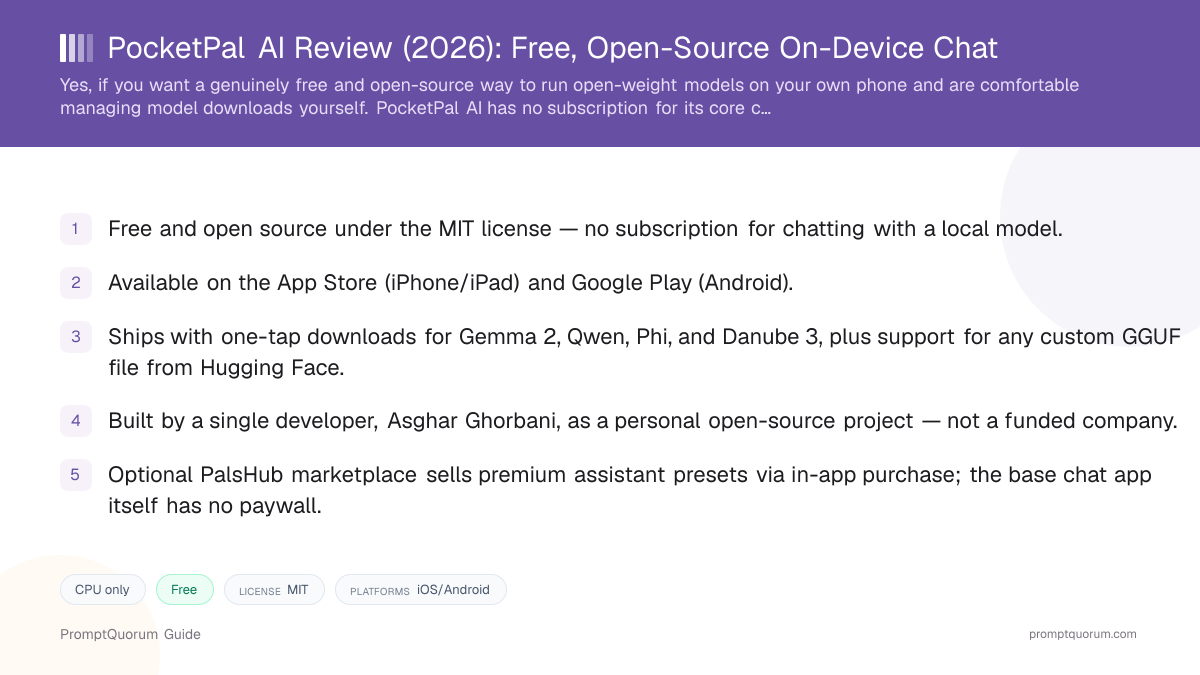
PocketPal AI is a mobile app that downloads open-weight language models in the GGUF format and runs them locally on an iPhone, iPad, or Android device, using llama.cpp as the inference engine. The app itself is built with React Native and is MIT-licensed, meaning the full source code is public and free to inspect, fork, or modify.
Unlike apps that lock users into a fixed, curated model list, PocketPal AI lets you pick from a set of models the app can fetch in one tap, or import any GGUF file you find on Hugging Face — including gated models you have accepted the license terms for. That flexibility is the app's defining trait: it behaves more like a general-purpose GGUF runtime with a chat UI than a single-vendor product.
Who Built PocketPal AI?
PocketPal AI was created by Asghar Ghorbani, who started it as a personal side project to run small language models on his own phone before open-sourcing it once it attracted outside interest. Ghorbani wrote about the project's origin and motivation in a Medium post, "PocketPal AI: Tiny LLMs in the Pocket", describing the goal as putting the power of small language models directly in his pocket.
The project is maintained in the developer's spare time rather than by a funded company or dedicated team — the repository's own setup documentation notes this directly, which is worth knowing before expecting enterprise-grade support response times. The GitHub repository (a-ghorbani/pocketpal-ai) has accumulated over 8,000 stars and more than 850 forks at review time, and it continues to receive regular releases covering new model support, UI changes, and feature additions such as internet search integration, chat pinning, and export to Markdown.
- Developer: Asghar Ghorbani (GitHub: a-ghorbani), working independently rather than as a company.
- Started as a personal project to run small language models on-device; open-sourced after gaining public interest.
- License: MIT — permissive open source, free to use, fork, and modify.
- Over 8,000 GitHub stars and more than 850 forks at review time, with an active issue tracker and pull request history.
- Development pace: frequent point releases adding model-runtime updates, new UI features, and expanded language support, maintained on a volunteer basis.
How to Get Started with PocketPal AI
Getting a working local chat in PocketPal AI takes four steps after installing the app, per the project's own getting-started documentation. There is no account creation or sign-in step — the entire flow happens on-device.
- 1Install the app
Why it matters: Download PocketPal AI from the [App Store](https://apps.apple.com/us/app/pocketpal-ai/id6502579498) on iPhone/iPad or [Google Play](https://play.google.com/store/apps/details?id=com.pocketpalai) on Android. No account or email sign-up is required to open the app. - 2Open the Models page
Why it matters: Navigate to the Models tab from the app menu to see the list of quick-download models (such as Gemma 2, Qwen, Phi, and Danube 3) and the option to import a custom GGUF file. - 3Download a model
Why it matters: Pick a model sized for your device's RAM (see the hardware section below) and download it. Larger, more capable models take longer to download and use more on-device storage. - 4Load the model and start chatting
Why it matters: Tap "Load" to bring the downloaded model into memory, then switch to the Chat page. Once loaded, all inference happens on-device — PocketPal AI's "Auto Offload/Load" feature can automatically unload the model when the app is backgrounded to save memory, then reload it when you return.
Which Models Does PocketPal AI Support?
Gemma 2
- Access method:
- One-tap quick download in-app
- Typical use case:
- General chat; Google's open-weight model family
Qwen
- Access method:
- One-tap quick download in-app
- Typical use case:
- General chat and reasoning; Alibaba's open-weight model family
Phi
- Access method:
- One-tap quick download in-app
- Typical use case:
- Compact reasoning; Microsoft's small-model family
Danube 3
- Access method:
- One-tap quick download in-app
- Typical use case:
- Lightweight chat; H2O.ai's small-model family
Any other GGUF model
- Access method:
- Manual import via Hugging Face Hub search inside the app, including gated models after accepting license terms
- Typical use case:
- Custom or niche models not in the quick-download list
Is PocketPal AI Available on iPhone and Android?
iPhone / iPad
- Availability:
- Available on the App Store
- Notes:
- Uses Apple's Metal GPU API for acceleration by default; this can be disabled in-app if it causes stability issues on a given device.
Android
- Availability:
- Available on Google Play
- Notes:
- Recent releases restored a Qualcomm Hexagon NPU acceleration backend for compatible chipsets, in addition to standard CPU inference.
Mac / Windows / Linux
- Availability:
- No desktop release found at review time
- Notes:
- PocketPal AI is a mobile-only app. Desktop users who want a local GGUF chat client should look at Ollama, LM Studio, or Jan AI instead.
How Much Does PocketPal AI Cost?
PocketPal AI is free to download and free to use for chatting with a locally downloaded model — there is no subscription, and the source code is public under the MIT license. The only paid component found in the app is PalsHub, an in-app marketplace where community members can publish and sell premium "Pals" (customizable assistant presets); PalsHub in-app purchases are available on the iOS and Android app depending on region.
Because the app and its model-running functionality are open source and free, the only ongoing cost to the user is the storage space and bandwidth needed to download GGUF model files — a 3–4B parameter quantized model is typically a few gigabytes, and larger models are proportionally bigger.
- Base app: Free, no subscription, MIT-licensed open source.
- Chatting with downloaded models: Free — no per-message or per-token charge, since inference runs on your own device.
- PalsHub marketplace: Optional in-app purchases for premium community-made assistant presets; the base chat functionality does not require this.
- Storage cost: Not monetary, but real — each downloaded GGUF model consumes device storage, typically several gigabytes per model.
What Features Does PocketPal AI Have?
Beyond basic local chat, PocketPal AI has grown a set of features common to more mature local-AI apps, added incrementally across its release history. These include:
- Pals and PalsHub. "Pals" are customizable assistant presets (system prompt, model, and behavior bundled together); PalsHub is a marketplace where users can share or sell their own Pals.
- Talents (tool-calling). The app supports an agent-style flow where a model can invoke defined tools mid-conversation rather than only generating plain text.
- Internet search in chat. Recent releases let a chat search the web using a user-supplied API key from providers such as Brave, Tavily, or Exa — this is optional and requires the user's own key, not a bundled search service.
- Text-to-speech output. The app can read responses aloud, with support expanding across dozens of languages in recent releases.
- Chat pinning and Markdown export. Conversations can be pinned for quick access and exported as Markdown files.
- Speculative decoding (experimental). A smaller "draft" model can be paired with a larger model to speed up generation — flagged by the project itself as an experimental feature, not a stable guarantee.
- Benchmarking tools. The app includes a way to benchmark model performance on the current device, useful for comparing how different quantization levels perform on your specific phone.
What Hardware Do You Need to Run PocketPal AI?
The model you pick, not the app itself, sets your real hardware floor — as a general rule for GGUF models on phones, a quantized 2–4B parameter model needs roughly 3–4 GB of free RAM, while a 7–8B parameter model needs 6–8 GB or more. This is standard local-LLM sizing guidance, not a PocketPal-specific benchmark; PromptQuorum has not independently benchmarked PocketPal AI's exact memory usage per model.
On iPhone and iPad, the app uses Apple's Metal GPU API by default, which generally improves inference speed over CPU-only execution on Apple Silicon devices. On Android, recent releases added support for a Qualcomm Hexagon NPU acceleration backend on compatible chipsets; devices without a supported NPU fall back to CPU inference, which is markedly slower for larger models.
- Small models (2–4B parameters, quantized): usable on most phones from the last few years with 4 GB+ of free RAM.
- Mid-size models (7–8B parameters, quantized): recommended device RAM of 8 GB or more for acceptable responsiveness.
- Storage: budget several gigabytes of free device storage per downloaded model file.
- Faster inference: an Apple Silicon iPhone/iPad (Metal acceleration) or a recent Android device with a supported Qualcomm Hexagon NPU will outperform older or budget hardware running CPU-only.
Who Should Use PocketPal AI
- Privacy-conscious users who want zero subscription cost. If the goal is running an open-weight model with no ongoing fee and no account, PocketPal AI's MIT-licensed, free core app is a direct fit.
- Users who want to try models beyond a fixed curated list. Because the app can load any GGUF file from Hugging Face — not just its quick-download shortlist — it suits people who already have a specific model in mind.
- Developers and technically curious users comfortable with open-source projects. The public GitHub repository, issue tracker, and frequent releases suit users willing to read release notes or file an issue rather than expect dedicated customer support.
- Users who want to inspect or modify the code themselves. The MIT license permits forking and modification, which matters to anyone who wants to audit exactly what the app does before trusting it with private conversations.
Who Should Not Use PocketPal AI
- Users who want a fully guided, zero-configuration experience. Picking the right model size for your device and managing downloads yourself is part of the workflow; users who want the app to make that decision for them may prefer a more curated app like Loci.
- Users who need Mac, Windows, or Linux support. PocketPal AI is mobile-only (iPhone/iPad and Android); desktop users should look at Ollama, LM Studio, or Jan AI instead.
- Users who want the most demanding models (70B+ parameters). Phone hardware, even flagship devices, cannot practically run models at that scale locally — those workloads need a desktop, workstation, or cloud API regardless of which mobile app is used.
- Users who expect dedicated commercial support. PocketPal AI is maintained by one developer in spare time, per the project's own documentation; users who need guaranteed response times or enterprise support agreements should look at a commercially backed alternative.
- Users who want built-in cloud sync across devices. Because inference and chat history are local to each device by design, PocketPal AI does not offer a built-in account-based sync between an iPhone and an Android device the way a cloud-backed chat app would.
PocketPal AI vs. Alternatives
PocketPal AI
- License / cost:
- Free, open source (MIT)
- Platforms:
- iPhone/iPad, Android
- Model flexibility:
- Quick-download shortlist (Gemma 2, Qwen, Phi, Danube 3) plus any GGUF file from Hugging Face
Articles about PocketPal AI (9)
- Best Local AI Apps for iPhone in 2026 (Run LLMs Without WiFi)Updated October 23, 2026
- Loci AI Review (2026): Offline AI for iPhone, Android, iPad, Mac and WindowsUpdated October 23, 2026
- Private LLM Review: On-Device AI Chat for iPhone, iPad, and MacUpdated October 23, 2026
- Run a Local LLM on Your Tablet: iPad Pro M5, Galaxy Tab S10, OnePlus Pad 2 (2026)Updated October 23, 2026
- Best Local LLM Apps for Android in 2026: 6 Apps Compared on Real PhonesUpdated October 19, 2026
- Best Mobile LLM Models for Phones in 2026: Phi-4 Mini vs Gemma 3 vs SmolLMUpdated October 19, 2026
- Local AI Chat Pocket Review: Offline LLM and Image Chat for iPhone and iPadUpdated October 6, 2026
- PAIOS Review: Offline Gemini Nano Chat for AndroidUpdated October 5, 2026
- Oscilla Review: Free On-Device AI Chat for iPhoneUpdated October 4, 2026
+36 more not shown
Loci
- License / cost:
- Free tier plus paid tiers; closed source
- Platforms:
- iPhone/iPad/Android/Mac/Windows (5 platforms)
- Model flexibility:
- Curated library (~10 models); cannot import custom GGUF files
Private LLM
- License / cost:
- Paid, one-time purchase; closed source
- Platforms:
- iPhone/iPad/Mac (Apple only)
- Model flexibility:
- 140+ models, with OmniQuant and GPTQ quantization formats
Articles about Private LLM (10)
- Private LLM Review: On-Device AI Chat for iPhone, iPad, and MacUpdated October 23, 2026
- Best Local AI Apps for iPhone in 2026 (Run LLMs Without WiFi)Updated October 23, 2026
- Loci AI Review (2026): Offline AI for iPhone, Android, iPad, Mac and WindowsUpdated October 23, 2026
- Local Chat Apps & Assistants Compared (2026): Desktop, Mobile, Self-Hosted, Assistants and RoleplayUpdated September 20, 2026
- AI on Device Review: A $4.99 Apple Intelligence-Only AppUpdated September 12, 2026
- Google AI Edge Gallery Review: Gemma 4 On-Device Chat for iPhoneUpdated September 12, 2026
- Liquid Apollo Review: On-Device LFM2 Chat, Plus Optional CloudUpdated September 12, 2026
- Noema Review: Multi-Format Local AI for iPhone, iPad, and MacUpdated September 12, 2026
- Off Grid AI Review: Cross-Platform Local AI for iOS, Android, macOS, and WindowsUpdated September 12, 2026
- Pocket AI Review: Offline On-Device AI Chat for iPhoneUpdated September 11, 2026
+12 more not shown
Enclave AI
- License / cost:
- Free with paid tier; closed source
- Platforms:
- iPhone/iPad/Mac (Apple only)
- Model flexibility:
- Curated on-device model list; Siri and Shortcuts integration
Articles about Enclave AI (3)
- Enclave AI Review: On-Device AI for iPhone, iPad, MacUpdated October 17, 2026
- Local Chat Apps & Assistants Compared (2026): Desktop, Mobile, Self-Hosted, Assistants and RoleplayUpdated September 20, 2026
- Liquid Apollo Review: On-Device LFM2 Chat, Plus Optional CloudUpdated September 12, 2026
Also mentioned in:
- On Device AI Review: 200+ Local Models for iPhone, iPad, MacUpdated September 12, 2026
- Maid Review: Open-Source Local LLM Chat App for AndroidUpdated September 6, 2026
- RikkaHub Review: Multi-Provider AI Chat for AndroidUpdated September 6, 2026
Locally AI
- License / cost:
- Free; closed source
- Platforms:
- iPhone/iPad
- Model flexibility:
- Curated model list, per its App Store listing
Articles about Locally AI (5)
- Locally AI Review: Private Offline LLMs on iPhone, iPad and MacUpdated September 4, 2026
- Best Local AI Apps for iPhone in 2026 (Run LLMs Without WiFi)Updated October 23, 2026
- Run a Local LLM on Your Tablet: iPad Pro M5, Galaxy Tab S10, OnePlus Pad 2 (2026)Updated October 23, 2026
- Oscilla Review: Free On-Device AI Chat for iPhoneUpdated October 4, 2026
- Local Chat Apps & Assistants Compared (2026): Desktop, Mobile, Self-Hosted, Assistants and RoleplayUpdated September 20, 2026
Also mentioned in:
- LocalMindAI Review: On-Device AI Companion for iPhoneUpdated October 24, 2026
- Private LLM Review: On-Device AI Chat for iPhone, iPad, and MacUpdated October 23, 2026
- Tina Review: iPhone Client for Ollama, llama.cpp and ComfyUIUpdated October 4, 2026
ChatterUI
- License / cost:
- Free, open source (AGPL-3.0)
- Platforms:
- Android (build from source)
- Model flexibility:
- Runs GGUF files on-device via llama.cpp, or connects to remote APIs; Character Card v2 support
RikkaHub
- License / cost:
- Free, open source
- Platforms:
- Android
- Model flexibility:
- Multi-provider client; local on-device inference via a LiteRT provider for models like Gemma and Qwen
Articles about RikkaHub (2)
- RikkaHub Review: Multi-Provider AI Chat for AndroidUpdated September 6, 2026
- LocalAI Review: ApexCreator's Offline Android AI Chat AppUpdated September 12, 2026
Also mentioned in:
- Private LLM Review: On-Device AI Chat for iPhone, iPad, and MacUpdated October 23, 2026
- AnyLLM Review: BYOK AI Chat Client for AndroidUpdated October 17, 2026
- Local Chat Apps & Assistants Compared (2026): Desktop, Mobile, Self-Hosted, Assistants and RoleplayUpdated September 20, 2026
- ToolNeuron Review: Open-Source Encrypted Android AI AppUpdated September 12, 2026
- Chapper Review: AI & LM Studio Client for iPhone, iPad, and MacUpdated September 6, 2026
- LLM Farm Review: Open-Source GGUF App, Off the App StoreUpdated September 6, 2026
MLC Chat (MLC-LLM)
- License / cost:
- Free, open source (Apache 2.0)
- Platforms:
- iPhone/iPad, Android
- Model flexibility:
- Runs models compiled for the MLC runtime rather than raw GGUF files
LLM Farm, a formerly popular open-source iOS GGUF chat app, was delisted from the App Store and marked "temporarily unavailable" on its own GitHub repository at review time — it is omitted from active recommendations above for that reason. Layla, another on-device assistant app, reportedly had its free "Layla Lite" tier removed from Google Play; check layla-network.ai directly for current availability before assuming it is installable.
Frequently Asked Questions
Is PocketPal AI free?
Yes. PocketPal AI is free to download and free to use for chatting with a downloaded model, and the app is open source under the MIT license. An optional in-app marketplace, PalsHub, sells premium community-made assistant presets, but the core chat functionality has no subscription or paywall.
Who developed PocketPal AI?
PocketPal AI was created by Asghar Ghorbani, who started it as a personal project to run small language models on his own phone before open-sourcing the code once it gained outside interest. It is maintained independently rather than by a company.
Is PocketPal AI open source?
Yes, the full source code is published on GitHub under the MIT license, a permissive license that allows free use, modification, and redistribution.
Which models can PocketPal AI run?
PocketPal AI ships with one-tap downloads for Gemma 2, Qwen, Phi, and Danube 3, and can additionally load any other GGUF-format model you find on Hugging Face, including gated models after you accept their license terms.
Does PocketPal AI work on iPhone and Android?
Yes. PocketPal AI is available on the App Store for iPhone and iPad, and on Google Play for Android. There is no Mac, Windows, or Linux version.
How much RAM does PocketPal AI need?
This depends on the model you choose, not a fixed app requirement. As general guidance for quantized GGUF models on phones, 2–4B parameter models typically need 3–4 GB of free RAM, and 7–8B parameter models typically need 8 GB or more. Larger devices with more RAM can run larger, more capable models.
Does PocketPal AI require an internet connection?
No internet connection is required to chat once a model is downloaded — inference runs entirely on-device via llama.cpp. An internet connection is needed to download models initially, and optionally to use the app's internet-search feature, which requires the user's own API key from a provider such as Brave, Tavily, or Exa.
Is PocketPal AI safe for private conversations?
Because inference happens locally and the source code is public and auditable under the MIT license, PocketPal AI does not need to send chat content to a server to function. This review has not conducted an independent security audit of the app; users who need that level of assurance should review the public repository or its issue tracker directly.
How does PocketPal AI compare to Private LLM or Loci?
PocketPal AI is free and open source with unrestricted GGUF model loading, while Private LLM is a paid, closed-source Apple-only app with a larger built-in model catalog (140+ models), and Loci is a closed-source app spanning five platforms with a smaller, more curated model library. Choose PocketPal AI if cost and openness matter most; choose Private LLM or Loci if a more guided, polished experience across more platforms matters more than being free or open source. See the comparison table above for details.
Can I run large models like 70B parameter models on PocketPal AI?
No. Phone hardware, including current flagship devices, does not have enough RAM to practically run models at that scale locally. PocketPal AI is built for small and mid-size models (roughly up to 8B parameters); users who need larger models should use a desktop workstation or a cloud API instead.
Verdict
PocketPal AI earns its place among mobile local-AI apps by being genuinely free, genuinely open source, and genuinely flexible about which model it runs — three things that are each individually rare, and rarer still combined, in this category. It is not the most polished app in this space: users manage their own model downloads, the interface trades some guidance for flexibility, and the project is maintained by one developer in spare time rather than a company with a support team. Choose PocketPal AI if you want to run an open-weight model on your own phone with no subscription and no vendor lock-in, and you are comfortable picking a model sized for your device yourself. Choose a paid, curated app like Private LLM or Loci instead if you would rather trade some cost and openness for a more guided setup and dedicated support across more platforms.
Sources
- PocketPal AI on GitHub — source code, license (MIT), release history, and star/fork counts referenced in this review.
- PocketPal AI getting-started documentation — setup steps, supported bundled models, and GPU acceleration notes.
- PocketPal AI on the App Store — iOS/iPadOS availability.
- PocketPal AI on Google Play — Android availability.
- "PocketPal AI: Tiny LLMs in the Pocket" by Asghar Ghorbani, Medium — project origin and developer motivation.