Local AI Trends 2027, Part 2 of 10: AI PCs Everywhere, NPUs Still Catching Up
This is Part 2 of 10 in the Local AI Trends 2027 series: analysts expect NPU-equipped "AI PCs" to become the majority of new laptop shipments well before 2027, but that hardware trend is running well ahead of local LLM software support. Tools like Ollama and llama.cpp still run local model inference on the CPU or GPU on most of these machines, not the NPU. The open question for 2027 is whether the inference-software stack catches up to the hardware volume — not whether the hardware ships, which is already largely settled.
Quick Answer
Market analysts project NPU-equipped "AI PCs" will make up the majority of new laptop shipments by 2027, driven by Windows 11 hardware requirements and refresh cycles. That does not automatically mean local LLM inference gets faster: as of mid-2026, mainstream tools like Ollama and llama.cpp still route inference through the CPU or GPU on most AI PCs, not the NPU, because the software stack for general-purpose NPU inference is immature. The hardware-shipment trend and the software-readiness trend are separate and currently out of sync.
- ▸Hardware trend: analysts project AI PCs become the laptop-market default well before 2027, driven by OS requirements and normal upgrade cycles
- ▸Software trend: local LLM inference tools still default to CPU/GPU on most AI PCs today, not the NPU — see the dedicated NPU-support review linked below
- ▸These are two separate curves — hardware volume is close to settled; software catch-up is the open variable for 2027
- ▸This is Part 2 of a 10-part series; see Part 3 on small language models and Part 5 on hybrid local-cloud routing for adjacent angles
Key Takeaways
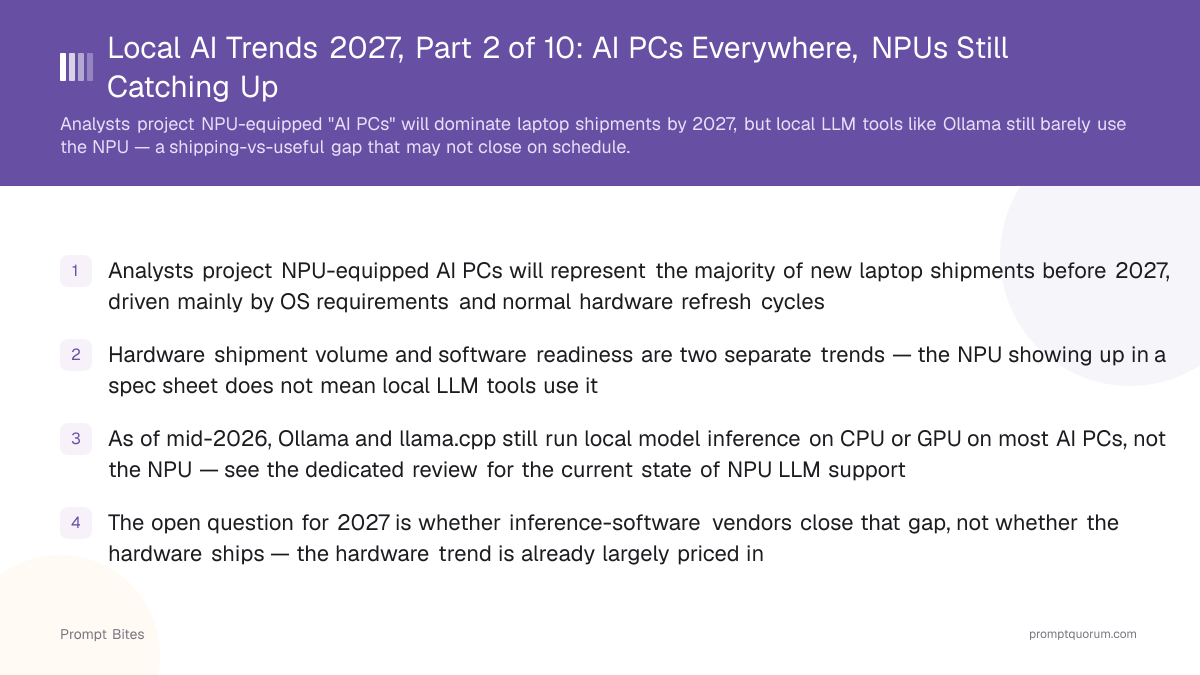
- ✓Analysts project NPU-equipped AI PCs will represent the majority of new laptop shipments before 2027, driven mainly by OS requirements and normal hardware refresh cycles
- ✓Hardware shipment volume and software readiness are two separate trends — the NPU showing up in a spec sheet does not mean local LLM tools use it
- ✓As of mid-2026, Ollama and llama.cpp still run local model inference on CPU or GPU on most AI PCs, not the NPU — see the dedicated review for the current state of NPU LLM support
- ✓The open question for 2027 is whether inference-software vendors close that gap, not whether the hardware ships — the hardware trend is already largely priced in
- ✓Buyers should choose an AI PC today based on its CPU/GPU inference capability, not its NPU TOPS rating, until that software gap closes
What Analysts Project for AI PC Shipments Through 2027
This is Part 2 of a 10-part Local AI Trends 2027 series; part of the broader shift covered across the series is that AI-capable hardware is becoming the market default rather than a premium tier. Analyst firms such as IDC and Canalys have both published projections that NPU-equipped "AI PCs" will make up a majority of new laptop shipments within the next few years, driven less by consumer demand for on-device AI and more by baseline hardware requirements tied to new Windows releases and the normal 3-to-5-year corporate refresh cycle.
That shipment trend is largely a hardware and OS-cycle story: once a chip vendor bundles an NPU into its mainstream mobile silicon line — as Intel, AMD, and Qualcomm have all done — nearly every new laptop at every price point inherits an NPU whether or not the buyer asked for one. Directionally, this means NPU-equipped hardware becomes ordinary background infrastructure rather than a distinguishing feature, similar to how integrated graphics became standard rather than optional.
For the rest of this series: Part 3 covers the parallel trend in [small language models](/prompt-bites/local-ai-trend-2027-small-language-models), Part 5 covers [hybrid local-cloud routing](/prompt-bites/local-ai-trend-2027-hybrid-local-cloud-routing), and Part 6 covers [AI NAS home servers](/prompt-bites/local-ai-trend-2027-ai-nas-home-server) as a related hardware-normalization angle outside the laptop market.
Why the NPU Hardware Trend Does Not Mean Faster Local LLMs Yet
Hardware shipping in volume is not the same claim as that hardware being useful for local LLM inference today, and the two should not be conflated. A companion piece on this site, [Are Copilot+ PC NPUs Good for Local LLMs?](/prompt-bites/best-npu-copilot-pc-local-llm), reviews the current state directly: as of mid-2026, Ollama and llama.cpp still run local model inference on the CPU or integrated GPU on Copilot+ PCs, not the NPU, because neither tool has a mature, general-purpose NPU backend for arbitrary GGUF models.
The NPU on these machines is not idle — it accelerates specific, narrower OS-level features (on-device transcription, translation, camera effects) through vendor-specific runtimes. But routing an open-ended chat request through an arbitrary local model is a different, harder engineering problem than accelerating a single fixed feature, which is why the general-purpose inference backend has lagged behind the narrower on-device features.
This is the core tension of the 2027 trend: hardware vendors have already normalized the NPU as a checkbox spec, while the software ecosystem that would make that spec matter for local LLM users is still under active development, with no shipped, production-grade general-purpose NPU backend in the tools most local LLM users actually run.
Will Local LLM Software Catch Up to AI PC Hardware by 2027?
Whether the inference-software gap closes by 2027 is a genuinely open question, not a settled prediction — treat any confident claim in either direction with caution. Closing it depends on independent, harder-to-forecast variables: whether inference-framework maintainers prioritize NPU backends, whether chip vendors publish and stabilize the low-level APIs those backends need, and whether NPU-accelerated inference actually beats CPU/GPU inference by enough to justify the engineering effort once it ships.
For buyers deciding today, the practical guidance does not depend on how that question resolves: evaluate an AI PC's CPU and integrated-GPU inference performance for the model sizes you actually plan to run, and treat the NPU TOPS figure as a platform-certification detail rather than a local LLM performance signal, until shipped tools demonstrably use it for that purpose.
For adjacent angles in this series, see Part 4 on [frontier desktop AI](/prompt-bites/local-ai-trend-2027-frontier-desktop-ai) and Part 7 on [local agentic AI](/prompt-bites/local-ai-trend-2027-local-agentic-ai), both of which depend on similar hardware-vs-software timing questions.
Frequently Asked Questions
Is it accurate to say AI PCs will be everywhere by 2027?▾
Does this article contradict the finding that NPUs don't help Ollama today?▾
Should I wait to buy a laptop until NPU-accelerated local LLM inference exists?▾
Which analyst firms track AI PC shipment projections?▾
What would have to happen for the software gap to close?▾
Related Prompt Bites
- ▸Local AI Trends 2027, Part 1 of 10: The Cloud Pricing Reset
- ▸Local AI Trends 2027, Part 3 of 10: Small Models Take Over the Boring Jobs
- ▸Local AI Trends 2027, Part 4 of 10: Private RAG Becomes Default Infrastructure
- ▸Local AI Trends 2027, Part 5 of 10: Frontier-Class Compute Comes to the Desktop
- ▸Local AI Trends 2027, Part 6 of 10: Hybrid Routing Becomes a Product Category
- ▸Local AI Trends 2027, Part 7 of 10: The NAS Becomes an Always-On AI Memory Layer
- ▸Local AI Trends 2027, Part 8 of 10: Local Agents Get a Longer Leash
- ▸Local AI Trends 2027, Part 9 of 10: The Regulatory Calendar Local AI Teams Should Watch
- ▸Local AI Trends 2027, Part 10 of 10: Fine-Tuning Without Writing a Training Script