Local AI Trends 2027, Part 8 of 10: Local Agents Get a Longer Leash
Analysts forecast that local agentic AI will shift mainly on supervision frequency between 2026 and 2027 — well-scoped, single-domain agents needing fewer human check-ins over longer stretches — rather than a sudden jump to full unsupervised autonomy. This is Part 8 of a 10-part Local AI Trends 2027 series, and the forward-looking counterpart to Local AI Agents in 2026: What Actually Works, which evaluates today's stacks rather than forecasting tomorrow's. Gartner projects that more than 40% of agentic AI projects will be cancelled by 2027 over cost, unclear business value, or inadequate risk controls — a caution against assuming smooth, linear progress, in local deployments as much as cloud ones.
Quick Answer
Analysts expect the biggest shift to be in supervision frequency, not raw capability: local agents scoped to a single domain are forecast to need fewer human check-ins over longer stretches, while fully autonomous multi-agent coordination on open-ended tasks remains the harder, later milestone. Gartner projects that over 40% of agentic AI projects will be cancelled by 2027 due to cost and unclear ROI, even as Gartner separately forecasts agentic AI capability spreading into a growing share of enterprise software by 2028. This article is a forecast for what changes next — not a report on what already works today.
- ▸Task horizon: analysts expect longer unsupervised stretches for well-scoped, single-domain tasks, not a jump to full autonomy on ambiguous work.
- ▸Attrition: Gartner projects over 40% of agentic AI projects cancelled by 2027 over cost, unclear ROI, or risk controls — local deployments are not exempt.
- ▸Adoption: Gartner separately forecasts agentic AI capability embedded in roughly a third of enterprise software by 2028, up from under 1% in 2024.
- ▸Multi-agent coordination on local hardware is expected to move from demo to practical only for narrow, typed-step pipelines by 2027 — not open-ended teamwork.
Key Takeaways
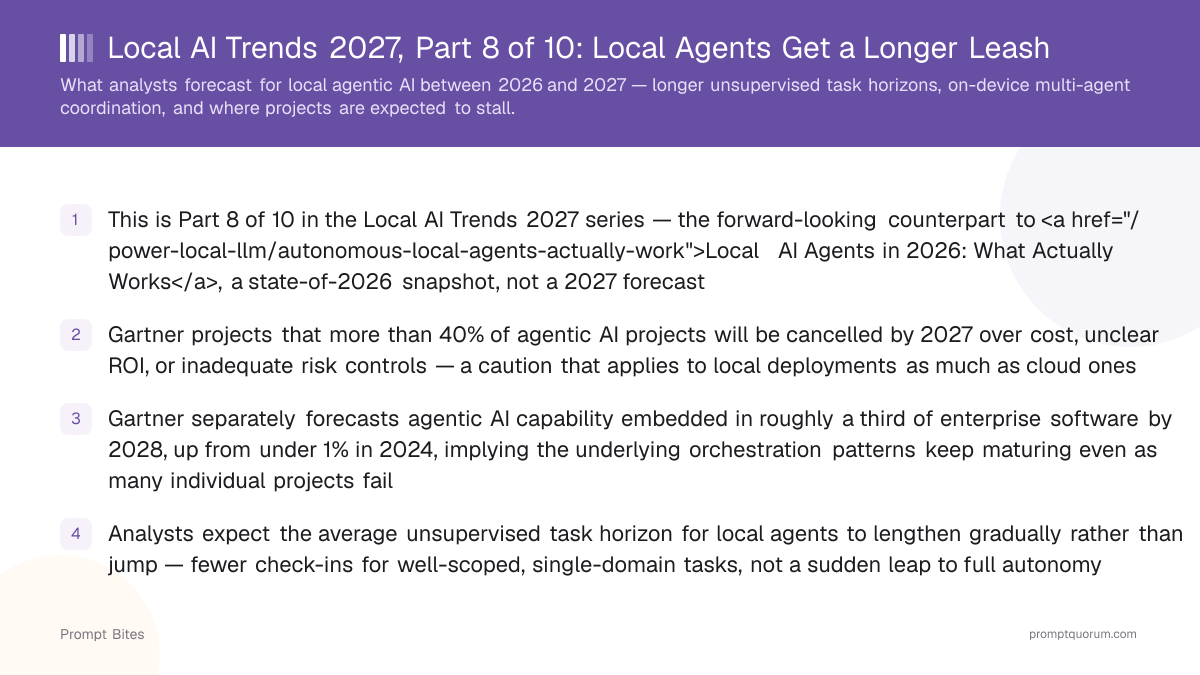
- ✓This is Part 8 of 10 in the Local AI Trends 2027 series — the forward-looking counterpart to <a href="/power-local-llm/autonomous-local-agents-actually-work">Local AI Agents in 2026: What Actually Works</a>, a state-of-2026 snapshot, not a 2027 forecast
- ✓Gartner projects that more than 40% of agentic AI projects will be cancelled by 2027 over cost, unclear ROI, or inadequate risk controls — a caution that applies to local deployments as much as cloud ones
- ✓Gartner separately forecasts agentic AI capability embedded in roughly a third of enterprise software by 2028, up from under 1% in 2024, implying the underlying orchestration patterns keep maturing even as many individual projects fail
- ✓Analysts expect the average unsupervised task horizon for local agents to lengthen gradually rather than jump — fewer check-ins for well-scoped, single-domain tasks, not a sudden leap to full autonomy
- ✓Multi-agent coordination running entirely on local hardware is expected to move from experimental demo toward practical use for narrow, well-defined pipelines — open-ended autonomous teamwork on ambiguous tasks remains the harder, later milestone
What Is Forecast to Change in Local Agentic AI Between 2026 and 2027?
The most significant shift analysts project is in supervision frequency, not a sudden jump in raw model capability. Local agent stacks in 2026 already run tool-calling loops reliably inside a single application when scoped narrowly and watched closely — see Local AI Agents in 2026: What Actually Works for that state-of-2026 evaluation. This article looks forward instead: what changes between now and 2027 according to industry forecasts, not what a specific tool does today.
Gartner projects that more than 40% of agentic AI projects will be cancelled by 2027, citing escalating costs, unclear business value, and inadequate risk controls as the leading causes. That forecast argues against assuming linear progress — plenty of agentic AI initiatives, local ones included, are expected to stall or get scrapped rather than mature smoothly toward greater autonomy.
This is Part 8 of a 10-part Local AI Trends 2027 series. For the hardware side of this shift, see Local AI Trend 2027, Part 3: AI PC & NPU Normalization; for the compliance angle on running agents against sensitive local data, see Local AI Trend 2027, Part 9: Data Sovereignty & Compliance.
Independent of project attrition, the direction analysts point to for the underlying technology is incremental — steadier state-tracking across multi-step plans and fewer dropped tool calls, not a qualitative leap to general-purpose problem-solving. Builders evaluating a local agent roadmap should read Gartner's cancellation forecast as a reason to budget conservatively and scope narrowly, not as a reason to expect the underlying capability to stall.
How Much Longer Will Local Agents Run Before Needing a Human Check-In?
Analysts expect the average unsupervised task horizon to lengthen gradually through 2027, rather than jump to indefinite autonomy. The forecast direction is toward fewer check-ins for well-scoped, single-domain work — a coding agent completing a larger chunk of a refactor, or a research agent finishing more steps of a multi-step lookup, before it needs a human decision point.
This forecast does not extend to ambiguous, multi-domain, or high-stakes tasks. Industry analysts covering agentic AI consistently flag human-in-the-loop review as a persistent requirement wherever a task touches irreversible actions — financial transactions, production deployments, data deletion — and that requirement is expected to hold through 2027, not fade out.
The practical implication for builders: plan for approval gates that shrink in frequency for narrow, repeatable tasks, not gates that disappear.
Expect this lengthening to vary significantly by task type rather than apply uniformly. Coding and data-transformation tasks, which have clear, checkable success criteria, are the categories analysts expect to extend fastest. Open-ended research or judgment-heavy tasks, where "success" is harder to define programmatically, are expected to keep shorter check-in intervals well past 2027.
Will Multi-Agent Coordination Become Practical on Local Hardware by 2027?
Multi-agent coordination running entirely on local hardware is forecast to move from experimental demo toward practical use for narrow, typed-step pipelines — not for open-ended teamwork on ambiguous goals. Gartner separately forecasts that agentic AI capability will be embedded in roughly a third of enterprise software by 2028, up from under 1% in 2024, which implies the orchestration patterns behind multi-agent systems keep maturing industry-wide even as many individual projects fail.
The distinction that matters for local setups: scripted, well-defined multi-step pipelines — a fixed sequence of typed hand-offs between specialized agents — are the segment analysts expect to reach production reliability first. Fully autonomous multi-agent teams that divide up open-ended work on their own remain the harder, later milestone, and that gap is expected to persist past 2027 for most local deployments.
Hardware trends factor into this timeline as much as orchestration software does. As on-device compute for running multiple concurrent model instances becomes more common, local multi-agent pipelines gain headroom to run several specialized agents in parallel without the latency or memory pressure that limits multi-agent setups on today's typical consumer hardware.
For the models and hardware side of this trend, see Local AI Trend 2027, Part 5: Frontier Desktop AI and Local AI Trend 2027, Part 6: Hybrid Local-Cloud Routing, which covers when to offload orchestration steps that don't yet run reliably on local hardware alone.
Frequently Asked Questions
Does this mean local AI agents will run fully unsupervised by 2027?▾
How is this different from the "what actually works" article?▾
Which local agent use cases are expected to mature fastest?▾
Should teams delay adopting local agents until 2027?▾
Related Prompt Bites
- ▸Local AI Trends 2027, Part 1 of 10: The Cloud Pricing Reset
- ▸Local AI Trends 2027, Part 2 of 10: AI PCs Everywhere, NPUs Still Catching Up
- ▸Local AI Trends 2027, Part 3 of 10: Small Models Take Over the Boring Jobs
- ▸Local AI Trends 2027, Part 4 of 10: Private RAG Becomes Default Infrastructure
- ▸Local AI Trends 2027, Part 5 of 10: Frontier-Class Compute Comes to the Desktop
- ▸Local AI Trends 2027, Part 6 of 10: Hybrid Routing Becomes a Product Category
- ▸Local AI Trends 2027, Part 7 of 10: The NAS Becomes an Always-On AI Memory Layer
- ▸Local AI Trends 2027, Part 9 of 10: The Regulatory Calendar Local AI Teams Should Watch
- ▸Local AI Trends 2027, Part 10 of 10: Fine-Tuning Without Writing a Training Script