Local AI Trends 2027, Part 9 of 10: The Regulatory Calendar Local AI Teams Should Watch
This is Part 9 of 10 in PromptQuorum's Local AI Trends 2027 series — see Part 3: Small Language Models, Part 6: Hybrid Local-Cloud Routing, and Part 10: No-Code Fine-Tuning for the rest of the series. Three regulatory developments are converging on 2027 for teams running local or on-device AI to track: the EU AI Act's phased high-risk obligations reaching AI systems embedded in regulated products, continued escalation of sector-specific rules in finance and healthcare, and additional jurisdictions adopting data-localization requirements. None of these dates are fully fixed — implementation guidance and enforcement timelines routinely shift — but each has a concrete local-AI consequence worth planning around now, distinct from the general compliance-drives-local-AI thesis covered elsewhere on this site.
Quick Answer
Three specific developments are worth tracking, though exact 2027 timing for each remains subject to change: the EU AI Act's high-risk obligations for AI embedded in regulated products (Annex I use cases) are currently scheduled to phase in around August 2027; finance and healthcare regulators are expected to keep tightening sector-specific data-processing rules; and more jurisdictions are expanding data-localization requirements beyond the countries that already have them. Each pushes some workloads toward local or on-device inference rather than cross-border cloud APIs.
- ▸EU AI Act: high-risk obligations for AI systems that are safety components of regulated products are currently scheduled around August 2027, per the Act's phased-in text — implementation guidance could still adjust the practical deadline
- ▸Finance and healthcare: sector regulators are expected to keep narrowing where patient and financial data may be processed and analyzed
- ▸Data localization: additional jurisdictions are expected to add residency requirements beyond the EU, and existing rules may see tighter enforcement
- ▸Net effect: more workloads will need to run on-device or in-country rather than through cross-border cloud APIs, regardless of exactly when each date lands
Key Takeaways
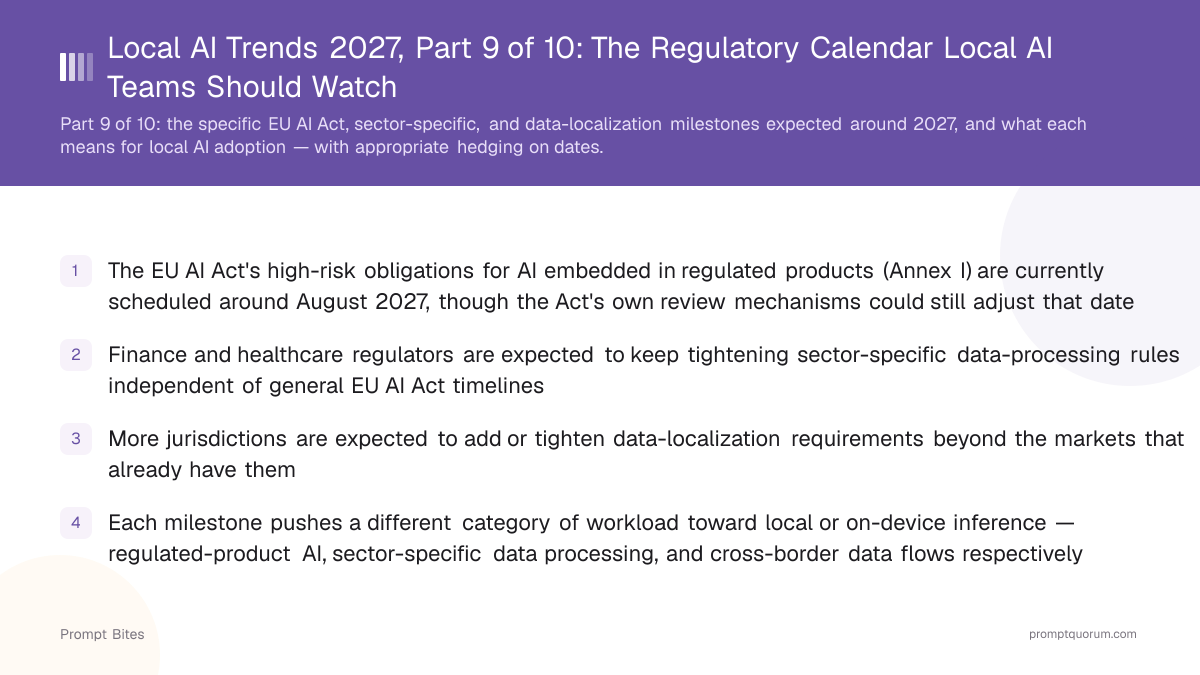
- ✓The EU AI Act's high-risk obligations for AI embedded in regulated products (Annex I) are currently scheduled around August 2027, though the Act's own review mechanisms could still adjust that date
- ✓Finance and healthcare regulators are expected to keep tightening sector-specific data-processing rules independent of general EU AI Act timelines
- ✓More jurisdictions are expected to add or tighten data-localization requirements beyond the markets that already have them
- ✓Each milestone pushes a different category of workload toward local or on-device inference — regulated-product AI, sector-specific data processing, and cross-border data flows respectively
- ✓Treat every specific 2027 date in this article as directional, not fixed — regulatory implementation guidance and enforcement timelines change as agencies build capacity
What EU AI Act Deadline Is Approaching in 2027?
**Under Regulation (EU) 2024/1689's current phased schedule, obligations for high-risk AI systems that serve as safety components of regulated products — covered under Annex I, such as medical devices, machinery, and vehicles — are set to apply from around August 2, 2027.** That is roughly a year after the Act's general high-risk-system obligations (Annex III use cases) became applicable in August 2026, giving manufacturers of regulated hardware and embedded AI systems a longer runway than most other high-risk categories.
This later deadline is written into the Act's own text, not merely a projection — but the European Commission has floated simplification and timeline adjustments for parts of the AI Act before, so August 2027 should be treated as the current plan rather than a guaranteed date.
The practical consequence for local AI teams: products that embed AI as a safety component will need to document data flows and processing locations as part of conformity assessment. Running inference on-device or on infrastructure fully inside the EU simplifies that documentation compared with routing safety-relevant inference through external cloud APIs. For the general enterprise-compliance backdrop behind this shift, see [Enterprise Compliance: GDPR, HIPAA, SOC2, and AI Regulations](/local-llms/enterprise-compliance-local-llms) and [AI Geopolitics Explained: EU AI Act vs US vs China](/prompt-engineering/geopolitics-and-ai).
Are Finance and Healthcare Rules Tightening Faster Than General AI Law?
**Yes — sector regulators in finance and healthcare have historically moved ahead of general AI legislation, and analysts expect that pattern to continue through 2027.** Financial regulators in multiple markets already restrict where certain transaction and risk data can be processed, and healthcare regulators layer patient-data rules on top of general privacy law; neither category waits for an omnibus AI law to finish phasing in.
Gartner has projected that a growing share of large enterprises deploying AI in regulated sectors will need to demonstrate documented control over where model inference actually happens, not just where training data is stored — a distinction that matters specifically for local AI adoption, since on-device or on-premises inference gives a verifiable answer to "where does processing happen" that a third-party cloud API often cannot.
This is a narrower, faster-moving pressure than the general compliance-and-AI-Act narrative — see [Why Enterprises Use Local LLMs: Cost, Compliance, and Control](/local-llms/why-enterprises-use-local-llms) for that broader background.
Which Markets Are Expanding Data-Localization Rules Next?
**Analysts including PwC have noted continued growth in data-localization mandates outside the EU, particularly across parts of Asia-Pacific and the Gulf region, as more countries formalize rules requiring certain data categories to stay within national borders.** Exact scope and enforcement dates vary by country and are still being finalized in several markets, so specific timelines should be treated as directional rather than confirmed.
For teams operating across these markets, the practical effect is the same regardless of exactly when each rule takes hold: workloads touching in-scope data categories increasingly need to run in-country, which favors local or regionally hosted inference over a single centralized cloud deployment serving every market.
Frequently Asked Questions
Are these 2027 dates confirmed?▾
Does this mean every AI system needs to run locally by 2027?▾
How is this different from the general "compliance drives local AI" argument?▾
What should a compliance or engineering lead do now, given the uncertainty?▾
Related Prompt Bites
- ▸Local AI Trends 2027, Part 1 of 10: The Cloud Pricing Reset
- ▸Local AI Trends 2027, Part 2 of 10: AI PCs Everywhere, NPUs Still Catching Up
- ▸Local AI Trends 2027, Part 3 of 10: Small Models Take Over the Boring Jobs
- ▸Local AI Trends 2027, Part 4 of 10: Private RAG Becomes Default Infrastructure
- ▸Local AI Trends 2027, Part 5 of 10: Frontier-Class Compute Comes to the Desktop
- ▸Local AI Trends 2027, Part 6 of 10: Hybrid Routing Becomes a Product Category
- ▸Local AI Trends 2027, Part 7 of 10: The NAS Becomes an Always-On AI Memory Layer
- ▸Local AI Trends 2027, Part 8 of 10: Local Agents Get a Longer Leash
- ▸Local AI Trends 2027, Part 10 of 10: Fine-Tuning Without Writing a Training Script