Local AI Trends 2027, Part 10 of 10: Fine-Tuning Without Writing a Training Script
This is Part 10 of 10 — the closing part — in the Local AI Trends 2027 series. The workflow trend to watch is no-code fine-tuning: platforms that turn dataset upload, hyperparameter selection, and before/after evaluation into a guided sequence instead of command-line scripting. Future of Local LLMs already names this trend at a summary level; this piece goes deeper into the concrete workflow, who it unlocks fine-tuning for, and what still requires ML judgment no interface can automate away. See Part 1: Cloud Subsidy Collapse to start the series from the beginning.
Quick Answer
A no-code fine-tuning workflow compresses four steps that currently require command-line tools into a guided interface: upload a dataset via drag-and-drop, let the platform pick starting hyperparameters (learning rate, epoch count, LoRA rank) instead of the user guessing them, run a one-click comparison of the fine-tuned model against the unmodified base model on held-out examples, and get a warning if the model is overfitting a small dataset before it ships. Analysts including Gartner have flagged low-code/no-code AI customization as a growing enterprise category, though exact adoption timing and specific vendor tooling remain unsettled — treat any specific date or duration figure as directional, not a fixed 2027 benchmark.
- ▸Drag-and-drop dataset upload replaces manually formatting JSONL and running a CLI script
- ▸Automatic hyperparameter selection removes the guesswork of picking a learning rate, epoch count, or LoRA rank by hand
- ▸One-click evaluation compares the fine-tuned model against the base model on held-out examples before deployment
- ▸Built-in overfitting guardrails flag when a small dataset is being memorized rather than generalized from
- ▸None of this fixes a poorly structured dataset or a wrong base-model choice — those still require human judgment
Key Takeaways
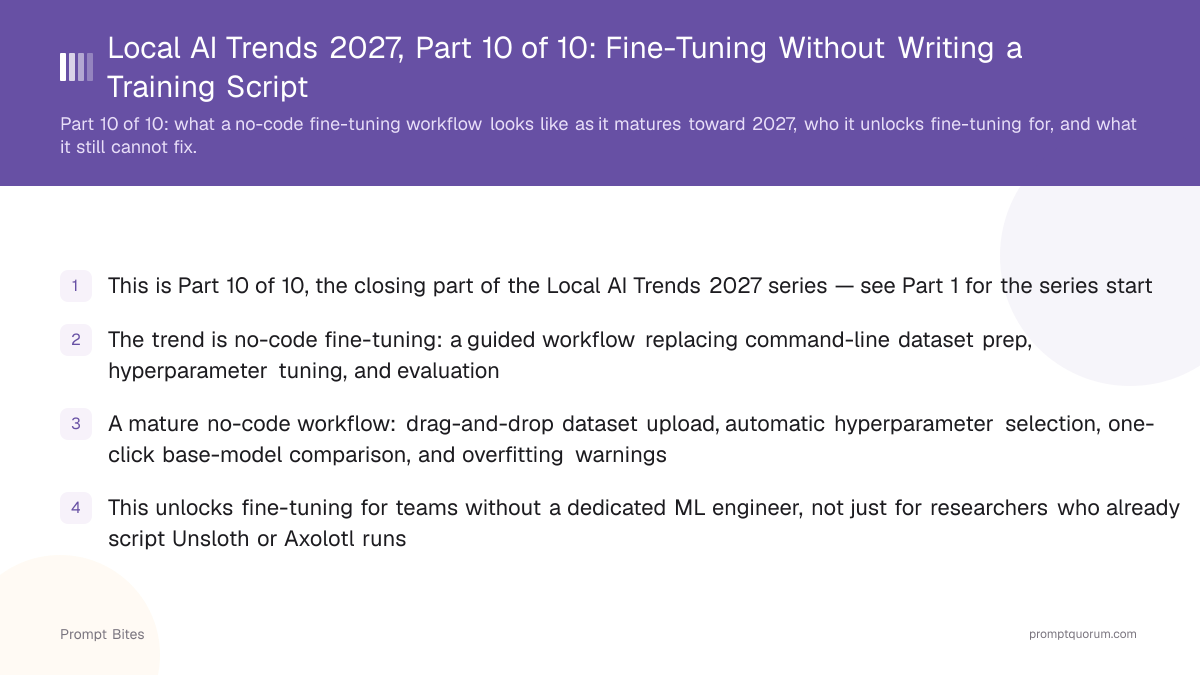
- ✓This is Part 10 of 10, the closing part of the Local AI Trends 2027 series — see Part 1 for the series start
- ✓The trend is no-code fine-tuning: a guided workflow replacing command-line dataset prep, hyperparameter tuning, and evaluation
- ✓A mature no-code workflow: drag-and-drop dataset upload, automatic hyperparameter selection, one-click base-model comparison, and overfitting warnings
- ✓This unlocks fine-tuning for teams without a dedicated ML engineer, not just for researchers who already script Unsloth or Axolotl runs
- ✓No-code tooling cannot fix a messy, unrepresentative dataset or compensate for choosing the wrong base model — those remain human decisions
A No-Code Fine-Tuning Workflow Compresses Four Manual Steps Into a Guided Sequence
**Today, fine-tuning a local model with a tool such as Unsloth or Axolotl requires four separate manual steps: formatting a dataset as JSONL, hand-picking hyperparameters, writing and running a training script, and manually comparing outputs before and after training.** Fine-Tuning a 7B Model Locally: Hardware Requirements and Fine-Tuning Local LLMs with LoRA cover what that process involves today.
A no-code platform replaces the first step with drag-and-drop upload — the interface validates row format and flags obvious data-quality issues (duplicate rows, empty fields, imbalanced label distribution) before training starts, rather than surfacing a cryptic error mid-run.
It replaces the second step with automatic hyperparameter selection: the platform proposes a starting learning rate, epoch count, and LoRA rank (see LoRA vs. Full Fine-Tuning for what that parameter controls) based on dataset size and base model, rather than requiring the user to already know reasonable defaults.
It replaces manual before/after comparison with a one-click evaluation report: the fine-tuned model and the unmodified base model both run against a held-out slice of the dataset, and the platform surfaces where responses diverged — not just an aggregate accuracy number, but concrete example pairs a non-specialist reviewer can read and judge.
Analysts including Gartner have described low-code and no-code AI customization tooling as an expanding enterprise category; IDC has separately tracked growth in AI model-customization software spend. Neither firm has published a specific 2027 timeline for no-code fine-tuning specifically reaching feature parity with scripted workflows, so treat that arrival as directional rather than scheduled.
No-Code Fine-Tuning Unlocks a New Team, Not a New Capability
**The main effect of a no-code fine-tuning workflow is access, not a new technique — the same LoRA and full fine-tuning methods underlie both the scripted and the no-code path.** What changes is who can run the process: a product manager, support-operations lead, or domain expert who understands the target task but has never run a command-line training job becomes able to produce a working fine-tuned model without pulling in an ML engineer for every iteration.
That access has real limits. A no-code interface cannot correct a dataset that is too small, too repetitive, or unrepresentative of the task the model will actually face in production — the platform can flag signs of overfitting, but it cannot manufacture the missing diversity in the underlying examples. Garbage in still produces garbage out, just with a friendlier upload screen.
It also cannot fix a wrong base-model choice. If the underlying model lacks the capacity or domain exposure the task needs, fine-tuning — no-code or scripted — will not compensate for that; see Best Model-Merging Tool: MergeKit for a related case where combining models is the more appropriate fix instead of fine-tuning a single base model further. No-code tooling makes running the process easier; it does not make the underlying ML decisions — which base model, how much and what kind of data is enough — any less important to get right.
This closes the 10-part Local AI Trends 2027 series. Revisit Part 1: Cloud Subsidy Collapse for the opening trend, or Part 3: Small Language Models and Part 8: Local Agentic AI for two of the other trends covered along the way.
Frequently Asked Questions
Does no-code fine-tuning replace tools like Unsloth and Axolotl?▾
Is future-of-local-llms.ts already covering this — why does this article exist?▾
Does no-code tooling make fine-tuning safe for teams without any ML background?▾
How fast will fine-tuning runs get with no-code tooling by 2027?▾
Related Prompt Bites
- ▸Local AI Trends 2027, Part 1 of 10: The Cloud Pricing Reset
- ▸Local AI Trends 2027, Part 2 of 10: AI PCs Everywhere, NPUs Still Catching Up
- ▸Local AI Trends 2027, Part 3 of 10: Small Models Take Over the Boring Jobs
- ▸Local AI Trends 2027, Part 4 of 10: Private RAG Becomes Default Infrastructure
- ▸Local AI Trends 2027, Part 5 of 10: Frontier-Class Compute Comes to the Desktop
- ▸Local AI Trends 2027, Part 6 of 10: Hybrid Routing Becomes a Product Category
- ▸Local AI Trends 2027, Part 7 of 10: The NAS Becomes an Always-On AI Memory Layer
- ▸Local AI Trends 2027, Part 8 of 10: Local Agents Get a Longer Leash
- ▸Local AI Trends 2027, Part 9 of 10: The Regulatory Calendar Local AI Teams Should Watch