Local AI Trends 2027, Part 3 of 10: Small Models Take Over the Boring Jobs
This is Part 3 of 10 in the Local AI Trends 2027 series: by 2027, analysts expect companies to run many small, task-specific local models — one for classification, one for extraction, one for routing — instead of sending every narrow job through a single large general-purpose API call. This is a deployment-pattern shift, not a capability shift: it is about which jobs get a dedicated small model at scale, not about small models suddenly matching large-model intelligence (that angle is covered in Part 8, Local Agentic AI, and in our separate Future of Local LLMs analysis). See also Part 1, Cloud Subsidy Collapse, and Part 5, Hybrid Local-Cloud Routing.
Quick Answer
Because at high request volume, routing a narrow, repetitive task — classification, extraction, intent routing — through one large general-purpose model costs and delays more per request than running a small model fine-tuned for exactly that task on local hardware. Gartner has projected that a growing share of enterprise generative AI spend will shift toward smaller, task-specific models by 2027 as organizations optimize for cost-per-request at scale rather than raw capability.
- ▸Deployment pattern, not intelligence pattern — the shift is about scale and cost, not about small models matching large-model quality
- ▸Narrow, high-volume jobs (classification, extraction, routing, single-purpose agents) are the target workloads, not open-ended chat
- ▸Analysts (Gartner, IDC) frame this as a directional shift in enterprise AI spend, not a settled fact for every company
- ▸For the "are small models as smart as old large models" question, see Part 8 and our Future of Local LLMs analysis instead
Key Takeaways
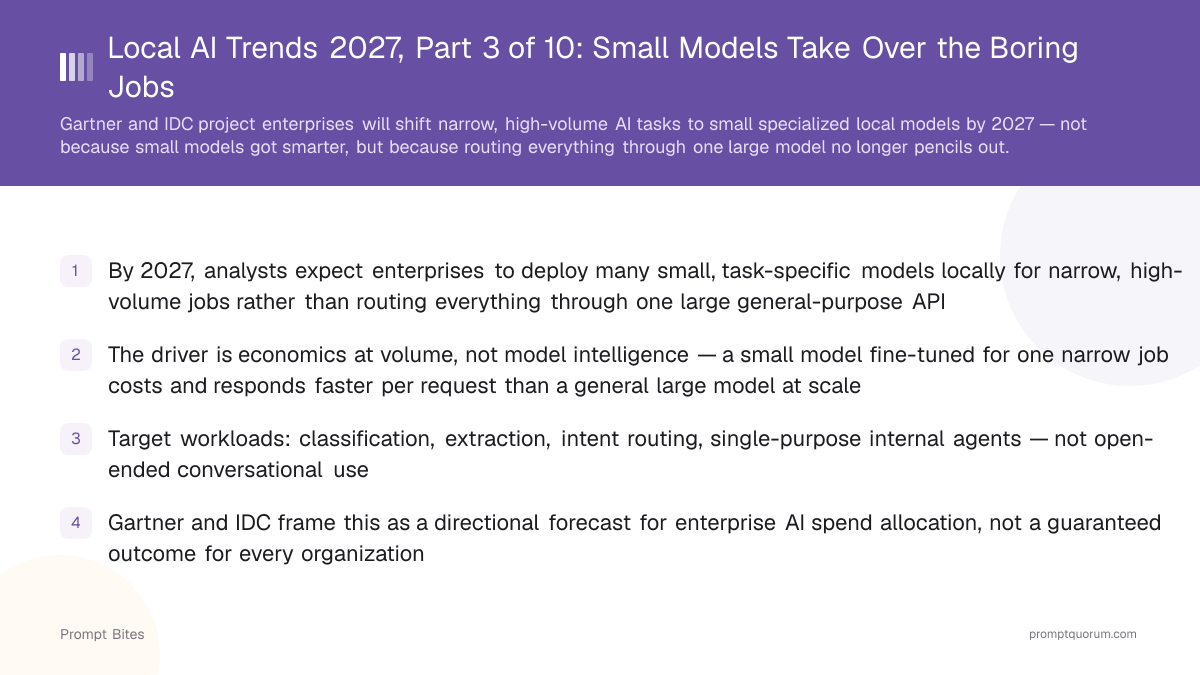
- ✓By 2027, analysts expect enterprises to deploy many small, task-specific models locally for narrow, high-volume jobs rather than routing everything through one large general-purpose API
- ✓The driver is economics at volume, not model intelligence — a small model fine-tuned for one narrow job costs and responds faster per request than a general large model at scale
- ✓Target workloads: classification, extraction, intent routing, single-purpose internal agents — not open-ended conversational use
- ✓Gartner and IDC frame this as a directional forecast for enterprise AI spend allocation, not a guaranteed outcome for every organization
- ✓This is a different trend from small models matching old large-model quality — see Part 8 and the separate Future of Local LLMs analysis for that angle
Why Does Request Volume Change Which Model Makes Sense?
**A single narrow request barely matters, but a narrow task run millions of times per month adds up fast.** A support-ticket classifier, a document-field extractor, or a request router are examples of narrow, repetitive, high-volume tasks — the kind that used to get bundled into a general-purpose LLM API call because it was the fastest way to ship. At low volume, that bundling is fine. At production scale, every one of those requests still pays the same per-call cost and latency as a request that actually needed the large model's full general capability.
IDC and PwC have both published enterprise AI adoption forecasts describing organizations increasingly separating workloads by task type rather than defaulting every request to the largest available model — routing narrow, repetitive jobs to smaller, purpose-built models running on local or on-premises hardware, and reserving large general-purpose models for genuinely open-ended tasks. Directionally, this reflects a maturing cost-optimization phase of enterprise AI adoption, following the earlier "just call the biggest model for everything" phase.
This is distinct from the question of whether small models are now as capable as the larger models of a few years ago — a real and separate trend covered in the "Trend 1" section of our Future of Local LLMs analysis. That trend is about model quality per parameter improving. This trend is about deployment architecture: which jobs get their own dedicated small model, independent of how smart that model is relative to older large models.
What Does a Small-Model Deployment Pattern Look Like in Practice?
**In practice, this pattern looks like several small models running locally, each handling one narrow job, coordinated by a lightweight router rather than a single large model handling every request type.** A classification model sorts incoming tickets or documents; an extraction model pulls structured fields out of unstructured text; a routing model decides which downstream system or team handles a request. None of these needs the broad general knowledge of a large frontier model — each needs to be reliably good at one narrow, well-defined task.
Forrester has discussed this kind of task-specialization as part of a broader shift toward composable, multi-model enterprise AI architectures rather than single-model deployments, projecting continued movement in that direction through 2027 as organizations mature past initial pilot-stage generative AI projects. The practical benefit at volume: smaller models run cheaper per request on local or on-premises hardware, respond faster since there is no round trip to an external API, and can be updated or replaced independently of one another without touching the rest of the pipeline.
The tradeoff analysts flag is added operational complexity — running and maintaining several small models instead of one API integration requires more infrastructure and monitoring. Organizations without existing MLOps capacity may find a single large-model API simpler to operate even at higher per-request cost, at least until volume justifies the added complexity. For the hardware side of running multiple small models locally, see Part 2, AI PC / NPU Normalization.
Frequently Asked Questions
Is this the same trend as "small models are now as good as old large models"?▾
What kinds of tasks are analysts describing as moving to small local models?▾
Which analyst firms are forecasting this shift?▾
Does this mean large general-purpose models become less important?▾
Related Prompt Bites
- ▸Local AI Trends 2027, Part 1 of 10: The Cloud Pricing Reset
- ▸Local AI Trends 2027, Part 2 of 10: AI PCs Everywhere, NPUs Still Catching Up
- ▸Local AI Trends 2027, Part 4 of 10: Private RAG Becomes Default Infrastructure
- ▸Local AI Trends 2027, Part 5 of 10: Frontier-Class Compute Comes to the Desktop
- ▸Local AI Trends 2027, Part 6 of 10: Hybrid Routing Becomes a Product Category
- ▸Local AI Trends 2027, Part 7 of 10: The NAS Becomes an Always-On AI Memory Layer
- ▸Local AI Trends 2027, Part 8 of 10: Local Agents Get a Longer Leash
- ▸Local AI Trends 2027, Part 9 of 10: The Regulatory Calendar Local AI Teams Should Watch
- ▸Local AI Trends 2027, Part 10 of 10: Fine-Tuning Without Writing a Training Script