Local AI Trends 2027, Part 6 of 10: Hybrid Routing Becomes a Product Category
This is Part 6 of 10 in the Local AI Trends 2027 series: analysts project that hybrid local-cloud routing shifts from hand-built glue code to a packaged product category between now and 2027. Instead of every team writing its own request-size or queue-depth routing logic, a distinct market of routing-layer products and AI gateway vendors is expected to emerge — sold, priced, and supported like any other infrastructure category, rather than assembled in-house. See Part 7, AI NAS and Home Servers, and Part 8, Local Agentic AI, for related infrastructure shifts in this series.
Quick Answer
Analysts project directional growth toward packaged routing-layer products rather than custom-built glue code as the default way teams split inference between local and cloud environments. Gartner has flagged AI orchestration and gateway tooling as an emerging infrastructure segment, and the practical effect for teams is a shift from writing and maintaining their own routing logic to selecting, configuring, and paying for a vendor product that does it out of the box.
- ▸Directional forecast: packaged routing-layer products and AI gateway vendors become a distinct infrastructure category, not a definitive fact
- ▸What changes: teams move from writing custom routing logic to configuring a vendor product — a build-vs-buy decision, not a technical rebuild
- ▸For the how-to of building routing logic yourself today, see the dedicated guide, not this piece
- ▸Perishable claim: no specific vendor names are stable enough to cite yet — this is a category-level prediction
Key Takeaways
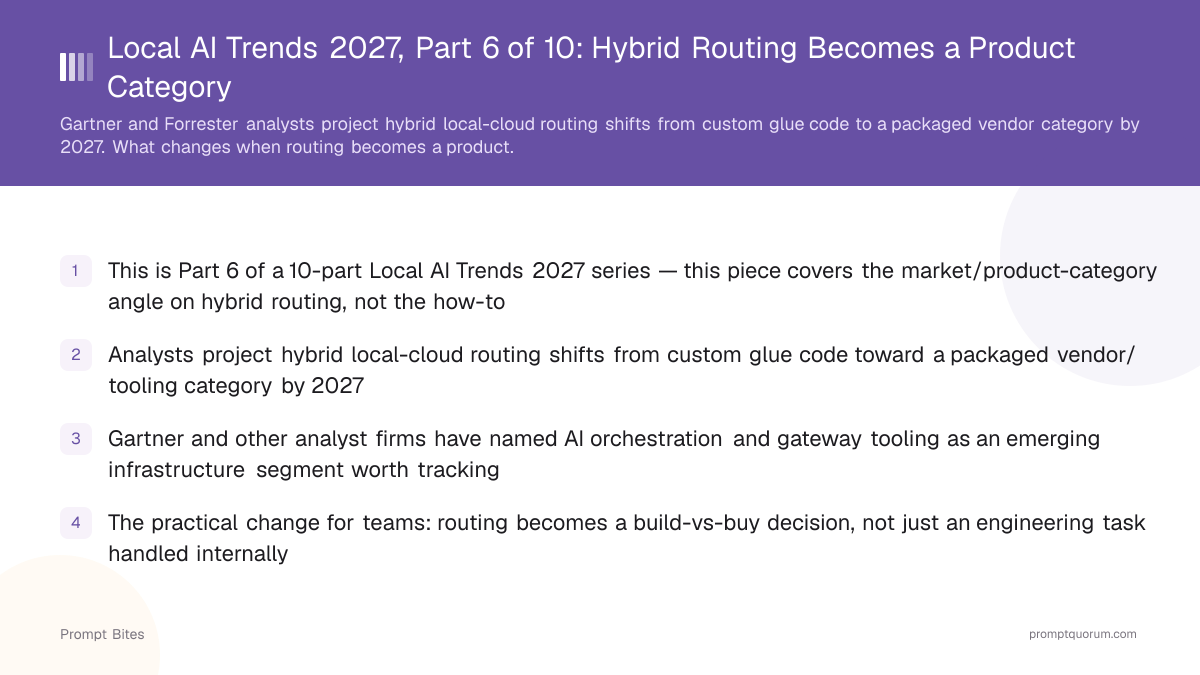
- ✓This is Part 6 of a 10-part Local AI Trends 2027 series — this piece covers the market/product-category angle on hybrid routing, not the how-to
- ✓Analysts project hybrid local-cloud routing shifts from custom glue code toward a packaged vendor/tooling category by 2027
- ✓Gartner and other analyst firms have named AI orchestration and gateway tooling as an emerging infrastructure segment worth tracking
- ✓The practical change for teams: routing becomes a build-vs-buy decision, not just an engineering task handled internally
- ✓For the actual how-to of building hybrid routing logic today, see hybrid-local-cloud-llm-strategy — that content is not repeated here
Why Does Hybrid Routing Move From DIY Code to a Packaged Product?
**Analysts project that any infrastructure problem solved independently by enough teams eventually attracts dedicated vendors, and hybrid local-cloud routing fits that pattern.** IDC and Gartner have both tracked this progression before in adjacent categories — API gateways, service meshes, and load balancers all started as custom code inside individual companies before becoming purchasable products with dedicated vendors, support contracts, and admin dashboards.
The underlying problem — deciding per-request whether to run inference locally or route to the cloud — is the same technical challenge regardless of which team solves it. That repetition across many organizations is exactly the condition analysts point to as a leading indicator of category formation: once a large enough population of teams independently builds similar glue code, a vendor market forms to sell a standardized version of it.
This does not mean the underlying technical patterns change. The routing decision itself (request size, queue depth, local-first-with-fallback) stays the same regardless of whether it runs inside custom code or inside a purchased product — see Hybrid Local-Cloud LLM Strategy for exactly how those patterns work if you want to build this yourself today. What changes is *who writes and maintains that logic*.
What Changes for Teams Once Routing Is a Vendor Category?
**Once packaged routing-layer products exist as a distinct category, the decision facing a team shifts from "how do we build this" to "do we build or buy this."** That is a procurement and vendor-evaluation question, not primarily an engineering one — closer to choosing a CDN provider than writing a networking stack from scratch.
Forrester and similar analyst firms typically describe this kind of category maturation in terms of reduced integration burden: a packaged product bundles the routing decision engine, monitoring dashboard, and failover handling that a team would otherwise have to build and maintain separately. The tradeoff is the usual build-vs-buy one — less engineering time spent on routing logic, in exchange for vendor lock-in risk and a recurring subscription cost instead of one-time internal engineering effort.
For teams evaluating this shift, the open questions are ordinary procurement questions: does the vendor product support your specific local inference stack, does it meet the same data-residency requirements you'd enforce in custom code, and does the subscription cost stay below what an in-house engineer's time would cost to build and maintain the same logic. None of those questions are answerable in general — they depend on team size, workload variability, and compliance requirements specific to each organization.
Frequently Asked Questions
Is this article about how to build hybrid local-cloud routing?▾
Which specific vendors will sell hybrid routing products by 2027?▾
Does a packaged routing product replace the need to understand routing patterns?▾
Is this prediction certain to happen by 2027?▾
Related Prompt Bites
- ▸Local AI Trends 2027, Part 1 of 10: The Cloud Pricing Reset
- ▸Local AI Trends 2027, Part 2 of 10: AI PCs Everywhere, NPUs Still Catching Up
- ▸Local AI Trends 2027, Part 3 of 10: Small Models Take Over the Boring Jobs
- ▸Local AI Trends 2027, Part 4 of 10: Private RAG Becomes Default Infrastructure
- ▸Local AI Trends 2027, Part 5 of 10: Frontier-Class Compute Comes to the Desktop
- ▸Local AI Trends 2027, Part 7 of 10: The NAS Becomes an Always-On AI Memory Layer
- ▸Local AI Trends 2027, Part 8 of 10: Local Agents Get a Longer Leash
- ▸Local AI Trends 2027, Part 9 of 10: The Regulatory Calendar Local AI Teams Should Watch
- ▸Local AI Trends 2027, Part 10 of 10: Fine-Tuning Without Writing a Training Script