Apple M4 Max vs M4 Pro: Which Is Better for Local LLMs?
The Apple M4 Max is better than the M4 Pro for local LLMs, primarily on memory bandwidth — up to 546 GB/s versus the M4 Pro's 273 GB/s. Since local LLM inference speed is bandwidth-bound once a model fits in memory, the M4 Max runs every model both chips can fit noticeably faster. The M4 Max also scales to 128 GB of unified memory versus the M4 Pro's 48 GB ceiling, unlocking larger models entirely.
This page contains links to third-party products for reference. PromptQuorum is not enrolled in any affiliate program — these are plain links that earn no commission. Clicking links and your next steps are entirely your own responsibility. These links do not represent any endorsement or verification by PromptQuorum.
Quick Answer
The M4 Max is better than the M4 Pro for local LLMs — up to 546 GB/s memory bandwidth vs 273 GB/s, and up to 128GB unified memory vs 48GB, meaning faster tokens/sec and support for larger models.
- ▸M4 Max memory bandwidth: up to 546 GB/s (highest-core-count config) vs M4 Pro's 273 GB/s — nearly double.
- ▸M4 Max unified memory ceiling: up to 128 GB vs M4 Pro's 48 GB — unlocks 70B-class models the Pro cannot fit.
- ▸For models both chips can fit (up to ~32B), the M4 Max generates tokens noticeably faster due to bandwidth alone.
Key Takeaways
- ✓Hardware update (September 2026): Apple has since moved to newer chips — M5 Pro/M5 Max in the MacBook Pro since March 2026, and now M6/M5 Pro in the Mac mini and M5 Max/M5 Ultra in the Mac Studio. The M4 Max vs M4 Pro comparison below is still accurate but now covers used/refurbished-tier hardware, not Apple's current lineup.
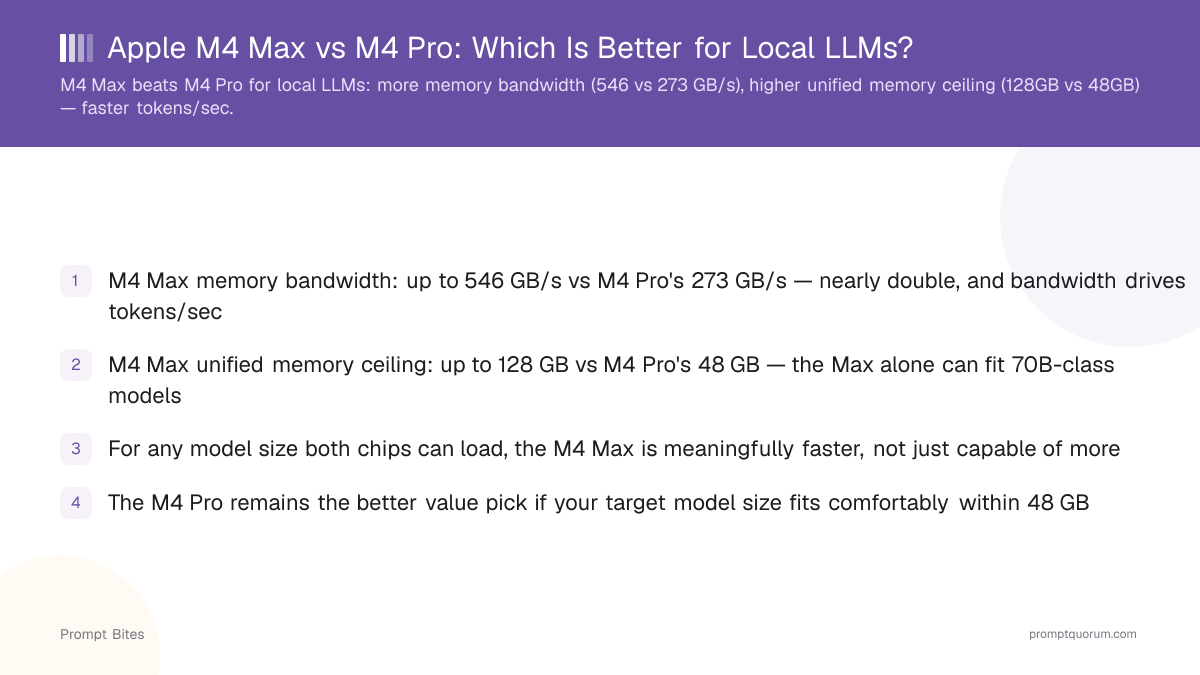
- ✓M4 Max memory bandwidth: up to 546 GB/s vs M4 Pro's 273 GB/s — nearly double, and bandwidth drives tokens/sec
- ✓M4 Max unified memory ceiling: up to 128 GB vs M4 Pro's 48 GB — the Max alone can fit 70B-class models
- ✓For any model size both chips can load, the M4 Max is meaningfully faster, not just capable of more
- ✓The M4 Pro remains the better value pick if your target model size fits comfortably within 48 GB
Best Pick: M4 Max, If Budget Allows
The Apple M4 Max outperforms the M4 Pro for local LLMs because local inference speed is primarily bound by memory bandwidth once a model fits in unified memory — and the M4 Max's bandwidth (up to 546 GB/s on the highest-core-count configuration) is nearly double the M4 Pro's 273 GB/s. This means the M4 Max runs identical models faster, not just larger ones.
The M4 Max also raises the unified memory ceiling to 128 GB, versus the M4 Pro's 48 GB maximum. That unlocks model sizes the M4 Pro simply cannot load at all — including 70B-class models at reasonable quantization, which need far more than 48 GB.
The M4 Pro remains the better value choice if your target models fit comfortably within its 48 GB ceiling — for example, sticking to 14B-32B models. You pay a real premium for the M4 Max's extra bandwidth and memory headroom, and it is only worth it if you actually need one or both.
M4 Max vs M4 Pro — Spec by Spec
Memory bandwidth is the headline difference: the M4 Pro tops out at 273 GB/s, while the M4 Max ranges from 410 GB/s (lower-core-count config) to 546 GB/s (higher-core-count config) depending on which M4 Max variant you buy — check the exact configuration before assuming the top bandwidth figure applies.
Unified memory ceiling is the other major factor: 48 GB maximum on the M4 Pro versus up to 128 GB on the M4 Max. If your model sizes will always fit within 48 GB, the bandwidth gap is the only thing you're paying for with the Max; if you need more than 48 GB of usable memory, the M4 Pro is not an option at all.
Both chips are now two generations behind Apple's current lineup — the bandwidth and memory relationship described above still holds between the M4 Pro and M4 Max, it just no longer represents Apple's fastest available silicon.
Related Reading
- ▸Is the Mac Mini M4 Good for Local LLMs? — the M4 and M4 Pro Mac Mini configurations
- ▸Best Local LLM for a 32 GB Unified Memory Mac — sizing models to memory
- ▸How Much VRAM for a 70B Model? — why the M4 Max's 128GB ceiling matters for 70B
- ▸Best GPU Buying Guide for Local LLMs 2026 — for when you outgrow unified memory and want dedicated VRAM
- ▸M5 Pro vs M5 Max LLM Benchmarks 2026 — the current-generation comparison for readers buying new hardware
Frequently Asked Questions
Is the M4 Max still worth buying in 2026?▾
Do all M4 Max configurations have the same memory bandwidth?▾
Is the M4 Pro good enough for most local LLM use?▾
How much more expensive is the M4 Max configuration?▾
Does the M4 Max help with fine-tuning too?▾
Want the full breakdown?
Read the complete guide →