Key Takeaways
- Foundry Local is Microsoft's on-device AI inference tool; source at github.com/microsoft/Foundry-Local, project site foundrylocal.ai
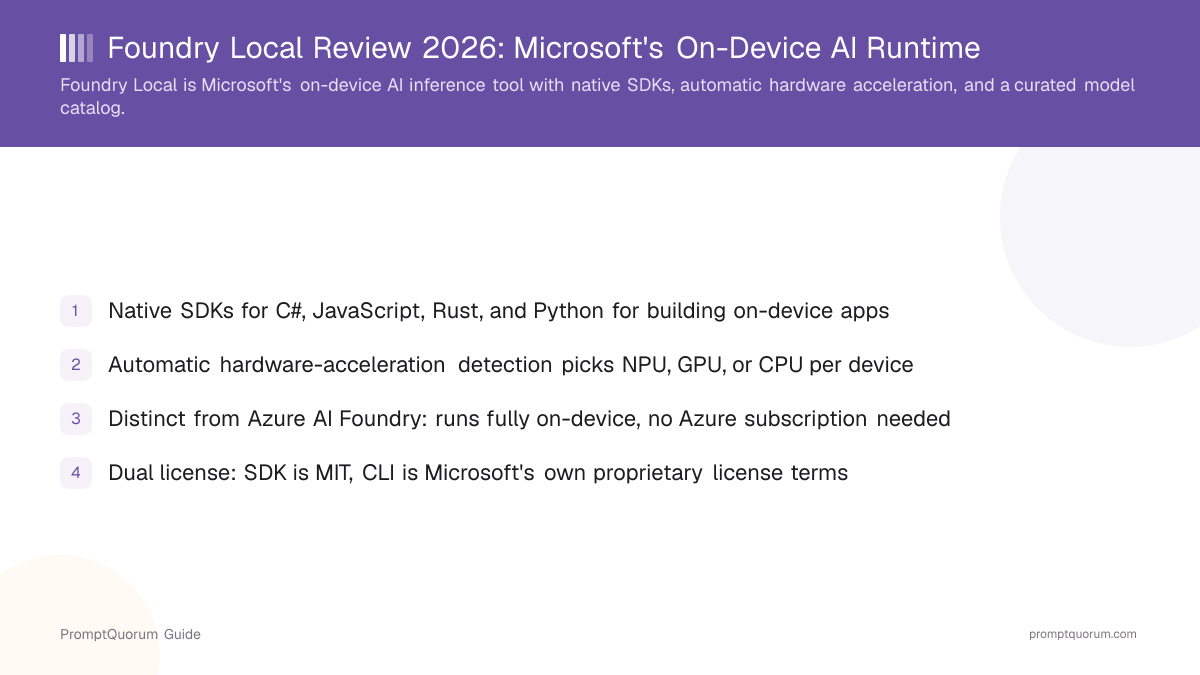
- Native SDKs for C#, JavaScript, Rust, and Python, plus automatic hardware-acceleration detection that selects the optimal execution provider — NPU, GPU, or CPU — per device
- Runs on Windows, macOS (Apple Silicon), and Linux, per the official README; readers should check the official repository directly for full platform coverage on any specific device class
- Lightweight package, roughly 20 MB
- License is split: the SDK is MIT-licensed, while the CLI is distributed under Microsoft's own proprietary Microsoft Software License Terms — this is not a fully open-source product
- Distinct from Azure AI Foundry: Foundry Local runs on-device and does not require an Azure subscription for local-only use, while Azure AI Foundry is Microsoft's separate cloud platform for building and deploying AI at scale; the two are designed to interoperate in hybrid workflows
- Curated model catalog includes model families such as Qwen, DeepSeek, Mistral, Phi, and GPT-OSS, plus Whisper for audio transcription — each downloaded model carries its own separate license terms
- Exposes an OpenAI-compatible API (including OpenAI Responses API request/response formats) through a local web server, and uses ONNX Runtime for inference
- GitHub repository shows 2,541 stars, verified against github.com/microsoft/Foundry-Local on September 5, 2026
📍 In One Sentence
Foundry Local is Microsoft's on-device AI inference tool — native SDKs for C#, JavaScript, Rust, and Python, automatic hardware-acceleration detection, and a curated model catalog — and it is a separate product from the cloud-based Azure AI Foundry.
💬 In Plain Terms
Foundry Local lets a developer build an app that runs AI models directly on a user's Windows, Mac, or Linux machine, picking whichever chip (NPU, GPU, or CPU) does the job fastest on that specific device, without needing a cloud account for local use. It is not the same thing as Azure AI Foundry, which is Microsoft's cloud platform — the two can work together, but Foundry Local's whole point is running offline, on-device.
📌Note: This review is the deep-dive companion to Foundry Local's entry in the Local LLM Software Directory — see that page for how Foundry Local compares at a glance to dozens of other local AI tools.
What Is Foundry Local?
Foundry Local is Microsoft's on-device AI inference tool — an end-to-end local AI solution for building applications that run entirely on a user's device. Its GitHub repository describes it as bringing native SDKs, automatic hardware acceleration, and a curated model catalog together in a lightweight package aimed at developers who need inference to happen on the device itself, not on a remote server.
- Core function: run AI model inference locally on a device, with the runtime automatically detecting and using the best available hardware acceleration
- Native SDKs: C#, JavaScript, Rust, and Python, so developers can integrate local inference into applications written in each of those languages without a separate wrapper
- Automatic hardware-acceleration detection: the runtime selects the optimal execution provider — NPU, GPU, or CPU — for the device it is running on, rather than requiring the developer to hard-code that choice
- Model catalog: a curated set of models, rather than an open, unrestricted upload catalog
- Developer: Microsoft; the GitHub organization hosting the code is microsoft
- Canonical repository: github.com/microsoft/Foundry-Local; project site: foundrylocal.ai
Foundry Local vs. Azure AI Foundry
This is the single most important distinction to get right about Foundry Local: Foundry Local is not the same product as Azure AI Foundry, Microsoft's cloud-based platform for building and deploying AI at scale. Per Microsoft's own positioning, Foundry Local is "the high-performance local AI runtime stack that brings Azure AI Foundry's power to client devices" — language that signals a deliberate relationship between the two, not identical products.
Where inference runs
- Foundry Local:
- Entirely on the user's own device
- Azure AI Foundry:
- Microsoft's cloud infrastructure
Azure account needed
- Foundry Local:
- No, for local-only use
- Azure AI Foundry:
- Yes, it is an Azure cloud service
Offline capability
- Foundry Local:
- Yes, once models are downloaded
- Azure AI Foundry:
- No, it is a hosted cloud platform
Primary purpose
- Foundry Local:
- On-device inference for client applications
- Azure AI Foundry:
- Building and deploying AI solutions at cloud scale
The two products are designed to interoperate in hybrid workflows — a developer might prototype and test locally with Foundry Local, then scale a workload to Azure AI Foundry's cloud endpoints when it needs more capacity than a single device can provide — but they remain separate products, and Foundry Local does not require an Azure subscription for local-only use. Do not assume the two names refer to the same thing, or that installing Foundry Local creates any dependency on an Azure account.
Foundry Local Milestones
Microsoft released Foundry Local as an on-device counterpart to its broader Azure AI Foundry platform, aimed at developers who need inference to run on client hardware rather than in the cloud.
- 1Initial release — on-device inference tool
Why it matters: Foundry Local launched positioned specifically as the local, client-device counterpart to Azure AI Foundry, rather than as a standalone product unrelated to Microsoft's cloud AI strategy. - 2Ongoing — native SDK expansion (C#, JavaScript, Rust, Python)
Why it matters: Multiple native SDKs mean developers working in different language ecosystems can integrate on-device inference without writing their own bindings around a single reference implementation. - 3Ongoing — ONNX Runtime as the inference engine
Why it matters: Building on ONNX Runtime, rather than a project-specific inference engine, lets Foundry Local benefit from ONNX Runtime's own hardware-acceleration and execution-provider ecosystem. - 4Ongoing — curated model catalog expansion
Why it matters: The catalog has grown to include model families such as Qwen, DeepSeek, Mistral, Phi, and GPT-OSS, plus Whisper for audio transcription, broadening what a developer can run locally through the same SDK surface. - 5Ongoing — OpenAI-compatible API surface
Why it matters: Exposing an OpenAI-compatible API, including OpenAI Responses API request/response formats, lowers the integration cost for applications already built against that API shape.
What Can You Do With Foundry Local?
Foundry Local's feature set centers on making on-device inference straightforward to integrate for a developer, per its GitHub README.
- Native SDKs — C#, JavaScript, Rust, and Python SDKs for integrating local inference directly into applications written in each language
- Automatic hardware-acceleration detection — the runtime selects the optimal execution provider (NPU, GPU, or CPU) per device, instead of requiring the developer to detect and configure this manually
- Curated model catalog — model families such as Qwen, DeepSeek, Mistral, Phi, and GPT-OSS, plus Whisper for audio transcription; the catalog is curated rather than an open upload system, and each model carries its own separate license terms
- OpenAI-compatible API — a local web server that supports OpenAI request and response formats, including the OpenAI Responses API format, for applications already integrated against that API shape
- ONNX Runtime inference — models run through ONNX Runtime, which handles the actual execution across the detected hardware acceleration path
- Lightweight footprint — roughly a 20 MB install for the runtime itself, with models downloaded separately from the catalog
- CLI for model management — commands such as
foundry model run <model-name>andfoundry model listfor running and listing models from a terminal - Cross-platform support — Windows, macOS (Apple Silicon), and Linux, per the official README
Usage Examples: Three Ways to Use Foundry Local
These are workflows built from Foundry Local's documented CLI and SDKs above — not hypothetical use cases.
Install and Get Started
Foundry Local is a CLI-and-SDK developer tool, not a single consumer app with per-OS download buttons, so installation happens through GitHub Releases and language package managers rather than a signed installer from a marketing page.
- 1Download the CLI installer for your platform from GitHub Releases — release tags follow a pattern such as
cli-preview-0.10.0; check the Releases page directly for the current version rather than assuming a specific number. - 2For Python development, install the SDK from PyPI:
pip install foundry-local-sdk. - 3For JavaScript/Node development, install the SDK from npm:
npm install foundry-local-sdk. - 4Run a model from the catalog to confirm the install works:
foundry model run qwen2.5-0.5b. - 5List available models at any time with
foundry model list. - 6On supported hardware, Foundry Local's automatic hardware-acceleration detection selects the NPU, GPU, or CPU for you; no manual execution-provider configuration is required for the default path.
Foundry Local Pricing and Licensing
Foundry Local is free to install and use, with no subscription required for local-only inference. Licensing is more nuanced than a single blanket term, however: the SDK is MIT-licensed, while the CLI is distributed under Microsoft's own proprietary Microsoft Software License Terms — confirmed via the project's own LICENSE file. It is not accurate to describe the entire product as "open source" or as fully "MIT-licensed."
Foundry Local vs. Ollama
Foundry Local and Ollama get compared because both let a developer run models locally through a CLI and an API — the real difference for a reader deciding between them is the inference engine underneath and which ecosystem (Microsoft's SDKs vs. a hardware-agnostic llama.cpp-based runtime) fits the target application.
Primary purpose
- Foundry Local:
- On-device inference tool with native SDKs for building applications
- Ollama:
- General-purpose local model runtime and API
Inference engine
- Foundry Local:
- ONNX Runtime, with automatic NPU/GPU/CPU selection per device
- Ollama:
- Built-in llama.cpp-based engine
Native SDKs
- Foundry Local:
- C#, JavaScript, Rust, Python
- Ollama:
- No first-party SDKs; community libraries exist for several languages
Model catalog
- Foundry Local:
- Curated catalog (Qwen, DeepSeek, Mistral, Phi, GPT-OSS, Whisper)
- Ollama:
- Large, broadly open model library
License
- Foundry Local:
- Dual: SDK is MIT, CLI is Microsoft's proprietary license terms
- Ollama:
- MIT (open source)
Platforms
- Foundry Local:
- Windows, macOS (Apple Silicon), Linux, per the official README
- Ollama:
- Runs on any Mac, Windows, or Linux machine
If a developer specifically wants automatic hardware-acceleration selection across NPU, GPU, and CPU with native C#, JavaScript, Rust, or Python SDKs — for example, building a Windows or cross-platform client application — Foundry Local's design fits that use case directly. If a developer wants the broadest model library and a fully open-source runtime, Ollama's workflow is the more direct fit. See the full Ollama review for details.
Who Should Use Foundry Local?
Whether Foundry Local is worth adopting depends mainly on whether you are building an application (rather than just wanting a chat interface) and whether Microsoft's SDK languages and hardware-acceleration approach match your project.
Foundry Local vs. Other Local AI Tools
Foundry Local sits in the runtimes-and-managers segment, alongside other tools that run models locally through a CLI or API. See the Local LLM Software Directory for the full catalog.
- Ollama — a general-purpose local model runtime and API built on llama.cpp, fully MIT-licensed, with a larger and more open model library and no Microsoft-specific SDK requirement. The more direct fit if you want the broadest hardware compatibility and model choice rather than native C#/JavaScript/Rust/Python SDKs. See the full Ollama review.
- LM Studio — a GUI-first desktop app for local inference with a built-in model browser and document-chat feature, aimed at end users rather than developers integrating an SDK. A closer fit than Foundry Local if you want a polished graphical app instead of a CLI-and-SDK developer tool. See the full LM Studio review.
- Docker Model Runner — a CLI-and-API feature bundled with Docker Desktop/Engine for developers already working in a Docker-based workflow, another option to weigh against Foundry Local's native-SDK approach if your stack is container-centric. See the full Docker Model Runner review.
Common Mistakes When Evaluating Foundry Local
Most confusion about Foundry Local comes from conflating it with Azure AI Foundry, or assuming the whole product is open source.
Frequently Asked Questions
What is Foundry Local?
Foundry Local (github.com/microsoft/Foundry-Local) is Microsoft's on-device AI inference tool — an end-to-end local AI solution for building applications that run entirely on a user's device, with native SDKs for C#, JavaScript, Rust, and Python.
Is Foundry Local the same thing as Azure AI Foundry?
No. Foundry Local is a separate, on-device product that runs entirely on a user's device without requiring an Azure subscription for local-only use. Azure AI Foundry is Microsoft's cloud-based platform for building and deploying AI at scale. The two are designed to interoperate in hybrid workflows but are not the same product.
Is Foundry Local open source?
Partly. The SDK is MIT-licensed, but the CLI is distributed under Microsoft's own proprietary Microsoft Software License Terms, per the project's LICENSE file. It is not accurate to call the entire product open source.
Is Foundry Local free?
Yes, Foundry Local itself is free to install and use for local-only inference, with no subscription required. Individual downloaded models carry their own separate license terms, and any use of Azure AI Foundry alongside it in a hybrid workflow carries Azure's own separate billing.
How do I install Foundry Local?
Download the CLI installer from GitHub Releases, install the Python SDK with pip install foundry-local-sdk, or install the JavaScript/Node SDK with npm install foundry-local-sdk.
What platforms does Foundry Local support?
Windows, macOS (Apple Silicon), and Linux, per the official README. Check the official repository directly for full platform and device coverage before assuming a specific device class is supported.
What models are available in Foundry Local's catalog?
The catalog is curated and includes model families such as Qwen, DeepSeek, Mistral, Phi, and GPT-OSS, plus Whisper for audio transcription. Each model carries its own separate license terms.
Does Foundry Local expose an OpenAI-compatible API?
Yes. Foundry Local provides a local web server that supports OpenAI request and response formats, including the OpenAI Responses API format, so applications built against that API shape can integrate with minimal changes.
What inference engine does Foundry Local use?
Foundry Local uses ONNX Runtime for inference, with automatic hardware-acceleration detection that selects the optimal execution provider — NPU, GPU, or CPU — per device.
How many GitHub stars does Foundry Local have?
Foundry Local's repository (github.com/microsoft/Foundry-Local) showed 2,541 stars as of September 5, 2026, per this site's own directory verification. Check the repository directly for a current count, since it changes over time.