Why This Is Not a Mini-PC Category
An ordinary mini PC with a Core Ultra chip and 32–64 GB of RAM answers a different question: "can I run a 7–32B model quietly on my desk?" A local AI workstation answers "can I load a 100B-class model at all?". The gap comes from the memory system: a 256-bit LPDDR5X bus feeding both CPU and GPU, soldered to the board, with a large share addressable by the GPU. Mini PCs with two-channel DDR5 modules reach a fraction of that bandwidth. For those machines, see our ASUS mini PC guide and the mini-PC roundup.
This page tracks the class under one name, Local AI Workstations, so these machines are compared with each other and not with entry-level desktops. Macs form a separate category and are covered in the Mac buying guide.
Three Architectures, Three Trade-offs
The real competition is between platforms, not between the nine brands. Most of the AMD machines share one processor and differ in cooling, power limits, connectivity, firmware, warranty and price.
NVIDIA GB10 (DGX Spark)
- Memory:
- 128 GB LPDDR5X, 273 GB/s
- Main advantage:
- CUDA and NVIDIA AI software, 200 Gbps ConnectX-7 networking for linking boxes
- Main limitation:
- Memory capped at 128 GB; Arm CPU and DGX OS (Linux) only
AMD Strix Halo (Ryzen AI Max+ 395, PRO 495)
- Memory:
- 128 GB (395) or up to 192 GB (PRO 495)
- Main advantage:
- Most memory per dollar, x86, Windows or Linux
- Main limitation:
- Software and driver maturity varies by OS and backend (ROCm, Vulkan); 10GbE rather than a high-speed fabric on the Ryzen AI Halo
Intel Panther Lake (Core Ultra X9 388H)
- Memory:
- Up to 96 GB, 153.6 GB/s
- Main advantage:
- New Arc graphics and NPU
- Main limitation:
- Less memory and bandwidth than both rivals
Spark figures are from NVIDIA's product page; Intel figures are from NanoReview's spec database. The 192 GB PRO 495 bandwidth is not stated by Framework or AMD in the sources we read; the 256-bit bus at 8533 MT/s works out to roughly 273 GB/s by arithmetic, which we have not seen independently measured.
The Five Machines to Shortlist
Five machines cover the real buying decisions: the most memory, the vendor reference design, the business option, the best value and the expandable workstation. This is an editorial selection from spec sheets and third-party reports; PromptQuorum has not benchmarked any of them. Links go to vendor pages with no affiliate relationship. Each machine also has its own page: DGX Spark, Ryzen AI Halo, Framework Desktop, HP Z2 Mini G1a, GMKtec EVO-X2 and Minisforum MS-S1 MAX.
Framework Desktop 192GB
Most memory, modular and repairable
Ryzen AI Max+ PRO 495 with 192 GB of LPDDR5X-8533 in a 4.5 L case, offered as a DIY Edition or pre-built with Fedora. Framework opened pre-orders on 30 September 2026 for one batch only, with first shipments expected in November. Framework's store pages later showed batches 1 and 2 sold out and a December batch 3. The PRO 495 configuration has an open PCIe x4 slot and supports USB4 and PCIe clustering.
Pros
- +More memory than a DGX Spark in a standard, repairable chassis
- +Open PCIe slot and a documented DIY path
Cons
- –Pre-order only; the November ship date is an expectation
- –192 GB comes only as preconfigured memory, at a Spark-level price
AMD Ryzen AI Halo
AMD's own answer to the DGX Spark
AMD's developer platform: Ryzen AI Max+ 395 with 128 GB of LPDDR5x-8000 (256 GB/s), a 2 TB SSD, 10GbE and a choice of Windows 11 Pro or AMD's Linux developer image. A 192 GB PRO 495 version has been reported at retail. StorageReview's test found it clearly slower than the Spark in vLLM serving, with no high-speed fabric for clustering.
Pros
- +Preconfigured AI software stack and dual-OS support
- +Lowest-risk way to get the 395 platform from AMD itself
Cons
- –US availability through Micro Center only, per launch coverage
- –Single 10GbE port, so no multi-box scaling like the Spark
HP Z2 Mini G1a
The business-channel option
Ryzen AI Max+ PRO 395 with up to 128 GB in HP's Z workstation line, sold through business and reseller channels with a wide price spread. It is the same platform as the cheaper boxes; you pay for the HP warranty and procurement path.
Pros
- +Established enterprise support and purchasing channels
- +Same 128 GB platform as the boutique machines
Cons
- –HP's own US price is above every boutique 128 GB machine we found
- –Prices differ strongly by reseller and storage size
GMKtec EVO-X2
Value pick on the same processor
Ryzen AI Max+ 395 with 128 GB, among the first boutique Strix Halo boxes. Its store price changes dynamically, and listings we saw ranged widely, so check the live page. It uses the same processor as the machines above, so the case for it is price, not performance.
Pros
- +Several third-party reviews exist
- +Often among the lower-priced 128 GB options
Cons
- –Warranty and support terms are the vendor's own; check them before buying
- –Price and configuration listings conflict across sellers
Minisforum MS-S1 MAX
Workstation-oriented design
Ryzen AI Max+ 395 with 128 GB LPDDR5x-8000, dual 10GbE, USB4 v2 and a PCIe x16 expansion slot, with 2U rack-mount support. Its US store listed the 128 GB / 2 TB model on sale when we checked, with shipping estimated for early November. A 192 GB MS-S1 MAX-P495 is listed on its US store and was sold out at last check.
Pros
- +Dual 10GbE and an expansion slot, unusual in this class
- +Rack-mount option for office or lab use
Cons
- –Regular price is 25% above the sale price
- –Seller warranty of 2 years on the US store
Price Check Across All Machines
Every figure below is a US price from the stated source at the time of the last refresh (see the Last updated date); none is converted from another currency. Memory shortages have raised prices repeatedly in 2026, and several lines conflict between sellers, so treat the table as a snapshot and open the vendor page before ordering. European prices differ and are not listed because we could not verify them.
NVIDIA DGX Spark
- Chip and memory:
- GB10, 128 GB
- US price seen:
- $6,950
- Status and source note:
- Reported 2026-10-03 by ServeTheHome; launched at $3,999, Founders Edition $4,699 earlier in 2026; OEM 64 GB models from $4,999
AMD Ryzen AI Halo
- Chip and memory:
- 395, 128 GB
- US price seen:
- $3,999
- Status and source note:
- 2 TB SSD; Micro Center per launch coverage
AMD Ryzen AI Halo 192GB
- Chip and memory:
- PRO 495, 192 GB
- US price seen:
- $7,299
- Status and source note:
- Reported by HotHardware and BornCity for Micro Center stores; not confirmed on a retailer page
Framework Desktop 192GB
- Chip and memory:
- PRO 495, 192 GB
- US price seen:
- $6,799 DIY / $7,449 pre-built
- Status and source note:
- Announced as one November batch (Phoronix); Framework's store later showed a December batch
Framework Desktop 128GB
- Chip and memory:
- 395, 128 GB
- US price seen:
- $3,449
- Status and source note:
- Quoted by Phoronix for comparison
Minisforum MS-S1 MAX
- Chip and memory:
- 395, 128 GB
- US price seen:
- $3,919 sale / $4,899 regular
- Status and source note:
- 128 GB / 2 TB on the Minisforum US store; early-November shipping
HP Z2 Mini G1a
- Chip and memory:
- PRO 395, 128 GB
- US price seen:
- $3,800 to $6,954
- Status and source note:
- Micro Center and CDW 128 GB / 2 TB listings (Serious Insights); HP's own US list price was reported at $5,079 by Notebookcheck
GMKtec EVO-X2
- Chip and memory:
- 395, 128 GB
- US price seen:
- $2,199.99 and $3,649
- Status and source note:
- GMKtec US page lists $2,199.99 (sold out); Amazon $3,649 for 128 GB / 2 TB per Notebookcheck, 2026-07-18; sources conflict
Corsair AI Workstation 300
- Chip and memory:
- 395, 128 GB
- US price seen:
- $3,399
- Status and source note:
- Tom's Hardware report; report date not confirmed
Beelink GTR9 Pro
- Chip and memory:
- 395, 128 GB
- US price seen:
- not verified
- Status and source note:
- US listings conflict; a PRO 495 variant is priced in China only, so far
Bosgame M5
- Chip and memory:
- 395, 128 GB
- US price seen:
- not verified
- Status and source note:
- No current price found
We could not verify the MSI PRO MAX EDGE AI+ 11M, so it is not listed. Prices that were not on a vendor page we opened ourselves are attributed to the publication that reported them.
What Independent Tests Show
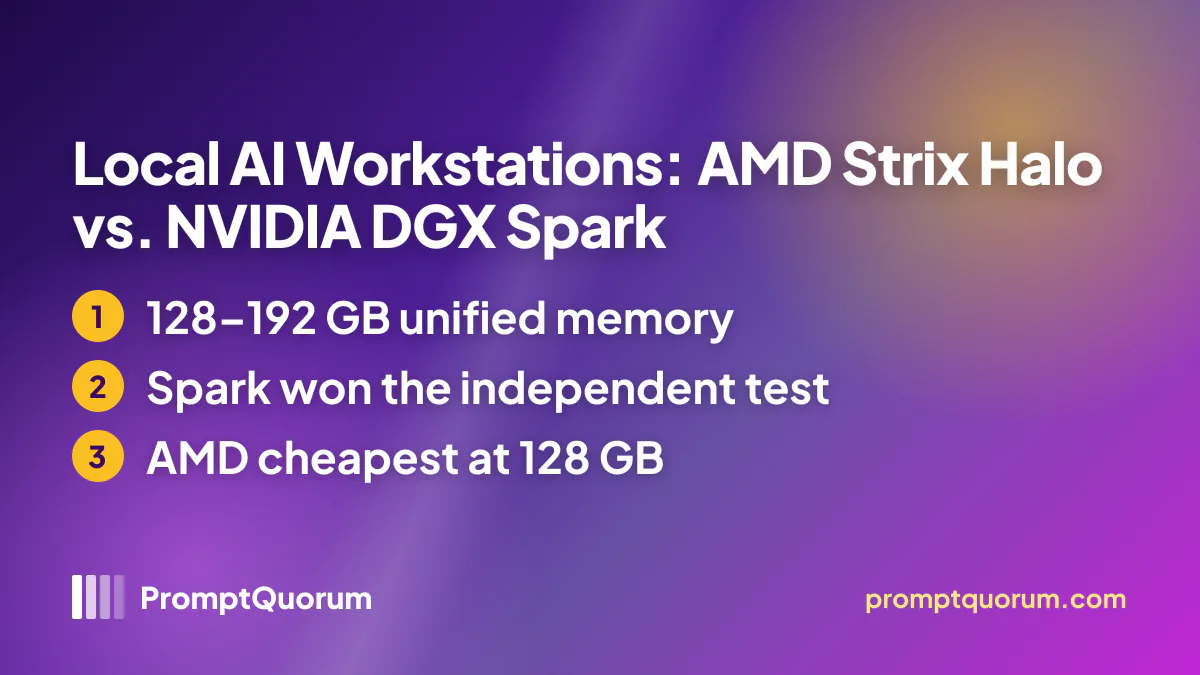
The only head-to-head we found with published numbers is StorageReview's Ryzen AI Halo vs. DGX Spark test, and the Spark won every case. It ran vLLM online serving on Linux at batch 64 across six models. The Spark led by roughly 2–13× in 16 of the 18 scenarios and by about 11–12% in the other two, both decode-heavy runs of smaller dense models. The widest gaps appeared on prefill-heavy work and on the FP4 model, which suits Blackwell hardware.
That test measures multi-request serving throughput. Single-user chat speed depends mostly on memory bandwidth, which is close between the two (256 vs. 273 GB/s), so we would expect a smaller gap there, but it is an expectation and was not measured in that test. AMD's own published comparisons, including those against Intel, are vendor tests and not independent benchmarks.
What Fits in 128 GB vs. 192 GB
Capacity decides what loads; bandwidth and software decide how fast it runs. The table is quantisation arithmetic (parameters × bits per weight, plus working space for context), not a benchmark.
Model class | Quantisation | Weights alone | 128 GB machine | 192 GB machine |
|---|---|---|---|---|
| 70B dense | 8-bit | ~70 GB | Fits, room for context | Fits comfortably |
| 120B-class | 4-bit | ~60–70 GB | Fits comfortably | Fits with large context |
| 200B-class | 4-bit | ~100 GB | Tight once context is added | Fits |
| 300B-class | 4-bit | ~150 GB | Does not fit | Fits with limited context |
Not all memory is available to the GPU by default. How much memory the GPU can address depends on OS, kernel and driver settings, and StorageReview notes the Ryzen AI Halo ships with its variable graphics memory preset to the maximum. Check the vendor guide for your OS and backend (Vulkan or ROCm).
Where Intel Stands
Intel's Panther Lake platform is worth watching but is not yet a large-model machine. The Core Ultra X9 388H with Arc B390 graphics supports up to 96 GB at 153.6 GB/s according to NanoReview, against 192 GB at 256 GB/s for the PRO 495. HotHardware found the Arc B390 ahead of Strix Halo in some OpenVINO workloads, while Strix Halo led in ONNX. Those results compare against the 395, not the PRO 495.
The HP Z2 Mini G1i is a different design again: an Intel workstation with a discrete NVIDIA RTX 4000 SFF Ada card, which means dedicated GPU memory rather than one large shared pool. It belongs in a broader workstation comparison, not in this one.
Which One to Buy
- Cheapest way into 128 GB: an AMD Ryzen AI Max+ 395 machine (Ryzen AI Halo, Minisforum MS-S1 MAX, GMKtec EVO-X2, Corsair). Compare current prices, since they are volatile.
- More than 128 GB: Framework Desktop 192GB or the 192 GB Ryzen AI Halo, accepting a price near a Spark's and a pre-order or limited-retail wait.
- Fastest measured serving, CUDA, fine-tuning or two linked boxes: the DGX Spark, now at a much higher price than at launch.
- Business purchasing and warranty: HP Z2 Mini G1a.
- Not this class: anyone whose models fit in 32–64 GB should read the mini-PC guides first.
Common Mistakes
- Reading 192 GB as "faster than 128 GB". It loads larger models and longer contexts; speed still follows bandwidth, compute and software.
- Treating nine Strix Halo boxes as nine different processors. Check cooling, power limits, ports and warranty instead of the spec-sheet chip name.
- Buying on a launch-era price. Several figures in this class have risen since the summer; the table carries dates for that reason.
- Assuming all unified memory is usable by the GPU. Allocation limits depend on OS, BIOS and backend.
Frequently Asked Questions
Is the AMD Ryzen AI Halo faster than the DGX Spark?
No, in the independent test we found. StorageReview measured the Spark ahead in all 18 vLLM serving scenarios, though two decode-heavy runs were within about 12%.
Can a 192 GB machine run models a Spark cannot?
Yes, in terms of loading: a roughly 300B-class 4-bit model needs about 150 GB for weights alone. Whether it runs at a usable speed depends on bandwidth and software.
Do I need ROCm to run models on Strix Halo?
Not necessarily. llama.cpp can also run through Vulkan; which backend is faster depends on kernel and driver versions, so test both on your setup.
Why not include Apple Silicon?
Macs are a separate category with their own memory tiers and software; see the Mac buying guide linked above.
Is a Core Ultra mini PC with 64 GB a DGX Spark competitor?
No. It has half the memory at best and a far narrower memory bus, so it competes with the mini PCs in our other guides.
Are these machines good for fine-tuning?
NVIDIA states the Spark supports fine-tuning up to 70B parameters; we found no comparable vendor claim or independent test for the AMD machines.