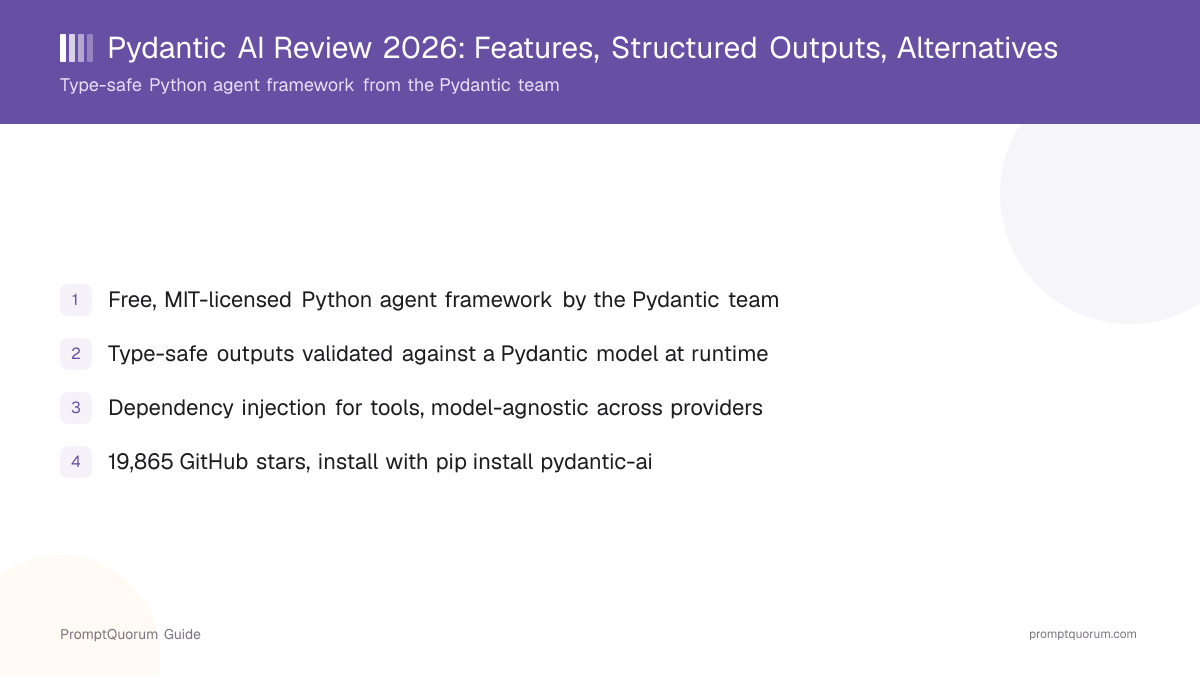
Key Takeaways
- MIT license — free to use, modify, and self-host, including commercially
- GitHub repository pydantic/pydantic-ai has passed 19,865 stars and 2,697 forks (created June 21, 2024)
- PyPI package
pydantic-ai, current stable release 2.42.0 (September 8, 2026) — very actively maintained, with new releases shipping multiple times per week - Core concept: type-safe agents (Pydantic-model-validated outputs), dependency injection for tools, and model-agnostic configuration across major providers
- Built by: the Pydantic team, maker of the Pydantic validation library that underpins the OpenAI SDK, the Anthropic SDK, the Google ADK, and LangChain
- Install:
pip install pydantic-ai, with optional extras such as `pip install "pydantic-ai[temporal]"` for Temporal-backed durable execution
📍 In One Sentence
Pydantic AI is a free, MIT-licensed Python agent framework from the Pydantic team for building type-safe agents, where an output is defined as a Pydantic model and every LLM response is validated against it at runtime, alongside dependency injection for tools and model-agnostic provider support.
💬 In Plain Terms
Pydantic AI lets you tell an LLM agent exactly what shape its answer should have, using the same Pydantic models Python developers already use for data validation, and it rejects or retries responses that don't match — instead of you parsing raw text and hoping it's valid JSON.
📌Note: Pydantic AI's core job is building validated, type-safe single agents, closest in category to Semantic Kernel. See the Local LLM Software Directory for how Pydantic AI fits among agent frameworks at a glance.
From Pydantic to Pydantic AI
Pydantic AI comes from the team behind Pydantic, the Python data-validation library that has become foundational infrastructure across the AI ecosystem — Pydantic models are the underlying validation layer inside the OpenAI SDK, the Anthropic SDK, the Google ADK, and LangChain, among many other tools. The pydantic/pydantic-ai GitHub repository was created on June 21, 2024, applying that same validation-first approach directly to agent outputs.
The project moved quickly from an early package to a declared-stable API: the first public release (v0.0.1) shipped October 30, 2024, and v1.0.0 — the first release the team marked stable for production use — shipped September 5, 2025, roughly 15 months after the repository was created. A v2.0.0 major release followed on June 23, 2026.
Pydantic AI is under very active development as of this review: the pydantic-ai package on PyPI has a current stable release of 2.42.0 (published September 8, 2026), and the GitHub repository has had commits pushed as recently as the day of this review — the project ships new point releases multiple times per week.
The same team separately builds and sells Pydantic Logfire, an OpenTelemetry-based observability platform that integrates with Pydantic AI (and with plain Python code generally) for tracing, debugging, and cost tracking. Logfire is a distinct, optionally paid product — it is not required to use Pydantic AI, and Pydantic AI itself remains free and MIT licensed.
pydantic-ai repository created
- Date:
- 2024-06-21
- What it means:
- The Pydantic team starts a dedicated agent framework built on Pydantic models
First public release (v0.0.1)
- Date:
- 2024-10-30
- What it means:
- Early package published on PyPI, pre-stable API
v1.0.0 — first stable release
- Date:
- 2025-09-05
- What it means:
- The team marks the API stable for production use
v2.0.0 released
- Date:
- 2026-06-23
- What it means:
- Major version bump
v2.42.0 on PyPI
- Date:
- 2026-09-08
- What it means:
- Latest verified stable release as of this review
📌Note: "Pydantic AI" (the agent framework, this article) and "Pydantic" (the underlying data-validation library) are related but distinct projects from the same team and GitHub organization — Pydantic AI depends on Pydantic, but Pydantic itself has no agent features of its own.
What Is Pydantic AI?
Pydantic AI is an open-source Python framework (MIT license, actively maintained, github.com/pydantic/pydantic-ai) for building type-safe LLM agents — agents whose inputs, outputs, and tool calls are described and validated with ordinary Pydantic models rather than loosely parsed text or dictionaries.
- Structured, validated outputs: define an
output_typeas a Pydantic model (or a plain Python type) and Pydantic AI validates the model's response against it at runtime, retrying automatically on a validation failure - Dependency injection: pass a typed
depsobject — a database connection, an HTTP client, an API key, or a test double — into an agent's system prompts and tools, making agent code easier to unit test without real network calls - Model-agnostic design: the documentation describes support for "virtually every model and provider" — OpenAI, Anthropic, Google (Gemini), AWS Bedrock, Azure AI Foundry, Groq, Mistral, xAI, and Ollama among others — with switching providers close to a one-line change
- Tool calling: register a Python function as a tool with a decorator, and Pydantic AI generates the tool's JSON schema automatically from the function's type hints and docstring
- Streaming: agents can stream partial structured output as it is generated, not just raw text tokens
- Durable execution (optional extra): a Temporal integration, installed via `pip install "pydantic-ai[temporal]"`, lets long-running agent workflows survive process restarts
- Observability (optional, separate product): Pydantic Logfire, built by the same team on OpenTelemetry, adds tracing, debugging, and cost tracking for agent runs — it is not required to use Pydantic AI
pip install pydantic-ai

# Minimal example: a type-safe agent with a validated output
from pydantic import BaseModel
from pydantic_ai import Agent

class CityInfo(BaseModel):
    city: str
    country: str
    population: int

agent = Agent('openai:gpt-4o', output_type=CityInfo)
result = agent.run_sync('Tell me about the capital of France.')
print(result.output)  # CityInfo(city='Paris', country='France', population=...)
How Much Does Pydantic AI Cost?
Pydantic AI itself is free under the MIT license — there is no subscription or paid tier for the framework. You pay for your own compute plus any API fees from whichever LLM provider you configure. The team's separate observability product, Pydantic Logfire, does have paid tiers, but it is entirely optional.
- Pydantic AI (the open-source framework): free forever under the MIT license, self-hosted, no usage caps, no account required to run it
- No hosted product or subscription for the framework itself: it is a library you import and run yourself
- Optional cost: API fees from your configured LLM provider (for example, per-token pricing from a cloud model) if you connect a cloud backend instead of a locally served one via Ollama or another OpenAI-compatible endpoint
- Optional companion product: Pydantic Logfire observability has a free Personal tier (10 million spans/logs per month, 1 seat, 3 projects, 30-day retention, no credit card required) and paid Team ($49/month, 5 seats, 5 projects, 10M included spans, $2 per million spans overage) and Growth ($249/month, unlimited seats and projects) plans, effective under a pricing structure that took effect January 1, 2026
How Do You Install and Get Started With Pydantic AI?
Install Pydantic AI from PyPI with pip install pydantic-ai. No cloning or Docker is required for the base framework — Pydantic AI is used as a regular Python import, though optional integrations like durable execution need extra packages.
- 1Install the package:
pip install pydantic-ai. - 2For optional durable execution, install the Temporal extra: `pip install "pydantic-ai[temporal]"`.
- 3Configure an LLM provider — for example, an OpenAI, Anthropic, or Google model string, or a locally served OpenAI-compatible endpoint such as Ollama — via the model identifier passed to
Agent(...). - 4Define the agent's expected output as a Pydantic
BaseModel(or a plain Python type) and pass it asoutput_typewhen constructing theAgent. - 5Optionally register tools with the
@agent.tooldecorator and declare a typeddepsobject for dependency injection into the system prompt and tools. - 6Call
agent.run_sync(...)or the asyncagent.run(...)to execute the agent and receive a validated, typed result. - 7See the Pydantic AI documentation for the full guide to multi-agent patterns, streaming, and the optional Logfire integration.
Do I need Docker or a GPU to run Pydantic AI?
No. Pydantic AI is a Python library that calls an LLM provider you configure — it does not require Docker or local GPU hardware unless you are separately running a local model server.
Does Pydantic AI work with local models?
Yes, if the local model is served through an OpenAI-compatible endpoint, such as Ollama, that you point the Agent's model configuration at — Pydantic AI itself does not ship a built-in model.
Who Should Use Pydantic AI?
Pydantic AI fits Python developers who specifically want validated, type-safe agent outputs and dependency injection for testable tool code, especially teams already using Pydantic for data validation elsewhere. It is a narrower fit for teams that need multi-agent orchestration or a no-code visual builder.
When Should You NOT Use Pydantic AI?
Skip Pydantic AI when your task is primarily about coordinating multiple communicating agents, when you need a visual no-code builder, or when strict output validation is not actually a requirement for the task at hand.
- A task that needs several agents conversing and dividing labor — a multi-agent orchestration framework like CrewAI, AutoGen, or CAMEL models that pattern more directly than a single type-safe agent
- A team that needs a visual, no-code workflow builder — Pydantic AI is code-first with no drag-and-drop interface
- A task where the model's raw text output is genuinely fine as-is (for example, open-ended creative writing) — the validation machinery adds little value when there is no target schema to validate against
- A workflow that needs explicit, persistent, branching state across many steps as its primary concern rather than a single agent's output shape — a graph-based framework like LangGraph models that more directly
- Use Pydantic AI instead specifically when the task benefits from a validated, typed contract between the LLM and the rest of your application, or when you are already invested in the Pydantic ecosystem
Pydantic AI vs. Alternatives
Pydantic AI's closest points of comparison are other Python-first, structured-output-oriented frameworks — Semantic Kernel takes a similarly typed approach across multiple languages, DSPy optimizes prompts programmatically rather than validating outputs, and LangChain offers the broadest general-purpose integration surface.
Tool | Core Job | License | Status | Best For |
|---|---|---|---|---|
| Pydantic AI | Type-safe agents with validated outputs | MIT | Active | Validated outputs, DI-based testing |
| LangChain | General-purpose LLM application framework | MIT | Active | Broadest integration ecosystem |
| Semantic Kernel | Enterprise orchestration SDK (C#/Python/Java) | MIT | Active | Multi-language enterprise stacks |
| DSPy | Programming, not prompting, language models | MIT | Active | Optimizing prompts/weights in one pipeline |
This table compares Pydantic AI against other structured, Python-oriented frameworks with the closest conceptual overlap. It does not include multi-agent orchestration tools like CrewAI or CAMEL, which solve a different problem — coordinating several communicating agents rather than validating a single agent's output.
Common Mistakes When Evaluating Pydantic AI
These mistakes come from confusing Pydantic AI with the underlying Pydantic library, treating Logfire as mandatory, or expecting multi-agent orchestration features it does not primarily provide.
Frequently Asked Questions
Is Pydantic AI still maintained?
Yes. The pydantic/pydantic-ai repository is under very active development; the pydantic-ai package on PyPI has a current stable release of 2.42.0 (September 8, 2026), with new releases shipping multiple times per week.
Is Pydantic AI free to use?
Yes. Pydantic AI is MIT licensed and free for commercial use, modification, and self-hosting. The team's separate Pydantic Logfire observability product has paid tiers, but Logfire is optional and not required to use Pydantic AI.
Who builds Pydantic AI?
The Pydantic team — the same team that builds Pydantic, the Python data-validation library used inside the OpenAI SDK, the Anthropic SDK, the Google ADK, and LangChain.
What is the difference between Pydantic and Pydantic AI?
Pydantic is a general-purpose Python data-validation library with no agent or LLM features. Pydantic AI is a separate agent framework, built by the same team, that uses Pydantic models to define and validate an agent's structured output.
Does Pydantic AI support local models?
Yes, if the local model is served through an OpenAI-compatible endpoint, such as Ollama, that you point the agent's model configuration at.
How do I install Pydantic AI?
Run pip install pydantic-ai. For optional durable execution via Temporal, install the extra: `pip install "pydantic-ai[temporal]"`.
What is Pydantic Logfire, and do I need it?
Pydantic Logfire is a separate, OpenTelemetry-based observability product from the same team, for tracing, debugging, and cost tracking. It is optional — Pydantic AI works fully without it, and Logfire has a free Personal tier if you want it.
What models and providers does Pydantic AI support?
The project describes support for virtually every major model and provider, including OpenAI, Anthropic, Google (Gemini), AWS Bedrock, Azure AI Foundry, Groq, Mistral, xAI, and Ollama, switchable with close to a one-line change.
What license is Pydantic AI released under?
MIT, which permits free commercial use, modification, and self-hosting.
How many GitHub stars does Pydantic AI have?
The pydantic/pydantic-ai repository has passed 19,865 GitHub stars and 2,697 forks, as of September 2026.
How is Pydantic AI different from LangChain?
LangChain is a broader general-purpose LLM application framework with the largest integration ecosystem in this category. Pydantic AI is narrower and validation-first — it centers on defining an agent's output as a Pydantic model and validating every response against it at runtime.