Key Takeaways
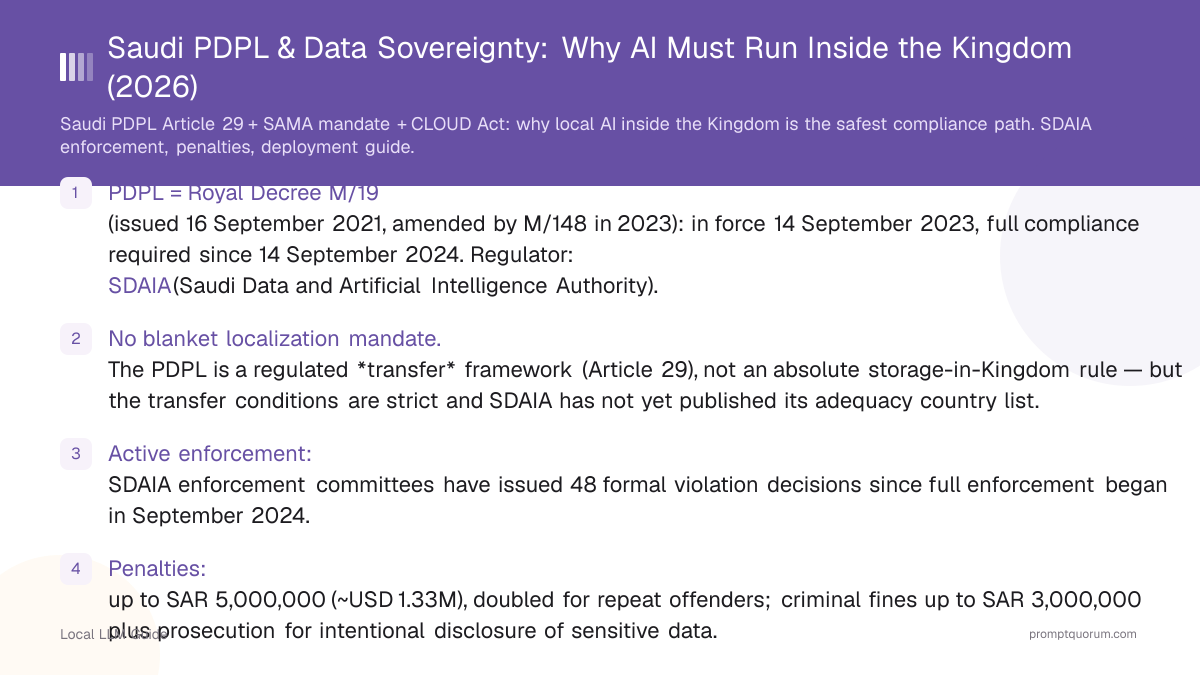
- PDPL = Royal Decree M/19 (issued 16 September 2021, amended by M/148 in 2023): in force 14 September 2023, full compliance required since 14 September 2024. Regulator: SDAIA (Saudi Data and Artificial Intelligence Authority).
- No blanket localization mandate. The PDPL is a regulated *transfer* framework (Article 29), not an absolute storage-in-Kingdom rule — but the transfer conditions are strict and SDAIA has not yet published its adequacy country list.
- Active enforcement: SDAIA enforcement committees have issued 48 formal violation decisions since full enforcement began in September 2024.
- Penalties: up to SAR 5,000,000 (~USD 1.33M), doubled for repeat offenders; criminal fines up to SAR 3,000,000 plus prosecution for intentional disclosure of sensitive data.
- CLOUD Act risk: US-headquartered cloud providers (AWS, Azure, Google Cloud) can be compelled to produce data under 18 U.S.C. § 2713 even from Saudi-region data centers. No US–Saudi bilateral CLOUD Act agreement exists.
- SAMA is stricter: financial institutions must keep core banking, customer, and transaction data physically in-Kingdom and obtain SAMA pre-approval before using any cloud service.
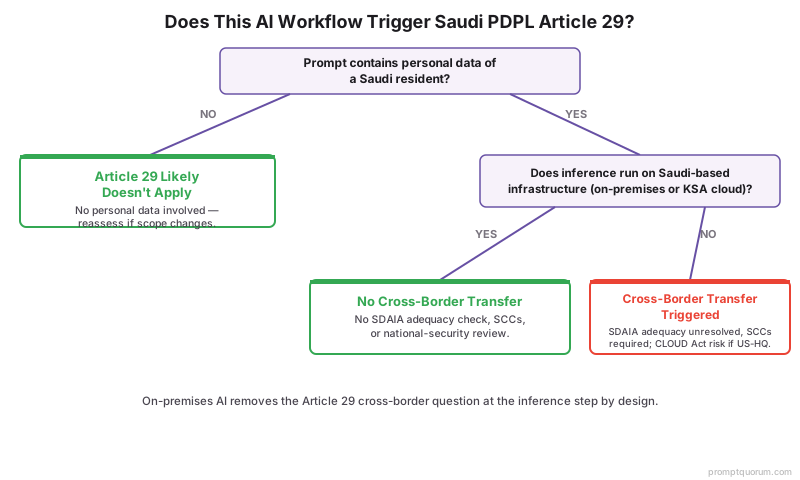
- Local AI removes Article 29 entirely: if inference never leaves your premises, there is no cross-border transfer to regulate, and the CLOUD Act attack surface disappears.
- Not legal advice. Consult your DPO and Saudi-qualified counsel before relying on any compliance position in this article.
📍 In One Sentence
Saudi PDPL Article 29, SAMA financial-sector rules, and the US CLOUD Act together make on-premises local AI the most defensible compliance path for personal data in the Kingdom.
💬 In Plain Terms
Saudi law does not force all data to stay in the country, but moving data abroad is heavily restricted. The simplest way to stay compliant is to run AI on your own hardware inside Saudi Arabia, so no data ever crosses a border.
Saudi PDPL and SDAIA: The Regulatory Landscape
Saudi Arabia's Personal Data Protection Law was enacted by Royal Decree No. M/19 on 16 September 2021, substantially amended by Royal Decree No. M/148 (27 March 2023), and brought into force with its Implementing Regulations on 14 September 2023. A one-year grace period followed; full compliance has been mandatory for all public and private entities since 14 September 2024.
SDAIA (the Saudi Data and Artificial Intelligence Authority) is the competent regulator. It supervises and enforces the PDPL, operates specialized enforcement committees, and is responsible for national data governance and AI strategy under Vision 2030.
Enforcement is real, not theoretical. Since full enforcement began, SDAIA enforcement committees have issued 48 formal decisions confirming PDPL violations. Common violation categories include processing personal data without a valid legal basis, unauthorized disclosure, failure to implement technical and organizational safeguards, and unsolicited marketing.
Extraterritorial scope: the PDPL applies to any processing of the personal data of individuals residing in Saudi Arabia, regardless of where the processing organization is located — the same broad reach model as the GDPR.
Sensitive personal data is a distinct, higher-protection category covering seven types: racial or ethnic origin; religious, intellectual, or political beliefs; criminal records; biometric data used for identification; genetic data; health data; and data indicating unknown parentage. Continuous or large-scale cross-border transfers of sensitive data require a mandatory risk assessment under the Transfer Regulation.
Penalties: administrative fines up to SAR 5,000,000 (~USD 1.33M), which can be doubled for repeat offenses; criminal fines up to SAR 3,000,000 plus possible imprisonment for the intentional disclosure of sensitive personal data to cause harm or for personal gain.
Cloud AI Cross-Border Risks: Article 29, CLOUD Act, and SDAIA Adequacy
Sending a prompt to a cloud AI API is a cross-border data transfer the moment that prompt contains personal data and the inference server sits outside the Kingdom. PDPL Article 29 governs exactly this scenario.
Article 29 imposes three cumulative conditions on any cross-border transfer: (1) the transfer must not prejudice national security or the vital interests of the Kingdom; (2) the recipient jurisdiction must provide a level of data protection at least equivalent to the PDPL, as assessed by SDAIA; and (3) only the minimum necessary personal data may be transferred (data minimization).
SDAIA has not yet published its adequacy country list. Until it does, organizations cannot rely on a simple "this country is adequate" determination. In practice, lawful transfers depend on SDAIA-issued Standard Contractual Clauses (SCCs, four modular variants), Binding Common Rules (BCRs) for intra-group transfers, or a Certificate of Accreditation — each of which adds legal overhead and ongoing risk-assessment obligations.
The US CLOUD Act (18 U.S.C. § 2713) is the structural problem most Saudi enterprises overlook. It requires US-headquartered cloud providers — AWS, Microsoft Azure, Google Cloud — to preserve and produce data in response to a valid US government order, *regardless of where that data is physically stored*. Data sitting in an AWS Riyadh or Azure Saudi region is still reachable.
This creates a direct legal conflict. Saudi Arabia's Cloud Computing Regulatory Framework (CCRF) prohibits cloud service providers from disclosing subscriber data except as required by Saudi law. A US provider served with a CLOUD Act order is simultaneously compelled by US law to disclose and prohibited by Saudi law from doing so. No US–Saudi bilateral CLOUD Act executive agreement exists (only the UK and Australia have signed such agreements with the US), so there is no clean resolution mechanism.
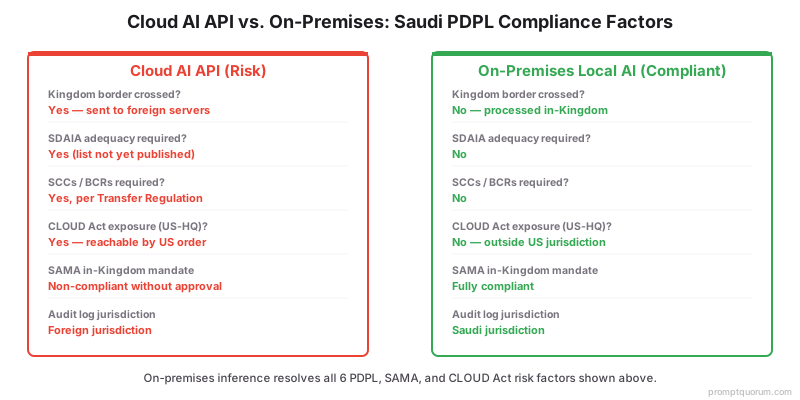
The table below compares the three deployment models against the key Saudi compliance dimensions.
Factor | US-Based Cloud API | Saudi-Region Cloud (AWS/Azure) | On-Premises Local AI |
|---|---|---|---|
| PDPL Article 29 transfer | Triggered — SDAIA approval + adequacy + SCCs required | Data in KSA, but US-HQ provider — adequacy still unresolved | Not triggered — no cross-border transfer |
| CLOUD Act exposure | High — US government can compel production | High — Saudi-region servers give no CLOUD Act protection | None — hardware in Kingdom, outside US jurisdiction |
| SAMA (financial sector) | Non-compliant | Partial — in-KSA datacenter + SAMA approval required | Fully compliant |
| SDAIA enforcement risk | High | Moderate — CLOUD Act gap remains | Minimal |
| Sensitive-data risk assessment | Mandatory at scale | Required for sensitive-data transfers | Not required — no cross-border transfer |
How In-Kingdom Local AI Solves the Compliance Challenge
Running AI on hardware physically located inside Saudi Arabia eliminates the cross-border transfer entirely — and with it, the hardest parts of PDPL compliance.
Article 29 simply does not apply. If a prompt and its inference never leave your premises, there is no transfer to assess, no adequacy determination to wait for, no SCCs to execute, and no transfer risk assessment to file. The single most complex obligation in the PDPL is removed at the architecture level.
The CLOUD Act attack surface disappears. Data processed on your own GPUs, behind your own firewall, is not held by a US-headquartered provider and is therefore not reachable by a US government production order.
SAMA compliance becomes straightforward. Financial institutions that must keep core banking and customer data in-Kingdom can run AI inference on the same in-country infrastructure, with no separate cloud approval and no egress to monitor.
You retain a full audit trail. Every prompt, model, and output stays in logs you control — which is precisely what SDAIA, SAMA, and the NCA expect to see when they audit data flows and access records.
This aligns with national direction. Saudi Arabia declared 2026 the Year of Artificial Intelligence, and the draft Global AI Hub Law (2025) treats data sovereignty as a strategic priority. In-Kingdom local AI is not a workaround — it is the architecture the regulatory environment is actively steering toward.
Tools and Models for In-Kingdom Local AI Deployment
A production local-AI stack needs an inference runtime, a serving layer, and a model — all of which are open-source and deployable on Saudi-hosted hardware.
- Ollama — the simplest way to run open models locally; one-line model pulls, an OpenAI-compatible API, and GPU acceleration out of the box. See What Are Local LLMs? for fundamentals.
- llama.cpp — the underlying inference engine for GGUF-quantized models; maximum control over quantization, context length, and hardware tuning for CPU or GPU.
- vLLM — high-throughput serving for multi-user enterprise workloads; paged attention and continuous batching for concurrent Arabic-language requests.
- Open WebUI — a self-hosted chat front-end with role-based access control and audit logging, suitable for internal teams.
- ALLaM 7B — the Saudi-developed Arabic model (NCAI/SDAIA, now HUMAIN), released under Apache 2.0 with GGUF quantizations on Hugging Face that run directly in Ollama and llama.cpp. The leading publicly self-hostable Arabic model.
- Qwen2.5 — a strong multilingual alternative when you need broad language coverage alongside Arabic; review the trade-offs in Multilingual Local LLMs.
- Hardware sizing — a 7B model needs roughly 6–8 GB of VRAM at Q4_K_M; a 70B model needs 40–48 GB. Use the VRAM Calculator to size your in-Kingdom GPUs before procurement.
SAMA, Government, and Healthcare Sector Notes
Sector-specific rules layer on top of the PDPL and are frequently stricter — particularly on data localization.
Financial services (SAMA). The Saudi Central Bank's "Artificial Intelligence Principles for Financial Institutions" (2023) bind all SAMA-licensed entities to AI governance, risk management, and accountability requirements. SAMA's Cloud Computing Regulatory Framework requires pre-approval before using any cloud service, a separate approval for out-of-Kingdom cloud, and mandates that core banking systems, customer data, transaction records, and payment credentials be physically hosted in Saudi Arabia. The National Cybersecurity Authority (NCA) enforces parallel Essential Cybersecurity Controls (ECC). For financial AI, on-premises inference is the path of least regulatory resistance.
Government and critical infrastructure. The Cloud Computing Regulatory Framework restricts government entities and critical national infrastructure from using foreign cloud services for sensitive workloads. The draft Global AI Hub Law (2025) reinforces sovereign data-center models. Local AI deployment fits this posture directly.
Healthcare. Health data is one of the seven PDPL sensitive-data categories, so it attracts the strictest transfer conditions and mandatory risk assessments at scale. Ministry of Health data-handling expectations push strongly toward in-country processing. Local AI keeps patient data on-premises end to end. See the Local LLM Security & Privacy Checklist for verification steps.
This is not legal advice. Regulatory interpretation depends on your specific data, sector, and processing activities. Consult your DPO and Saudi-qualified legal counsel before acting on anything in this guide.
Frequently Asked Questions: Saudi PDPL and Local AI
Does Saudi PDPL require all data to stay in Saudi Arabia?
No — the PDPL is not a blanket data-localization law. Its Article 29 is a regulated cross-border transfer framework: transfers abroad are permitted only if they meet national-security, adequate-protection, and data-minimization conditions. However, because SDAIA has not yet published its adequacy country list and sector rules (SAMA, health) can mandate in-Kingdom storage, keeping data in the country is often the simplest compliant path.
What is SDAIA and what powers does it have?
SDAIA (the Saudi Data and Artificial Intelligence Authority) is the competent regulator for the PDPL. It supervises compliance, operates enforcement committees, issues Standard Contractual Clauses and transfer guidance, and can impose administrative fines up to SAR 5,000,000 — doubled for repeat offenders. It has issued 48 formal violation decisions since full enforcement began in September 2024.
How does PDPL Article 29 apply to cloud AI services?
When a prompt contains personal data and is sent to an AI inference server outside the Kingdom, that is a cross-border transfer subject to Article 29. You must satisfy the national-security check, demonstrate equivalent protection in the recipient jurisdiction (typically via SDAIA SCCs, since no adequacy list exists yet), and transfer only the minimum necessary data. Running inference locally avoids all of this.
Does AWS Riyadh or Azure Saudi Arabia protect me from PDPL risks?
Partially. Hosting data in a Saudi cloud region helps with physical data residency, but the provider is still US-headquartered and therefore subject to the US CLOUD Act, which can compel data production regardless of storage location. The adequacy question for the provider's home jurisdiction also remains unresolved. On-premises local AI is the only model that removes both issues.
What is the CLOUD Act and why does it matter for Saudi enterprises?
The US CLOUD Act (18 U.S.C. § 2713) requires US-headquartered cloud providers to produce data in response to a valid US government order, even when the data sits in a foreign data center. For Saudi enterprises this conflicts directly with the Cloud Computing Regulatory Framework, which prohibits providers from disclosing data except as required by Saudi law. No US–Saudi bilateral CLOUD Act agreement exists to mediate the conflict.
What penalties can SDAIA impose?
Administrative fines up to SAR 5,000,000 (~USD 1.33M), which can be doubled for repeat offenses. Intentional disclosure of sensitive personal data to cause harm or for personal gain carries criminal penalties — fines up to SAR 3,000,000 and possible imprisonment. Warnings are available as a lesser sanction.
Does SAMA have separate data localization requirements?
Yes, and they are stricter than the general PDPL. SAMA requires financial institutions to keep core banking systems, customer data, transaction records, and payment credentials physically in Saudi Arabia, to obtain pre-approval before using any cloud service, and to get a separate approval for any out-of-Kingdom cloud. The NCA enforces parallel cybersecurity controls. On-premises AI is fully compliant by default.
Which sensitive data categories get stricter treatment under the PDPL?
Seven categories: racial or ethnic origin; religious, intellectual, or political beliefs; criminal records; biometric data used for identification; genetic data; health data; and data indicating unknown parentage. Continuous or large-scale cross-border transfers of these categories require a mandatory risk assessment under the Transfer Regulation.
Does running AI locally eliminate all PDPL obligations?
No — it eliminates the cross-border transfer obligation (Article 29), which is the hardest one, but you still need a lawful basis for processing, must honor data-subject rights (access, correction, deletion), must implement technical and organizational safeguards, and must maintain audit logs. Local deployment makes those remaining obligations easier to satisfy because everything stays under your control.
What is the Saudi Global AI Hub Law draft?
It is a 2025 draft law that emphasizes sovereign AI infrastructure and data-center frameworks designed to keep data and AI processing within the Kingdom while attracting foreign investment. Together with the Cabinet declaring 2026 the Year of Artificial Intelligence, it signals a clear national direction toward in-Kingdom AI capability — which local deployment directly supports.
Sources
- SDAIA — Personal Data Protection Law (official) — sdaia.gov.sa
- ICLG — Data Protection Laws and Regulations: Saudi Arabia 2025–2026 — iclg.com
- A&O Shearman — Enforcement of the Saudi PDPL — aoshearman.com
- Clyde & Co — Enforcement of the Saudi PDP Law is live (March 2026) — clydeco.com
- King & Spalding — International Personal Data Transfers under the Saudi PDPL — kslaw.com
- Chambers & Partners — Data Protection & Privacy 2026: Saudi Arabia — chambers.com
- ITIF — Saudi Arabia Cross-Border Data Transfer Regulation (June 2025) — itif.org
- Kiteworks — SAMA Cloud Computing & Data Residency Compliance — kiteworks.com
- US Congress — CLOUD Act overview (18 U.S.C. § 2713) — congress.gov
- Simmons & Simmons — Cloud Computing Regulatory Framework (CCRF) in Saudi Arabia — simmons-simmons.com