What Bark Actually Does
Bark is a transformer-based, GPT-style generative model for text-to-audio, not a conventional text-to-speech pipeline. Instead of only mapping text to phonemes and waveforms, it generates audio tokens directly from text, which is what lets it produce non-speech sounds and expressive prosody that traditional TTS engines cannot.
- Multilingual speech. Bark supports 13 languages, per its official README: English, German, Spanish, French, Hindi, Italian, Japanese, Korean, Polish, Portuguese, Russian, Turkish, and simplified Chinese.
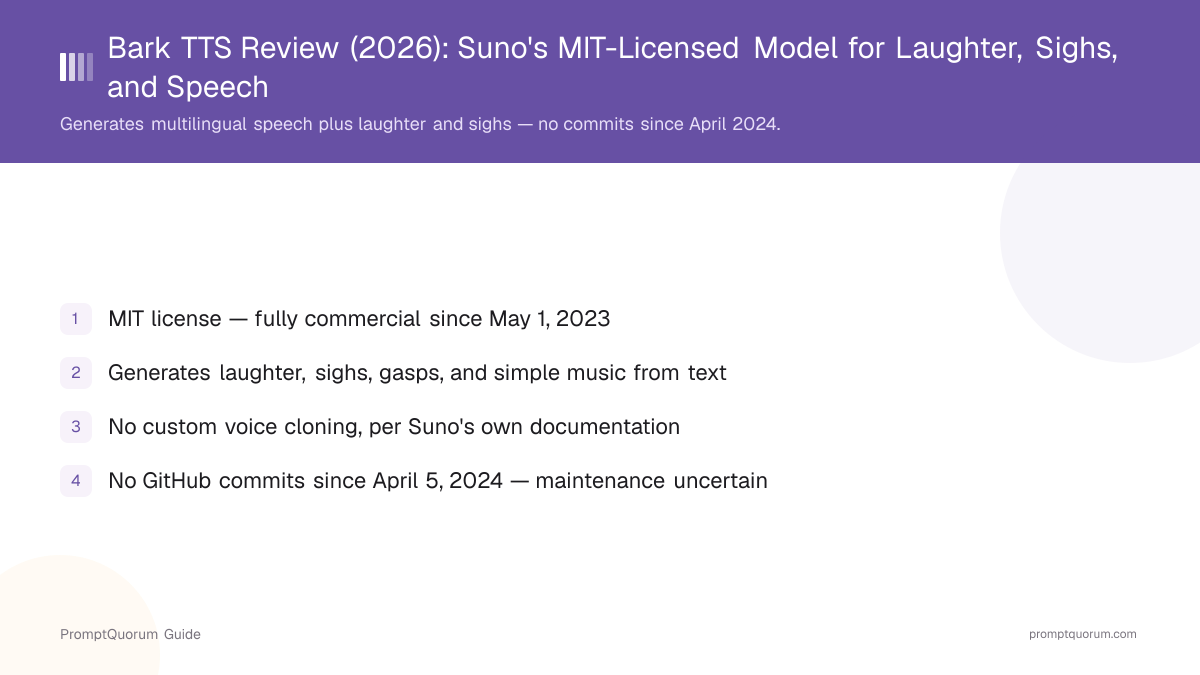
- Non-speech sound generation. Bark can generate `[laughter]
,[laughs],[sighs],[gasps], and[clears throat]as inline text cues, plus simple[music]`, documented directly in its own README — this is the feature that sets it apart from every other local TTS engine covered on PromptQuorum. - 100+ speaker presets. Bark ships with over 100 built-in speaker presets across its supported languages, selectable via a
history_promptargument (for examplev2/en_speaker_6) rather than a reference audio clip. - No custom voice cloning. Suno's own documentation states plainly that Bark "does not currently support custom voice cloning" — it can match the tone, pitch, emotion, and prosody of a given preset, but it cannot clone an arbitrary person's voice from a reference recording the way XTTS v2 does.
- Non-deterministic output. Bark's own README describes it as taking "creative liberties in its generations, resulting in higher-variance model outputs than traditional text-to-speech approaches" — running the same prompt twice can produce noticeably different results.
Real Usage Examples
These commands follow Bark's own documented Python quickstart. Note the installation warning below — it comes directly from the project's README.
- Keep prompts to roughly 13-14 seconds of spoken text. Bark's own README explains this is an architecture limit, not a bug: "Bark is a GPT-style model, and its architecture/context window is optimized to output generations with roughly this length." Longer narration needs to be split into chunks and stitched together.
- Expect variance between runs. Because output is non-deterministic, generate a few takes of any line you need to sound a specific way and pick the best one, rather than assuming the first take is representative.
# Install Bark — do NOT use "pip install bark", which installs an
# unrelated package not managed by Suno.
pip install git+https://github.com/suno-ai/bark.git

# Python API: basic generation
from bark import SAMPLE_RATE, generate_audio, preload_models
from scipy.io.wavfile import write as write_wav

preload_models()

text_prompt = "Hello, my name is Suno. And, uh — and I like pizza. [laughs]"
audio_array = generate_audio(text_prompt)

write_wav("bark_generation.wav", SAMPLE_RATE, audio_array)

# Using a specific speaker preset instead of a random voice
audio_array = generate_audio(
    "This is a specific preset voice speaking a new sentence.",
    history_prompt="v2/en_speaker_6",
)

# Reduce GPU memory use on smaller cards
import os
os.environ["SUNO_OFFLOAD_CPU"] = "True"
os.environ["SUNO_USE_SMALL_MODELS"] = "True"
License and Maintenance Status
Bark is licensed under the MIT License. Its README states plainly: "Bark is now licensed under the MIT License, meaning it's now available for commercial use!" — dated May 1, 2023. Unlike XTTS v2 (non-commercial CPML) or F5-TTS (CC-BY-NC-4.0), there is no commercial restriction on Bark's model weights or outputs. This is a factual summary of the license's general shape, not legal advice — read the MIT License text yourself before commercial deployment.
Maintenance is the real open question, not the license. The public suno-ai/bark repository's commit history shows no commits since April 5, 2024, as of this review's publication. GitHub does not display the repository as archived, and issues continue to be opened by the community, but PromptQuorum found no evidence of maintainer activity, releases, or fixes in that window. Suno, the company, has since become primarily known for its AI music-generation product rather than for Bark, and PromptQuorum could not confirm whether Suno currently assigns any engineering resources to the Bark repository.
Treat "actively maintained" as unconfirmed. If you depend on Bark for a production use case, budget for the possibility that no further updates, security patches, or bug fixes will arrive, and evaluate actively maintained alternatives like Coqui TTS (via the community-maintained idiap/coqui-ai-TTS fork) or Piper if ongoing maintenance matters for your use case.
What license does Bark use?
Bark is licensed under the MIT License, made fully commercial-use-eligible on May 1, 2023, according to its own README. This is not legal advice; read the MIT License text yourself before commercial use.
What Bark Is Not Good For
Bark is a distinctive research-grade generative audio model, not a general-purpose production TTS engine. It is the wrong tool for the following situations:
- Cloning a specific person's voice. Bark's own documentation states it "does not currently support custom voice cloning." If you need to clone a real voice from a short reference recording, XTTS v2 is built for exactly that (though under a non-commercial license) — Bark is not a substitute.
- Production systems that need guaranteed ongoing support. With no commits to the public repository since April 5, 2024 and Suno's public focus having shifted to AI music generation, betting a production dependency on continued Bark maintenance, security patches, or bug fixes is a real risk PromptQuorum cannot rule out.
- Low-latency, real-time applications on modest hardware. Bark's own README states that "on older GPUs, default colab, or CPU, inference time might be significantly slower" than the "roughly real-time" speed it achieves "on enterprise GPUs and PyTorch nightly." A lightweight engine like Piper is a better fit for real-time use on CPU-only or embedded hardware.
- Consistent, repeatable output. Because Bark's own README describes its generations as higher-variance and non-deterministic than traditional TTS, it is a poor fit for any workflow (IVR systems, accessibility tooling, regulated disclosures) that needs the exact same output every time for the same input.
- Long-form narration in a single pass. The roughly 13-14 second generation limit, which Bark's own README attributes to its GPT-style architecture and context window, means audiobook-length or long-podcast narration requires manually splitting text into chunks and stitching the resulting audio files together.
Alternatives to Bark
XTTS v2
- Best fit:
- Actual voice cloning from 6 seconds of reference audio, 17 languages
- License:
- CPML (non-commercial)
Articles about XTTS v2 (9)
- XTTS v2 Review: Multilingual Voice Cloning from 6 Seconds of AudioUpdated September 5, 2026
- Best Local TTS Engine for Mac (2026): What Actually Uses Apple SiliconUpdated September 11, 2026
- Best Local TTS Engine for an NVIDIA GPU Setup (2026)Updated September 11, 2026
- Best Local TTS Engine for Raspberry Pi (2026)Updated September 11, 2026
- Best TTS for Ollama (2026): Adding Voice Output to a Local LLM SetupUpdated September 11, 2026
- Piper vs Chatterbox TTS (2026): Fast Local Speech or Voice Cloning?Updated September 11, 2026
- Piper vs Kokoro TTS (2026): Which Local Voice Engine Should You Use?Updated September 11, 2026
- StyleTTS 2 Review: Columbia's MIT-Licensed Research Model for Natural SpeechUpdated September 6, 2026
- Coqui TTS Review: The Community-Maintained Voice-Cloning ToolkitUpdated September 5, 2026
+5 more not shown
Coqui TTS toolkit
- Best fit:
- Community-maintained toolkit that runs XTTS v2 and other models
- License:
- MPL-2.0
StyleTTS 2
- Best fit:
- Highest natural-sounding English narration quality (no voice cloning)
- License:
- MIT
Articles about StyleTTS 2 (5)
- StyleTTS 2 Review: Columbia's MIT-Licensed Research Model for Natural SpeechUpdated September 6, 2026
- Local Voice & Speech Tools Compared (2026): Text-to-Speech, Speech-to-Text and Voice AgentsUpdated September 20, 2026
- Kokoro vs ElevenLabs: Local TTS vs Cloud Voice AI (2026)Updated September 11, 2026
- Piper vs Kokoro TTS (2026): Which Local Voice Engine Should You Use?Updated September 11, 2026
- Local TTS & Voice Cloning Licenses 2026: Which Engines Allow Commercial Use (Piper, XTTS v2, F5-TTS, Coqui)Updated July 15, 2026
Also mentioned in:
- MLC Chat Review: The Mobile App Built on MLC LLM, Assessed HonestlyUpdated September 7, 2026
Piper
- Best fit:
- Fastest CPU-only synthesis, actively maintained, real-time on a Raspberry Pi
- License:
- GPL-3.0-or-later
ElevenLabs
- Best fit:
- Managed cloud API with commercial voice cloning and active support
- License:
- Proprietary (paid cloud API)
Frequently Asked Questions
What is Bark?
Bark is an open-source, generative text-to-audio model released by Suno that produces realistic multilingual speech plus non-speech sounds like laughter, sighs, and simple music, all from text prompts, without a reference audio clip.
Is Bark free to use commercially?
Yes. Bark is licensed under the MIT License, and Suno's own README states it became fully available for commercial use on May 1, 2023. This is not legal advice; read the MIT License text yourself before commercial deployment.
Can Bark clone a specific person's voice?
No. Suno's own documentation states plainly that Bark "does not currently support custom voice cloning." It can match the tone and prosody of one of its 100+ built-in speaker presets, but it cannot clone an arbitrary voice from a reference recording. For that, see PromptQuorum's review of XTTS v2, which is built specifically for voice cloning (under a non-commercial license).
Is Bark still maintained?
This is uncertain. The public suno-ai/bark GitHub repository shows no commits since April 5, 2024, though it is not marked archived and community issues are still opened. Suno, the company, has since become primarily known for its AI music-generation product rather than for Bark. PromptQuorum could not confirm whether Suno currently assigns engineering resources to the Bark repository.
How long can a single Bark generation be?
Roughly 13-14 seconds of spoken text per generation. Bark's own README attributes this to its GPT-style architecture and context window, not a bug — longer content needs to be split into chunks and stitched together afterward.
Why does the same Bark prompt sometimes produce different results?
Bark's own README describes it as taking "creative liberties in its generations, resulting in higher-variance model outputs than traditional text-to-speech approaches." Running the same prompt twice is expected to sometimes produce noticeably different audio.
How much GPU memory does Bark need?
The full model needs approximately 12 GB of VRAM, per its own README. Setting the SUNO_USE_SMALL_MODELS=True environment variable loads smaller models that fit into approximately 8 GB, and SUNO_OFFLOAD_CPU=True offloads models to CPU between generations to reduce memory use further.
Verdict
Bark remains the most distinctive local text-to-audio model covered on PromptQuorum: nothing else in this comparison set generates laughter, sighs, and simple music from inline text cues under a fully permissive MIT license. For expressive, non-speech-aware audio in personal projects, prototypes, or commercial products where the license needs to be unambiguous, Bark is a genuinely capable and low-risk choice on the licensing side. The two decisions that actually matter for most readers are its lack of custom voice cloning and its uncertain maintenance status: the public GitHub repository has had no commits since April 5, 2024, and Suno's public focus has shifted to AI music generation. If you need to clone a specific person's voice, use XTTS v2 instead (non-commercial license). If you need active maintenance and a fast, permissively licensed engine for production, consider Piper or the community-maintained Coqui TTS toolkit. For a managed commercial alternative, see the ElevenLabs comparison.
Sources
- Bark on GitHub — the official README: languages, speaker presets, non-speech sound tags, license, and installation instructions.
- Bark commit history — the public record of maintenance activity, showing no commits since April 5, 2024 as of this review's publication.
- Bark on Hugging Face — the model card, mirroring the GitHub README's feature and license description.
- XTTS v2 Review — PromptQuorum's dedicated review of the voice-cloning alternative Bark does not provide.
- Local TTS & Voice Cloning Licenses — full licensing comparison across local TTS engines.