What XTTS v2 Actually Does
XTTS v2 is a GPT-based, cross-lingual voice-cloning text-to-speech model. Given a short reference audio clip and target text, it generates speech in the cloned voice, including in a different language than the reference audio.
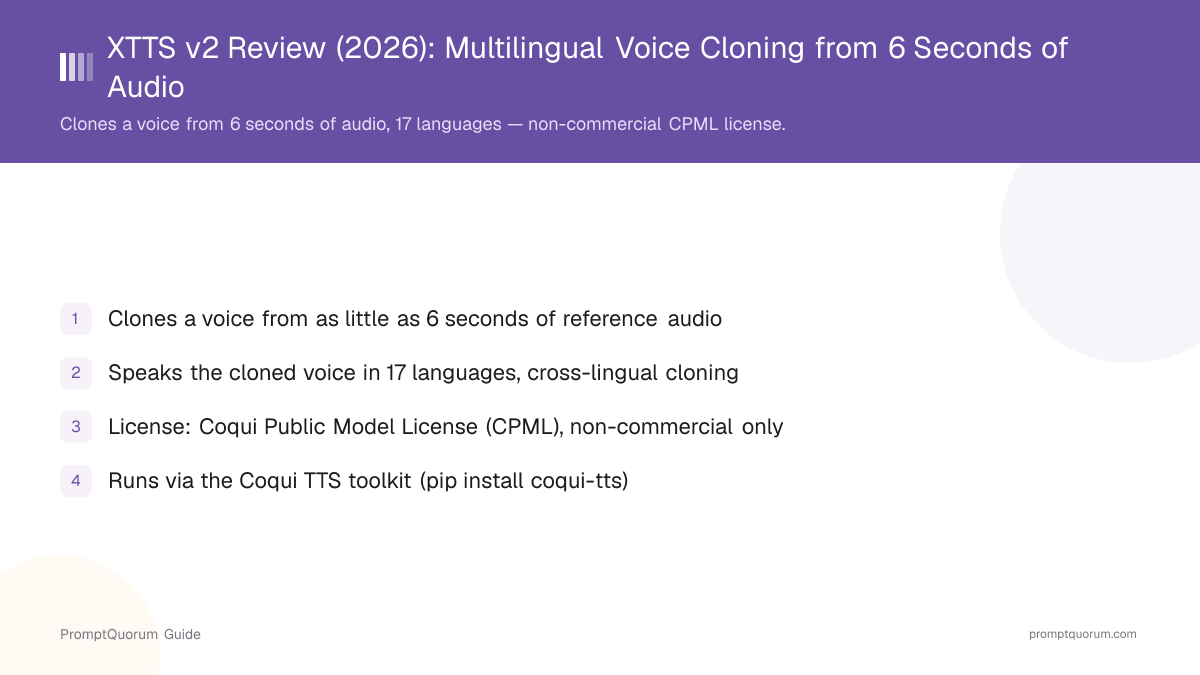
- Few-second voice cloning. A single 6-second reference audio clip is enough to clone a voice, per Coqui's official model card — no fine-tuning or training run is required for a new voice.
- 17-language support with cross-lingual cloning. Supported languages are English, Spanish, French, German, Italian, Portuguese, Polish, Turkish, Russian, Dutch, Czech, Arabic, Chinese (zh-cn), Japanese, Hungarian, Korean, and Hindi — you can clone a voice from English audio and generate speech in any of the other 16 languages with that same cloned voice.
- Streaming inference. XTTS v2 supports streaming synthesis with sub-200ms latency to first audio, documented since the feature was introduced in Coqui TTS v0.20.0 — useful for interactive voice applications where waiting for a full audio file to render is too slow.
- Runs via the Coqui TTS toolkit. The primary supported way to run XTTS v2 is through Coqui TTS (
pip install coqui-tts), which exposes it asTTS("tts_models/multilingual/multi-dataset/xtts_v2"). - Speaker embedding reuse. Beyond passing a raw reference clip each time, the toolkit supports computing and reusing a speaker's latent embedding, avoiding recomputation for repeated synthesis with the same cloned voice.
Real Usage Examples
These commands use the Coqui TTS toolkit's documented Python API, the primary supported way to run XTTS v2.
- Reference audio quality matters. A clean 6-second clip of a single speaker with no background noise or music produces a noticeably better clone than a short, noisy, or multi-speaker clip.
- Non-interactive CPML acceptance is required the first time XTTS v2 loads in an unattended environment (Docker, CI) — set
COQUI_TOS_AGREED=1before that first load.
# Install the toolkit
pip install coqui-tts

# Accept the CPML non-interactively (required for Docker/CI; otherwise an
# interactive prompt appears on first load)
export COQUI_TOS_AGREED=1

# Python API: clone a voice and generate speech
import torch
from TTS.api import TTS

device = "cuda" if torch.cuda.is_available() else "cpu"
tts = TTS("tts_models/multilingual/multi-dataset/xtts_v2").to(device)

# Same-language cloning
tts.tts_to_file(
    text="This is a cloned voice speaking a new sentence.",
    speaker_wav="reference_voice.wav",
    language="en",
    file_path="output_en.wav",
)

# Cross-lingual cloning: clone from English audio, speak Spanish
tts.tts_to_file(
    text="Esta es la misma voz clonada, ahora hablando en español.",
    speaker_wav="reference_voice.wav",
    language="es",
    file_path="output_es.wav",
)

# Streaming synthesis (low latency to first audio)
for chunk in tts.tts_stream(
    text="Streaming audio, chunk by chunk, for interactive use.",
    speaker_wav="reference_voice.wav",
    language="en",
):
    play_audio(chunk)
License and Commercial Use
XTTS v2's model weights and generated audio outputs are licensed under the Coqui Public Model License (CPML) 1.0.0, confirmed via the license file published alongside the model on Hugging Face. The CPML explicitly states it "allows only non-commercial use of a machine learning model and its outputs" — permitted uses include personal projects, academic research, and hobby work, so long as you do not receive direct or indirect payment tied to that use.
There is currently no active commercial licensing path for XTTS v2. The model card lists a contact address, info@coqui.ai, for commercial licensing inquiries, but Coqui AI, the company, shut down its paid services in December 2023 — PromptQuorum could not confirm that this address is actively staffed or that a commercial license is obtainable today. Treat XTTS v2 as non-commercial only unless you independently confirm otherwise before shipping a paid product.
The CPML applies specifically to the XTTS v2 model weights and their outputs — not to the Coqui TTS toolkit code that runs the model, which is separately licensed under MPL-2.0 and does permit commercial use with source-disclosure conditions on toolkit modifications. This paragraph explains the license's general shape; it is not legal advice — read the CPML yourself and consult a lawyer before any commercial deployment.
What license does XTTS v2 use?
XTTS v2 is released under the Coqui Public Model License (CPML) 1.0.0, a non-commercial license that applies to the model weights and their generated audio outputs. It permits personal, research, and hobby use, but prohibits commercial use — any paid product, SaaS tool, or client deliverable — without a separate agreement. This is not legal advice; read the CPML yourself before commercial use.
What XTTS v2 Is Not Good For
XTTS v2 is a high-quality voice-cloning model, not a general-purpose, commercially deployable TTS engine. It is the wrong tool for the following situations:
- Any commercial product without a confirmed license. The CPML is non-commercial, and there is currently no confirmed, active pathway to a commercial license following Coqui AI's 2023 shutdown. Do not ship XTTS v2 in a paid product, ad-supported app, or client deliverable without independently confirming licensing terms first.
- CPU-only, resource-constrained real-time use. XTTS v2 does support low-latency streaming, but that performance assumes GPU acceleration; on CPU alone it is meaningfully slower than a lightweight engine like Piper, and may not be practical for real-time use on modest hardware such as a Raspberry Pi.
- Cloning a voice from very short or noisy audio. While 6 seconds is the documented minimum, a noisy, compressed, or multi-speaker reference clip produces a noticeably worse clone than a clean, single-speaker recording.
- A language outside its supported 17. XTTS v2 supports exactly English, Spanish, French, German, Italian, Portuguese, Polish, Turkish, Russian, Dutch, Czech, Arabic, Chinese (zh-cn), Japanese, Hungarian, Korean, and Hindi — there is no official roadmap for additional languages as of publication.
- Impersonating someone without consent. Cloning a real person's voice without their knowledge or consent raises consent, right-of-publicity, and potentially fraud or impersonation concerns that are independent of the CPML's non-commercial restriction — those apply regardless of license terms, in personal and commercial use alike.
Alternatives to XTTS v2
Piper
- Best fit:
- Fastest CPU-only synthesis, no voice cloning, real-time on a Raspberry Pi
- License:
- GPL-3.0-or-later
Coqui TTS toolkit
- Best fit:
- The software that runs XTTS v2 (and other models) with a broader, permissively licensed codebase
- License:
- MPL-2.0 (toolkit only)
Bark
- Best fit:
- Expressive, non-speech audio — laughter, sighs, ambient sound
- License:
- MIT
Articles about Bark (7)
- Bark TTS Review: Suno's MIT-Licensed Model for Laughter, Sighs, and SpeechUpdated September 6, 2026
- Local Voice & Speech Tools Compared (2026): Text-to-Speech, Speech-to-Text and Voice AgentsUpdated September 20, 2026
- Best Local TTS Engine for Mac (2026): What Actually Uses Apple SiliconUpdated September 11, 2026
- Best Local TTS Engine for an NVIDIA GPU Setup (2026)Updated September 11, 2026
- Best TTS for Ollama (2026): Adding Voice Output to a Local LLM SetupUpdated September 11, 2026
- StyleTTS 2 Review: Columbia's MIT-Licensed Research Model for Natural SpeechUpdated September 6, 2026
- Local TTS & Voice Cloning Licenses 2026: Which Engines Allow Commercial Use (Piper, XTTS v2, F5-TTS, Coqui)Updated July 15, 2026
Also mentioned in:
- Willow Inference Server Review: Self-Hosted Whisper ASR and TTSUpdated September 19, 2026
- Piper vs Kokoro TTS (2026): Which Local Voice Engine Should You Use?Updated September 11, 2026
- MLC Chat Review: The Mobile App Built on MLC LLM, Assessed HonestlyUpdated September 7, 2026
+2 more not shown
StyleTTS 2
- Best fit:
- Highest natural-sounding English narration quality (no voice cloning)
- License:
- MIT
Articles about StyleTTS 2 (5)
- StyleTTS 2 Review: Columbia's MIT-Licensed Research Model for Natural SpeechUpdated September 6, 2026
- Local Voice & Speech Tools Compared (2026): Text-to-Speech, Speech-to-Text and Voice AgentsUpdated September 20, 2026
- Kokoro vs ElevenLabs: Local TTS vs Cloud Voice AI (2026)Updated September 11, 2026
- Piper vs Kokoro TTS (2026): Which Local Voice Engine Should You Use?Updated September 11, 2026
- Local TTS & Voice Cloning Licenses 2026: Which Engines Allow Commercial Use (Piper, XTTS v2, F5-TTS, Coqui)Updated July 15, 2026
Also mentioned in:
- MLC Chat Review: The Mobile App Built on MLC LLM, Assessed HonestlyUpdated September 7, 2026
ElevenLabs
- Best fit:
- Managed cloud API with commercial voice cloning and clear commercial licensing
- License:
- Proprietary (paid cloud API)
Frequently Asked Questions
What is XTTS v2?
XTTS v2 is a multilingual voice-cloning text-to-speech model released by Coqui that clones a voice from as little as 6 seconds of reference audio and generates speech in that voice across 17 languages, including cross-lingual cloning.
Can I use XTTS v2 commercially?
Not without a separate agreement. XTTS v2 is licensed under the Coqui Public Model License (CPML), which permits personal, research, and hobby use but prohibits commercial use — any paid product, SaaS, ad-supported content, or client work. Coqui AI, the company that released it, shut down its paid services in December 2023, and PromptQuorum could not confirm an active commercial licensing pathway exists today. Treat XTTS v2 as non-commercial only.
How much reference audio does XTTS v2 need to clone a voice?
As little as 6 seconds of clean, single-speaker reference audio, per its official Hugging Face model card. A longer, cleaner clip generally produces a more accurate clone.
How many languages does XTTS v2 support?
Exactly 17: English, Spanish, French, German, Italian, Portuguese, Polish, Turkish, Russian, Dutch, Czech, Arabic, Chinese (zh-cn), Japanese, Hungarian, Korean, and Hindi. It supports cross-lingual cloning — clone a voice from audio in one of these languages and generate speech in any of the others.
How do I run XTTS v2?
Install the Coqui TTS toolkit with pip install coqui-tts, then load the model with TTS("tts_models/multilingual/multi-dataset/xtts_v2"). Set the COQUI_TOS_AGREED=1 environment variable first if you need to accept the CPML license non-interactively, such as in a Docker container or CI pipeline.
Do I need a GPU to run XTTS v2?
A GPU is strongly recommended. XTTS v2 runs on CPU, but meaningfully slower — its documented sub-200ms streaming latency assumes GPU acceleration, and CPU-only use is not practical for real-time applications.
What is the difference between XTTS v2 and the Coqui TTS toolkit?
XTTS v2 is a specific voice-cloning model, licensed under the non-commercial CPML. The Coqui TTS toolkit is the software — a Python package and CLI — that runs XTTS v2 and other models, licensed separately under MPL-2.0, which does permit commercial use of the toolkit code itself.
Verdict
XTTS v2 remains one of the highest-quality local voice-cloning models available in 2026, and the combination of a 6-second cloning requirement, 17-language cross-lingual support, and sub-200ms streaming latency is genuinely capable for personal, research, and prototyping use. The decision that actually matters for most readers is the license: the Coqui Public Model License is unambiguously non-commercial, and with Coqui AI having shut down in December 2023, there is no confirmed active pathway to a commercial license today. If your use case is personal, academic, or a non-commercial prototype, XTTS v2 is a strong, well-documented choice. If you need commercial voice cloning, verify licensing terms independently before you build on it, or pair this review with PromptQuorum's coverage of Piper and Bark for permissively licensed alternatives, or the ElevenLabs comparison for a managed commercial option.
Sources
- XTTS v2 on Hugging Face — the model card: languages, cloning requirements, and license reference.
- XTTS v2 LICENSE.txt — the full Coqui Public Model License (CPML) 1.0.0 text.
- idiap/coqui-ai-TTS on GitHub — the actively maintained toolkit that runs XTTS v2, with usage documentation.
- Coqui TTS Review — PromptQuorum's dedicated review of the toolkit, including its post-shutdown maintenance history.
- Local TTS & Voice Cloning Licenses — full licensing comparison across local TTS engines.