Key Takeaways
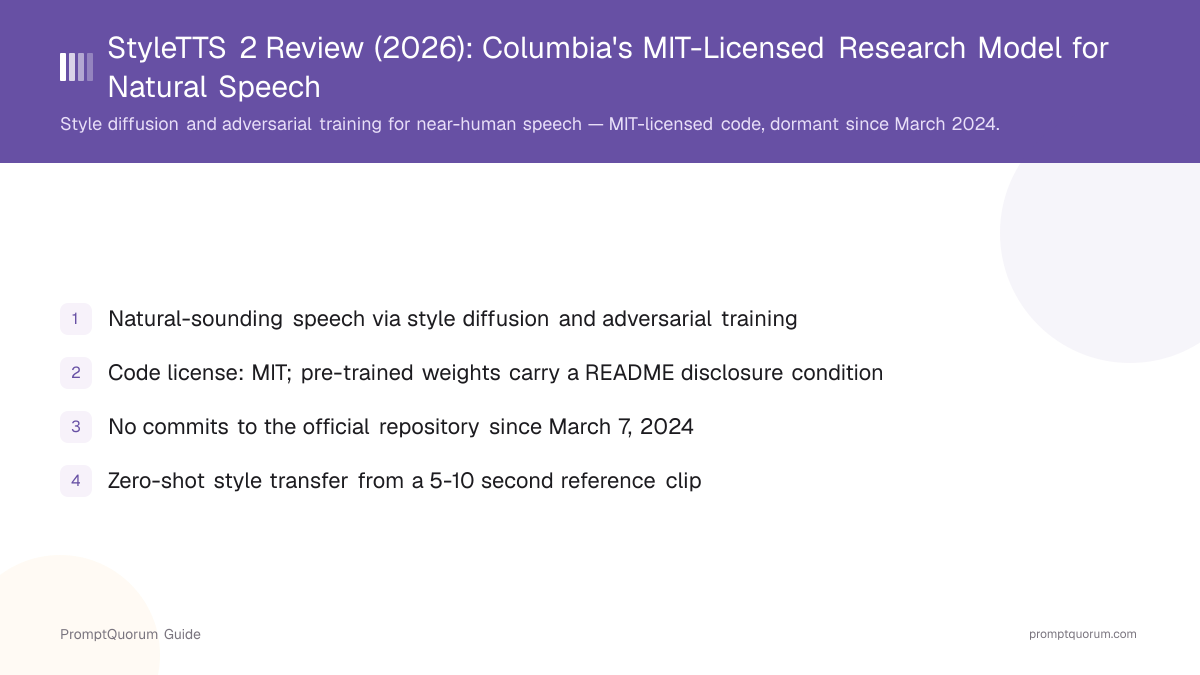
- Natural-sounding speech via style diffusion and adversarial training, matching or exceeding human recordings on standard single-speaker benchmarks per its NeurIPS paper.
- Code license: MIT. Pre-trained model weights carry a separate README disclosure condition, not encoded in the MIT license text.
- Zero-shot style transfer from a 5-10 second reference clip via the LibriTTS multi-speaker checkpoint (15-30 seconds recommended).
- Official inference needs GPL-3.0-licensed espeak-ng; a community pip package avoids it but was last released January 11, 2024.
- No commits to the official repository since March 7, 2024; not archived, 6,300+ GitHub stars.
- Pre-trained checkpoints are primarily English; the text aligner was also trained on Japanese and Chinese corpora and reportedly generalizes to some other languages without fine-tuning.
📍 In One Sentence
StyleTTS 2 is Columbia University's MIT-licensed, research-grade text-to-speech model that produces natural-sounding speech via style diffusion and adversarial training, with a documentation-level disclosure condition on its pre-trained weights and no GitHub commits since March 7, 2024.
💬 In Plain Terms
It is a free, downloadable AI model that turns text into very natural-sounding speech, built by university researchers rather than a company — free to use commercially under its code license, but its own instructions ask you to tell listeners the speech is synthesized, and nobody appears to be actively fixing bugs in it anymore.
📌Note: A GitHub issue on the project (#37) flagged that the README's disclosure requirement for pre-trained models sits outside the MIT license file itself, which some readers find confusing. Read both the LICENSE file and the README's model-usage section yourself before deploying — see the License and Cost section below.
History: A Columbia Research Project
StyleTTS 2 was created by researchers in the Department of Electrical Engineering at Columbia University — Yinghao Aaron Li, Cong Han, Vinay S. Raghavan, Gavin Mischler, and Nima Mesgarani — and published as a NeurIPS 2023 paper titled "StyleTTS 2: Towards Human-Level Text-to-Speech through Style Diffusion and Adversarial Training with Large Speech Language Models."
The paper's central claim is that its combination of style diffusion (modeling speaking style as a latent probability distribution rather than a single fixed vector) and adversarial training against large pre-trained speech language models lets it model human-like speech variation more accurately than earlier approaches. On the single-speaker LJSpeech benchmark, the paper reports StyleTTS 2 matching or exceeding recordings of real human speech in listener evaluations; on the multi-speaker LibriTTS dataset, it reports outperforming previously available public models on zero-shot speaker adaptation.
The public yl4579/StyleTTS2 GitHub repository has accumulated over 6,300 stars, and is not marked archived — but PromptQuorum found no commits to the repository's main branch since March 7, 2024, based on the project's own public commit history. This is consistent with a university research release rather than a commercially maintained open-source product: the code, paper, and pre-trained checkpoints were published to accompany the research, without an ongoing commitment to feature development or bug-fix releases.
A community-maintained pip package, styletts2 by developer Sidharth Rajaram, wraps the original research code into an installable package (pip install styletts2) that swaps out the GPL-3.0-licensed espeak-ng phonemizer for the MIT-licensed gruut library, to keep the whole install chain permissively licensed. Its most recent release on PyPI is version 0.1.6, published January 11, 2024 — also over two and a half years old as of this review, and a separate, third-party project from the original Columbia research code.
Who created StyleTTS 2?
StyleTTS 2 was created by Yinghao Aaron Li, Cong Han, Vinay S. Raghavan, Gavin Mischler, and Nima Mesgarani, researchers in the Department of Electrical Engineering at Columbia University, and published as a NeurIPS 2023 paper.
What StyleTTS 2 Actually Does
StyleTTS 2 is a text-to-speech model that generates a mel-spectrogram (and, in its end-to-end configuration, a raw waveform) from input text, using a diffusion model to sample a latent "style" vector rather than requiring one to be predicted deterministically — this is the mechanism its paper credits with producing more natural, human-like prosody.
- Style diffusion for natural prosody. Instead of predicting a single fixed style embedding from text, StyleTTS 2 samples from a learned probability distribution over styles via diffusion, which its paper reports produces more natural variation in pitch, rhythm, and emphasis than deterministic approaches.
- Adversarial training against speech language models. The training process pits the TTS model against large pre-trained speech language models (SLMs) acting as discriminators, a technique its paper credits with closing the remaining gap to human-recording quality on the LJSpeech benchmark.
- Two officially released pre-trained checkpoints. StyleTTS2-LJSpeech (single English speaker, 24kHz) and StyleTTS2-LibriTTS (multi-speaker English) are both hosted on Hugging Face.
- Zero-shot style transfer from reference audio. The LibriTTS multi-speaker checkpoint can synthesize new text in a style captured from a reference audio clip — the project's own documentation and third-party guides describe a 5-10 second minimum, with 15-30 seconds of clean, single-speaker reference audio recommended for accurate timbre, prosody, and pronunciation.
- Primarily English pre-trained checkpoints, with some multilingual groundwork. The officially released checkpoints are trained on English datasets (LJSpeech, LibriTTS). The paper notes its text aligner component was also pre-trained on Japanese (JVS) and Chinese (AiShell) corpora and "works well for most other languages without fine-tuning," and a multilingual PL-BERT model covering 14 languages is referenced as a starting point for training a non-English StyleTTS 2 model yourself — but there is no officially released, ready-to-use non-English checkpoint.
Install and Run StyleTTS 2: Step by Step
This walkthrough follows the project's own documented setup for running inference with a pre-trained checkpoint.
- 1Clone the repository and install dependencies.
Why it matters: Run `git clone https://github.com/yl4579/StyleTTS2.git && cd StyleTTS2 && pip install -r requirements.txt`. This installs the core Python dependencies listed in the project's own requirements file. - 2Install the phonemizer and espeak-ng.
Why it matters: Run `pip install phonemizer` and, on Linux, `sudo apt-get install espeak-ng` (or the equivalent for your OS). Note that espeak-ng is itself licensed under GPL-3.0 — see the License and Cost section for why that matters for the inference path, not just the StyleTTS 2 code itself. - 3Download a pre-trained checkpoint.
Why it matters: Download either [StyleTTS2-LJSpeech](https://huggingface.co/yl4579/StyleTTS2-LJSpeech/tree/main) (single speaker) or [StyleTTS2-LibriTTS](https://huggingface.co/yl4579/StyleTTS2-LibriTTS/tree/main) (multi-speaker, supports style transfer) from Hugging Face into the project directory. - 4Run inference via the provided notebooks.
Why it matters: The project ships `Demo/Inference_LJSpeech.ipynb` and `Demo/Inference_LibriTTS.ipynb` — open the one matching your downloaded checkpoint in Jupyter to load the model and synthesize your first sample. - 5(Alternative) Use the community pip package for a simpler MIT-only install chain.
Why it matters: Run `pip install styletts2`, then `from styletts2 import tts; my_tts = tts.StyleTTS2(); my_tts.inference("Hello there.", output_wav_file="test.wav")`. This third-party package (last released January 11, 2024) uses the MIT-licensed gruut library instead of espeak-ng, avoiding the GPL-3.0 dependency — at the cost of relying on an also-dormant, unofficial wrapper. - 6(Optional) Provide a reference clip for style transfer.
Why it matters: With the LibriTTS checkpoint, pass a `target_voice_path` argument (community package) or the equivalent reference-audio parameter (official notebook) pointing to a clean, 15-30 second single-speaker WAV file to synthesize new text in that captured style.
Real Usage Examples
These examples show both the community pip package's simplified API and the pattern used in the official project's inference notebooks.
- Reference audio quality matters for style transfer. A clean, single-speaker 15-30 second clip produces noticeably better style transfer than a short, noisy, or multi-speaker reference.
- Two separate dependency chains exist. The official repository's notebook path pulls in GPL-3.0-licensed espeak-ng; the community pip package avoids that with gruut instead — pick the chain that matches your licensing requirements before you build tooling around either one.
# Simplest path: community pip package (MIT-only dependency chain,
# last released 2024-01-11 — verify it still works before depending on it)
pip install styletts2

from styletts2 import tts

my_tts = tts.StyleTTS2()
my_tts.inference(
    "Hello there, this is a natural-sounding synthesized sentence.",
    output_wav_file="test.wav",
)

# Zero-shot style transfer from a reference clip (LibriTTS-style checkpoint)
my_tts.inference(
    "The same text, now spoken in a captured reference style.",
    target_voice_path="reference_voice.wav",
    output_wav_file="styled_test.wav",
)

# Custom checkpoint and config path
custom_tts = tts.StyleTTS2(
    model_checkpoint_path="/path/to/epochs_2nd_00020.pth",
    config_path="/path/to/config.yml",
)

# --- Official repository path (requires espeak-ng, GPL-3.0) ---
# git clone https://github.com/yl4579/StyleTTS2.git
# cd StyleTTS2 && pip install -r requirements.txt
# pip install phonemizer && sudo apt-get install espeak-ng
# Then open Demo/Inference_LJSpeech.ipynb or Demo/Inference_LibriTTS.ipynb
# in Jupyter and run the provided cells against your downloaded checkpoint.
License and Cost
StyleTTS 2's code is licensed under the MIT License, confirmed via the LICENSE file in the official repository. MIT is a permissive license: you can use, modify, and redistribute the code, including commercially, with minimal restriction.
The pre-trained model weights carry a separate, non-license condition stated in the README, not in the LICENSE file itself. The project's README asks users to "inform listeners that speech samples are synthesized by StyleTTS 2 models, unless you have permission to use the voice you synthesize." This is a documentation-level request, not a formal license clause — a GitHub issue on the project (#37) explicitly flagged this as potentially confusing, since the repository's license badge and LICENSE file suggest only MIT terms apply to a reader who does not also read the README's model-usage section. PromptQuorum found no maintainer response resolving that ambiguity in the public issue thread. Treat the disclosure condition as a real, documented request from the authors, and comply with it — but understand it sits outside the formal MIT grant on the code itself, which is a genuinely unusual structure worth flagging before commercial use.
Running official inference pulls in a GPL-3.0-licensed dependency: espeak-ng. The project's own installation instructions call for pip install phonemizer plus a system-level espeak-ng install, and espeak-ng is licensed under GPL-3.0. GPL-3.0 is a copyleft license with distribution obligations distinct from MIT; using espeak-ng as an unmodified external system dependency is generally treated differently from statically linking or redistributing its modified source, but the exact boundary depends on your deployment. The community styletts2 pip package sidesteps this specific issue by using the MIT-licensed gruut library instead of espeak-ng — a real practical difference if you want an all-permissive dependency chain, at the cost of depending on a third-party package with an even older last release date (January 11, 2024) than the official repository.
None of this is legal advice. Read the LICENSE file, the README's model-usage section, and consult a lawyer for your specific deployment before shipping StyleTTS 2 in a commercial product.
What license does StyleTTS 2 use?
StyleTTS 2's code is licensed under MIT. Its pre-trained model weights carry a separate, non-license condition stated in the project's README (disclose synthesized speech unless you have the speaker's permission), which is not part of the formal MIT license text — a distinction a GitHub issue on the project flagged as potentially confusing. This is not legal advice; read the LICENSE file and README yourself before commercial use.
What StyleTTS 2 Is Not Good For
StyleTTS 2 is a research-grade model with genuinely strong output quality, not a polished, actively maintained consumer product. It is the wrong tool for the following situations:
- Readers who want a simple pip-install-and-go experience. Unlike Piper, which is
pip install piper-ttsand a single CLI command away from working audio, the official StyleTTS 2 path involves cloning a research repository, installing a phonemizer, a system-level espeak-ng dependency, and running Jupyter notebooks — a meaningfully higher setup bar. - Production deployment without ML engineering effort. There is no maintained web server mode, no official Docker image, and no company backing ongoing support. Anyone deploying StyleTTS 2 in production should expect to write and maintain their own serving layer around the research code.
- Guaranteed ongoing bug fixes or feature updates. With no commits to the official repository since March 7, 2024, and the community pip package's last release dated January 11, 2024, do not assume active maintenance for either dependency chain — budget for the possibility that you are on your own for any issue you encounter.
- Ready-to-use non-English speech. The officially released pre-trained checkpoints are English-only (LJSpeech, LibriTTS). Training a non-English model yourself is architecturally possible per the paper's notes on its multilingual text aligner and PL-BERT, but requires your own training run — there is no downloadable non-English checkpoint from the project.
- A single, unambiguous license grant on everything you download. Because the code (MIT) and the pre-trained weights (MIT plus a README disclosure condition) are governed slightly differently, and the official inference path pulls in a GPL-3.0 dependency, StyleTTS 2 does not offer the single, simple license story that a project like Bark (fully MIT, no extra conditions) does.
Alternatives to StyleTTS 2
Piper
- Best fit:
- Simple pip-install-and-go setup, fastest CPU-only synthesis, real-time on a Raspberry Pi
- License:
- GPL-3.0-or-later
XTTS v2
- Best fit:
- Packaged voice cloning from 6 seconds of reference audio, 17 languages
- License:
- CPML (non-commercial)
Coqui TTS toolkit
- Best fit:
- Flexible multi-backend toolkit with broad language support and a maintained fork
- License:
- MPL-2.0
Bark
- Best fit:
- Expressive, non-speech audio — laughter, sighs, ambient sound, single unambiguous MIT license
- License:
- MIT
ElevenLabs
- Best fit:
- Managed cloud API with commercial voice cloning and active support, no self-hosting effort
- License:
- Proprietary (paid cloud API)
Frequently Asked Questions
What is StyleTTS 2?
StyleTTS 2 is an open-source text-to-speech model from researchers at Columbia University that generates natural-sounding speech using style diffusion and adversarial training with large speech language models, published as a NeurIPS 2023 paper.
Is StyleTTS 2 free to use commercially?
Its code is licensed under MIT, which permits commercial use. Its pre-trained model weights carry a separate, non-license condition in the README asking you to disclose synthesized speech unless you have the speaker's permission. This is not legal advice; read the LICENSE file and README yourself before commercial deployment.
Can StyleTTS 2 clone a voice?
Its LibriTTS multi-speaker checkpoint supports zero-shot style transfer from a reference audio clip (5-10 seconds minimum, 15-30 seconds recommended), which is similar in spirit to voice cloning. It is not packaged as a simple, one-line cloning feature the way XTTS v2 is — using it requires the notebook-based official workflow or the community pip package.
Is StyleTTS 2 still maintained?
The official GitHub repository is not marked archived, but PromptQuorum found no commits since March 7, 2024. The community pip package that simplifies installation was last released January 11, 2024. Treat both as dormant research artifacts rather than actively developed software.
Does StyleTTS 2 support languages other than English?
The officially released pre-trained checkpoints (LJSpeech, LibriTTS) are English-only. The paper notes its text aligner component was also trained on Japanese and Chinese corpora and generalizes reasonably to other languages without fine-tuning, and references a 14-language multilingual PL-BERT model as a starting point for training your own non-English model — but there is no ready-to-use, officially released non-English checkpoint.
Why does StyleTTS 2's official install need espeak-ng, and why does that matter?
The official inference path uses the phonemizer library with espeak-ng as its backend for converting text to phonemes. espeak-ng is licensed under GPL-3.0, a copyleft license with different distribution obligations than MIT. A community pip package (styletts2) avoids this by using the MIT-licensed gruut library instead, at the cost of depending on an even older, unofficial release (last updated January 11, 2024).
How does StyleTTS 2 compare to XTTS v2?
StyleTTS 2's code is MIT-licensed and free for commercial use (with the README disclosure condition on the weights); XTTS v2 is licensed under the non-commercial Coqui Public Model License. StyleTTS 2's official setup is more research-grade and requires more manual work; XTTS v2 ships a simpler, packaged voice-cloning API through the Coqui TTS toolkit. Choose based on your licensing needs and tolerance for setup complexity.
Verdict
StyleTTS 2 remains genuinely impressive on output quality: its style diffusion and adversarial training approach is credited in its own NeurIPS paper with matching or exceeding human-recording quality on the LJSpeech benchmark, under a code license (MIT) that is about as permissive as it gets. What keeps it from being an easy recommendation for most readers is everything around that core model: a documentation-level disclosure condition on the pre-trained weights that sits outside the formal MIT grant, an official inference path that pulls in a GPL-3.0 dependency, a community pip package that avoids that dependency but is itself over two and a half years stale, and no commits to the official repository since March 7, 2024. If you want the highest natural-sounding English narration quality available locally and are comfortable with research-grade setup and an unmaintained dependency chain, StyleTTS 2 delivers. If you want a simpler install, active maintenance, or packaged voice cloning, pair this review with PromptQuorum's coverage of Piper for fast CPU-only synthesis, XTTS v2 for packaged voice cloning, or the ElevenLabs comparison for a fully managed alternative. This review is the last of six local speech-to-text and text-to-speech engines PromptQuorum has reviewed in depth, alongside Whisper.cpp, Faster Whisper, Piper, Coqui TTS, XTTS v2, and Bark.
Sources
- StyleTTS 2 on GitHub — the official repository: README, LICENSE, install instructions, and commit history.
- StyleTTS 2 paper (arXiv) — "Towards Human-Level Text-to-Speech through Style Diffusion and Adversarial Training with Large Speech Language Models," the NeurIPS 2023 paper.
- GitHub Issue #37: Possibly misleading license info — the community-flagged discrepancy between the MIT LICENSE file and the README's model-usage disclosure condition.
- styletts2 on PyPI — the community-maintained pip package (Sidharth Rajaram), version 0.1.6, published January 11, 2024.
- StyleTTS2-LJSpeech and StyleTTS2-LibriTTS on Hugging Face — the official pre-trained checkpoints.
- Local TTS & Voice Cloning Licenses — full licensing comparison across local TTS engines.