Haystack是什么?
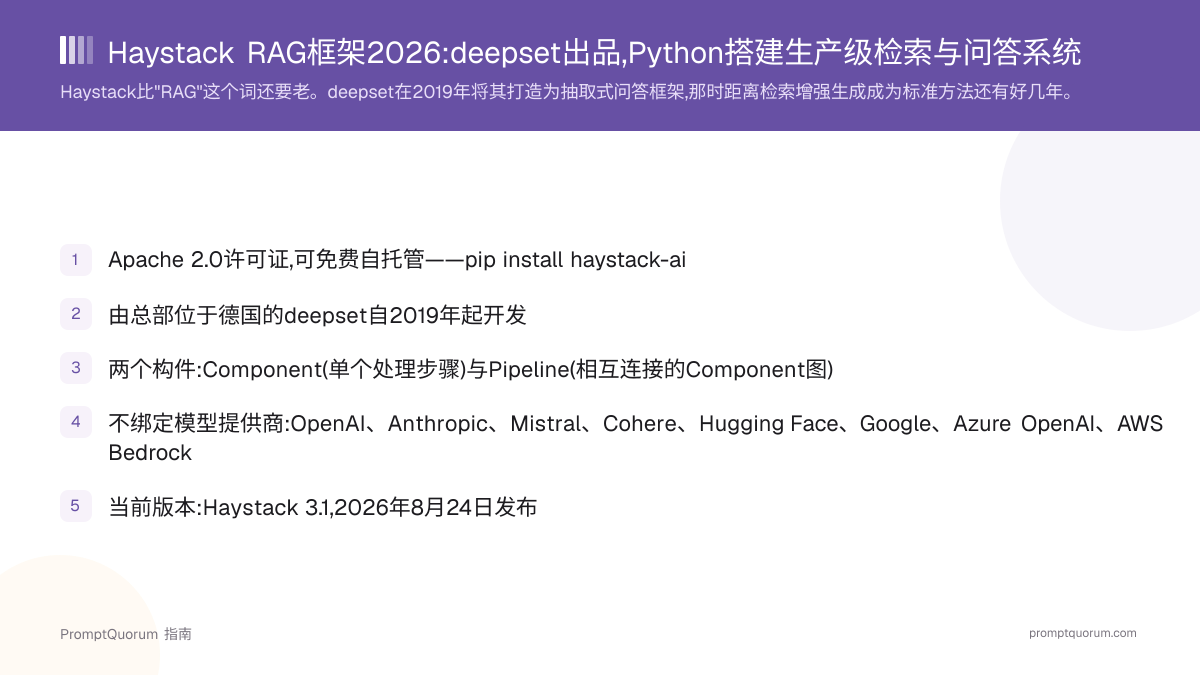
Haystack是一个开源Python框架(Apache 2.0,github.com/deepset-ai/haystack),用于构建搜索、问答和检索增强生成(RAG)应用。由总部位于德国的deepset维护,通过pip install haystack-ai安装。
- 2019年以抽取式问答框架起步——在文档中定位精确的答案片段——早于生成式LLM让RAG成为主流模式
- 围绕Haystack 2.0大幅重写为当前的Component/Pipeline架构,目前版本为3.2.0(2026年9月24日发布)
- 提供文档转换(PDF、HTML、DOCX)、文本切分、embedding、retrieval(基于关键词的BM25与向量/语义)、生成与评估等Component
- Document Store抽象将管道逻辑与存储后端解耦——无需重写管道即可将内存存储替换为Elasticsearch、Weaviate或Pinecone
- 开箱自带内存文档存储,用于本地开发和测试,无需外部数据库即可上手
- 同一管道内同时支持关键词retrieval(BM25)和向量/语义retrieval,还支持结合两者的混合retrieval
Haystack的Pipeline/Component架构如何运作?
Component是单个处理步骤(retriever、embedder、generator等),Pipeline是通过显式.add_component()和.connect()调用连接起来的Component有向图,步骤之间的数据流在代码中清晰可见,而不是藏在链对象里。
- Pipeline可序列化为YAML——用Python构建的pipeline可以保存、纳入版本管理,并在不重新运行构建代码的情况下重新加载
- 分支与合并是图模型的原生能力——一个retriever的输出可以同时喂给两个不同的generator,或两个retriever可以同时喂给一个ranker,无需额外的胶水代码
- 由于连接是显式的,出错的pipeline(类型不匹配、缺少连接)会在pipeline构建阶段就报出清晰的错误,而不是在运行时深藏在调用栈中才失败
Component
Component封装一个工作单元——获取文档、生成文本embedding、构建prompt、调用LLM、转换文件。每个Component都声明带类型的输入输出,因此一个输出Document对象列表的Component,只能连接到接受该类型的输入。可通过继承基类Component并实现run()来编写自定义Component。
Pipeline
Pipeline实例保存各个Component及它们之间的连接。用pipeline.add_component("名称", component_instance)注册每个步骤,再用pipeline.connect("来源.输出", "目标.输入")把它们连起来。调用pipeline.run(...)会按依赖顺序执行整个图,并返回每个未被下游消费的Component的输出。
Haystack与LangChain、LlamaIndex有何不同?
Haystack、LangChain和LlamaIndex都是code-first的Python框架,开源核心中都没有可视化构建器——区别在于各自的核心抽象。Haystack围绕由带类型Component组成的显式Pipeline图组织一切;LlamaIndex围绕在你的数据上构建的Index组织,Retriever和QueryEngine对象位于其上;LangChain围绕chain组织,其LangGraph扩展则围绕面向agent的state graph组织。
Haystack的Pipeline/Component模型
每一步——retrieval、prompting、生成——都是通过显式.connect()调用接入Pipeline的命名Component。没有任何隐式行为:如果两个Component没有连接,数据就不会在它们之间流动。这让pipeline易于检查、可按Component逐一进行单元测试,并可序列化为YAML用于版本控制。
LlamaIndex以索引为中心的模型
LlamaIndex的核心是在文档集合上构建Index(向量、列表、树或关键词索引),再通过Retriever和QueryEngine对其查询。它针对数据摄取和索引的便利性做了优化——几行代码就能索引一个文件夹并开始查询——但不像Haystack那样要求显式的逐步接线。
这在实践中意味着什么
Haystack的显式图往往在生产系统中更有价值——需要准确掌握每一步以何种顺序运行,并能在不触碰其余部分的情况下替换某一步(换一个retriever、换一个generator)。当任务是"索引这批数据,让我能查询"时,LlamaIndex的索引抽象往往能更快完成原型搭建。
Haystack支持RAG和生产级搜索吗?
支持——检索增强生成和生产级搜索是Haystack的核心用例,该框架在同一管道中支持关键词搜索、向量搜索和混合retrieval。
- RAG管道:retriever(BM25、向量或混合)将相关文档送入prompt builder,再送入generator(一次LLM调用)——这正是这个框架早于其得名就已预见、如今直接支撑的标准模式
- Retriever:BM25关键词retrieval和基于embedding的(向量/语义)retrieval都是一等能力;混合retrieval结合两者,并对合并结果重新排序
- Document Store:开发环境自带内存存储;生产部署可通过同一Component接口连接Elasticsearch、Weaviate、Pinecone等支持的向量数据库
- Agent:Haystack包含agent Component,可让模型自行决定接下来调用哪个工具或管道步骤,而不是遵循固定顺序
- 评估:Haystack提供评估Component,用于对照带标注的数据集衡量retrieval和生成质量——这对需要可衡量相关性的生产级搜索很关键
如何搭建第一个Haystack管道?
一个最小的RAG管道需要三个相连的Component:一个retriever、一个prompt builder和一个generator,把它们接入Pipeline对象并用查询运行。
- 1安装包:pip install haystack-ai。
- 2导入所需模块:from haystack import Pipeline, Document; from haystack.components.generators.chat import OpenAIChatGenerator; from haystack.components.retrievers import InMemoryBM25Retriever; from haystack.document_stores.in_memory import InMemoryDocumentStore; from haystack.components.builders import ChatPromptBuilder; from haystack.utils import Secret。
- 3创建document store并写入文档:document_store = InMemoryDocumentStore(),然后document_store.write_documents([Document(content="..."), ...])。
- 4创建各Component:retriever = InMemoryBM25Retriever(document_store=document_store)、prompt_builder = ChatPromptBuilder(template=prompt_template, required_variables="*")、llm = OpenAIChatGenerator(api_key=Secret.from_env_var("OPENAI_API_KEY"), model="gpt-4o-mini")。
- 5组装管道:rag_pipeline = Pipeline(),然后rag_pipeline.add_component("retriever", retriever)、rag_pipeline.add_component("prompt_builder", prompt_builder)、rag_pipeline.add_component("llm", llm)。
- 6连接各步骤:rag_pipeline.connect("retriever", "prompt_builder.documents") 和 rag_pipeline.connect("prompt_builder", "llm")。
- 7运行:results = rag_pipeline.run({"retriever": {"query": question}, "prompt_builder": {"question": question}})。
from haystack import Pipeline, Document
from haystack.components.generators.chat import OpenAIChatGenerator
from haystack.components.retrievers import InMemoryBM25Retriever
from haystack.document_stores.in_memory import InMemoryDocumentStore
from haystack.components.builders import ChatPromptBuilder
from haystack.utils import Secret

document_store = InMemoryDocumentStore()
document_store.write_documents([
    Document(content="My name is Jean and I live in Paris."),
    Document(content="My name is Mark and I live in Berlin."),
    Document(content="My name is Giorgio and I live in Rome."),
])

retriever = InMemoryBM25Retriever(document_store=document_store)
prompt_builder = ChatPromptBuilder(template=prompt_template, required_variables="*")
llm = OpenAIChatGenerator(api_key=Secret.from_env_var("OPENAI_API_KEY"), model="gpt-4o-mini")

rag_pipeline = Pipeline()
rag_pipeline.add_component("retriever", retriever)
rag_pipeline.add_component("prompt_builder", prompt_builder)
rag_pipeline.add_component("llm", llm)
rag_pipeline.connect("retriever", "prompt_builder.documents")
rag_pipeline.connect("prompt_builder", "llm")

results = rag_pipeline.run({"retriever": {"query": question}, "prompt_builder": {"question": question}})
试用Haystack需要OpenAI API密钥吗?
上面的示例使用OpenAIChatGenerator,但Haystack还提供Hugging Face、Anthropic、Mistral、Cohere、Google、Azure OpenAI、AWS Bedrock的generator Component,以及本地模型集成——不会被绑定在某一个模型提供商上。
入门需要向量数据库吗?
不需要。InMemoryDocumentStore无需任何外部服务,足以在本地搭建和测试管道。只有迁移到生产规模时才需要换成Elasticsearch、Weaviate或Pinecone。
Haystack适合哪些人?
Haystack适合需要对生产级搜索或RAG管道保持显式控制、并且熟悉Python的团队——在开源核心层面,它不是无代码或可视化工具。
适合使用Haystack的情况
- 你在构建生产级搜索、问答或RAG系统,retrieval质量需要被衡量和调优,而不只是接上就完事
- 你想要一个可检查的显式管道图,能够按Component逐一做单元测试,而不是一条隐式的链
- 你需要在不重写管道其余部分的情况下更换retriever、document store或模型提供商
- 你熟悉Python,想要的是一个框架而不是托管产品——Haystack自托管、code-first,在Apache 2.0下免费使用
应避免使用Haystack的情况
- 你希望无代码或可视化构建器作为主要界面——开源框架是code-first的,可视化层只存在于deepset的付费Enterprise Platform中
- 你的任务更接近"索引这个文件夹并让我以最少设置进行查询"——对于这类特定任务,LlamaIndex以索引为中心的API通常能更快得到首个答案
- 你需要原生的JavaScript/TypeScript框架——Haystack的开源SDK仅支持Python
- 你对搜索质量指标(BM25 vs. 向量 vs. 混合、retrieval评估)不感兴趣,只想让LLM在无需调优的情况下回答少量文档上的问题
Haystack对比其他方案
以下三个框架都是开源、以Python为主并积极维护——选择取决于哪种核心抽象更符合你团队思考管道的方式。
工具 | 核心抽象 | 许可证 | 最适合 |
|---|---|---|---|
| Haystack | 带类型Component组成的Pipeline | Apache 2.0 | 生产级搜索/可衡量的RAG |
| LlamaIndex | Index + Retriever + QueryEngine | MIT | 快速数据摄取/索引 |
| LangChain | Chain / LangGraph state graph | MIT | 通用LLM应用与agent胶水代码 |
评估Haystack时的常见误区
这些误区源于把Haystack当成托管SaaS产品,或当成另一个框架抽象的直接替代品。
误区一:以为Haystack是托管产品
开源框架(pip install haystack-ai)是自托管代码,不是需要订阅的SaaS。deepset的商业产品——Haystack Enterprise Platform和Haystack Enterprise Starter——是建立在同一开源核心之上的独立付费层,不是使用它的前提条件。
误区二:期待LlamaIndex那种"三行代码索引一个文件夹"的便利
Haystack显式的Pipeline/Component模型用一部分快速上手的便利性换取了可见性和控制力。如果任务纯粹是"指向一个文件夹,开始查询",预期需要比LlamaIndex以索引为中心的API更多的配置——回报会在后期显现,即需要在生产环境中替换或调试某一步骤时。
误区三:把Document Store的选择拖到生产阶段才决定
InMemoryDocumentStore便于开发,但并非为生产规模或持久化而设计。应尽早确定生产环境的Document Store(Elasticsearch、Weaviate、Pinecone或其他受支持的后端),因为retriever行为和索引策略可能因后端而异。
常见问题
Haystack是什么?
Haystack是总部位于德国的deepset开发的开源Python框架,用于搜索、问答和RAG管道。许可证为Apache 2.0,通过pip install haystack-ai安装。
谁开发了Haystack?
总部位于德国的deepset。deepset于2019年启动Haystack,当时是抽取式问答框架,早于检索增强生成成为常用术语。
Haystack采用什么许可证发布?
Apache License 2.0。源代码位于github.com/deepset-ai/haystack,可自由使用、修改和自托管。
Haystack目前的版本是多少?
Haystack 3.2.0,于2026年9月24日发布。该框架围绕Haystack 2.0进行了大幅重写,形成了当前的Component/Pipeline架构。
Haystack中Component和Pipeline有什么区别?
Component是单个处理步骤——retriever、embedder、prompt builder或generator。Pipeline是通过显式.add_component()和.connect()调用连接起来的Component图;运行pipeline会按依赖顺序遍历整个图。
Haystack与LlamaIndex有何不同?
Haystack围绕接入Pipeline图的显式、带类型Component组织管道。LlamaIndex围绕在你的数据上构建Index、再通过Retriever和QueryEngine查询来组织。开始索引数据通常LlamaIndex更快;Haystack的显式图为生产管道提供了更高的可见性和控制力。
Haystack与LangChain有何不同?
两者都是code-first的Python框架,开源核心中都没有可视化构建器。LangChain围绕chain组织,并通过LangGraph提供面向agent的state graph。Haystack围绕由带类型Component组成的Pipeline组织,将retrieval和搜索当作一等、可衡量的关切,而不是通用chain中的一环。
Haystack需要特定的向量数据库吗?
不需要。Haystack为开发环境自带内存Document Store,并通过同一Component接口集成多种向量数据库和搜索后端,包括Elasticsearch、Weaviate和Pinecone——切换后端无需重写管道。
deepset的Haystack Enterprise Platform是什么?
这是deepset在开源Haystack框架之上构建的付费商业产品,增加了可视化管道构建器以及托管或自托管的部署选项。它与本评测所讨论的免费、自托管、Apache 2.0开源框架是分开的。