Key Takeaways
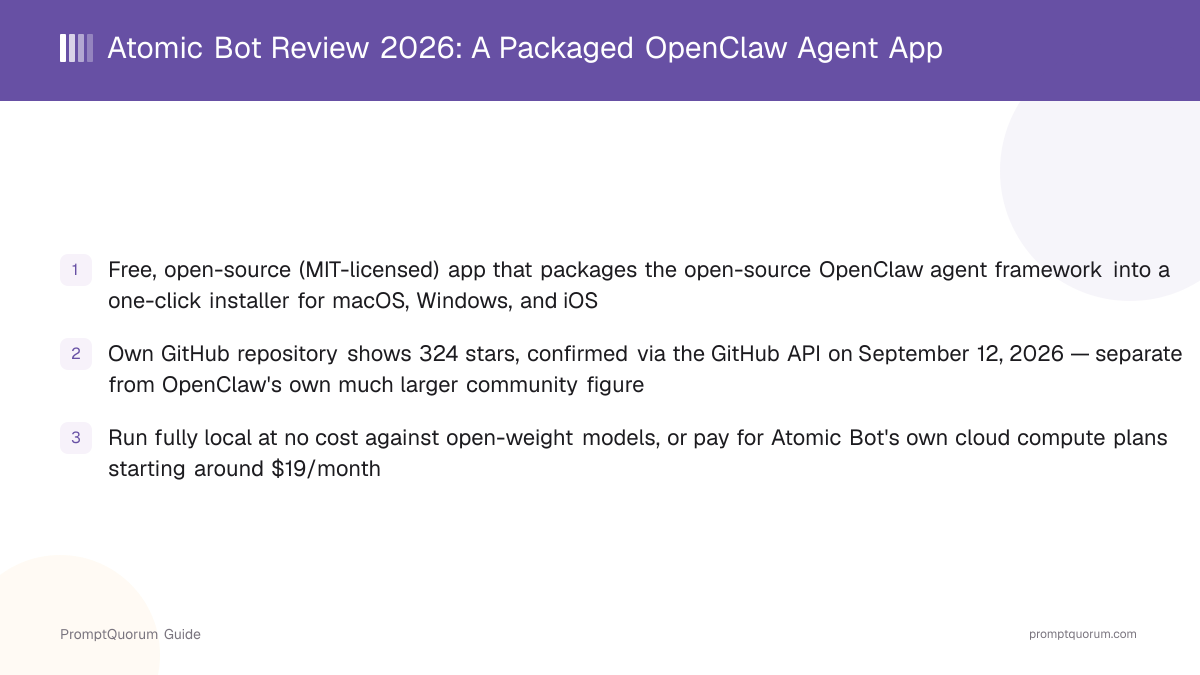
- Atomic Bot is free and open-source; its own GitHub repository is MIT-licensed, confirmed via the GitHub API on September 12, 2026
- The repository shows 324 stars as of that date — this is Atomic Bot's own repo count, not the much larger figure sometimes cited for the underlying OpenClaw ecosystem
- Packages the open-source OpenClaw agent framework into a native installer; also supports the alternative Hermes Agent backend
- Local mode: connects to open-weight models (Llama, Gemma, Qwen, Mistral, Phi family) via Hugging Face, fully offline, at no cost
- Cloud mode: connects to OpenAI, Anthropic, Mistral, Groq, and other providers, or runs on Atomic Bot's own paid cloud infrastructure
- Available for macOS (DMG), Windows (EXE), and iOS (App Store)
- Cloud compute plans are tiered, starting around $19/month per atomicbot.ai — reconfirm current pricing before budgeting, since plan details change
📍 In One Sentence
Atomic Bot is a free, open-source (MIT-licensed), one-click desktop and mobile app that packages the open-source OpenClaw personal-assistant agent framework, runnable fully locally at no cost or on Atomic Bot's own paid cloud.
💬 In Plain Terms
Atomic Bot is an app you install on your computer or phone that gives you a personal AI assistant able to browse the web, read and edit files, and run approved commands on your behalf. Instead of building an agent stack from scratch, it packages an existing open-source project called OpenClaw into a ready-to-use installer. You can run it entirely on your own device for free, using an open-weight model, or pay Atomic Bot for cloud compute so the same agent runs on their servers instead.
📌Note: This review is the deep-dive companion to Atomic Bot's entry in the Local LLM Software Directory — see that page for how it compares at a glance to dozens of other local AI tools.
What Is Atomic Bot?
Atomic Bot is a native desktop and mobile app, built by AtomicBot-ai, that packages the open-source OpenClaw personal-assistant agent framework into a one-click installer. Its GitHub repository describes it as "The Fastest Way to Run OpenClaw." Rather than asking a user to clone a repository, install dependencies, and configure OpenClaw manually, Atomic Bot ships a ready-to-run app that handles that setup for you — while still connecting to the same underlying open-source agent capabilities OpenClaw provides, including linking to messaging platforms such as WhatsApp, Telegram, Slack, and Discord.
- Core function: a packaged, one-click installer and onboarding flow for the open-source OpenClaw agent framework, plus an alternative Hermes Agent backend
- Relationship to OpenClaw: Atomic Bot does not replace OpenClaw — it wraps it in a native app so a non-technical user does not have to set up the framework manually. See the full OpenClaw review for what the underlying framework itself does and how it is licensed
- Interfaces: native desktop app (macOS, Windows), a mobile app (iOS), and a cloud-hosted deployment option
- Hybrid deployment: the same app can run fully locally, against an open-weight model on your own device, or on Atomic Bot's paid cloud servers — your choice
- Developer: AtomicBot-ai; its own GitHub org page describes the project as "your personal, open-source AI assistant based on OpenClaw"
- License: MIT for Atomic Bot's own repository, confirmed via the GitHub API (
license.spdx_id: "MIT") on September 12, 2026
Background: Atomic Bot and OpenClaw
Understanding Atomic Bot means understanding the relationship it has with the OpenClaw project it packages.
- OpenClaw is an open-source personal-assistant agent framework that can connect to messaging platforms (WhatsApp, Telegram, Slack, Discord) and act on tasks — see the full OpenClaw review for its own history, license, and star count, verified independently
- A widely repeated "150,000+ stars" figure refers to the OpenClaw ecosystem and community, not to Atomic Bot's own repository — Atomic Bot's repository shows 324 stars, verified via the GitHub API on September 12, 2026
- Atomic Bot also lists Hermes Agent as an alternative backend on its own site, described in the vendor's own marketing copy as featuring "self-improving" capabilities and "persistent memory that learns how you work over time" — this review has not independently verified those specific capability claims
- Atomic Bot's own app repository (github.com/AtomicBot-ai/atomicbot) is separate from the OpenClaw repository it packages; the two projects can carry different licenses, so check each repository directly rather than assuming one license applies to both
What Can You Do With Atomic Bot?
Atomic Bot's feature set follows from the OpenClaw and Hermes Agent capabilities it packages, per atomicbot.ai and the project's GitHub README.
- Browser automation — the agent can drive a web browser to complete tasks on a user's behalf
- File access — reads and edits files on the connected device or environment
- Approved shell commands — runs commands with user-configured permissions rather than unrestricted system access
- Session memory — retains context across sessions rather than starting fresh each time
- Email and workflow management — connects to email and other workflow tools to carry out multi-step tasks
- Messaging integrations (via OpenClaw) — the underlying OpenClaw stack connects to WhatsApp, Telegram, Slack, and Discord
- Backend choice — run the agent on the OpenClaw stack or switch to the alternative Hermes Agent backend
Usage Examples: Three Ways to Use Atomic Bot
These are the deployment paths Atomic Bot documents on its own site — not hypothetical use cases.
Get Atomic Bot: Downloads and Cloud Signup
Atomic Bot is available as a native download for macOS and Windows, an iOS app, and a paid cloud deployment. All official downloads and signup are distributed from atomicbot.ai; the vendor's pricing and download pages change between releases, so verify the current links directly there before installing.
macOS
- Get It:
- DMG download from atomicbot.ai
Windows
- Get It:
- EXE download from atomicbot.ai
iOS
- Get It:
- App Store — search "Atomic Bot" or follow the link on atomicbot.ai
Cloud (hosted)
- Get It:
- Sign up for a paid compute plan at atomicbot.ai
Source (self-host)
- Get It:
- MIT-licensed source at github.com/AtomicBot-ai/atomicbot
This review confirms the platforms and license Atomic Bot documents on its own site and repository, but could not verify a stable direct-download deep link for each build (the URLs are not exposed in the vendor's public API responses this review checked) — use the download buttons on atomicbot.ai directly rather than a bookmarked link, since these can change between releases. A dedicated Linux or Android build is not documented on the vendor's own site as of this review; check atomicbot.ai directly for current platform support before assuming availability.
Atomic Bot Pricing: Free Locally, Paid in the Cloud
Installing and running Atomic Bot locally against an open-weight model costs nothing — the app itself is free and MIT-licensed. What you pay for is optional: Atomic Bot's own hosted cloud compute, if you would rather run the agent on their servers than your own device. The figures below are per atomicbot.ai as reviewed on September 12, 2026 — cloud pricing pages change often, so reconfirm current tiers and limits before budgeting.
Local install
- Price:
- Free
- What You Get:
- MIT-licensed app, runs on your own device against an open-weight model via Hugging Face; no Atomic Bot fee
Base (cloud)
- Price:
- ~$19/month per the vendor's site
- What You Get:
- Roughly 4 vCPU / 8 GB RAM / 80 GB SSD plus an included AI credit allowance, per atomicbot.ai
Pro (cloud)
- Price:
- ~$39/month per the vendor's site
- What You Get:
- Roughly 8 vCPU / 16 GB RAM / 160 GB SSD plus a larger included AI credit allowance, per atomicbot.ai
Max (cloud)
- Price:
- ~$79/month per the vendor's site
- What You Get:
- Up to roughly 64 vCPU / 128 GB RAM / 1,280 GB SSD plus the largest included AI credit allowance, per atomicbot.ai
These cloud figures are approximate and reflect what atomicbot.ai listed at the time of this review — treat them as a starting reference, not a locked-in price, and check the live pricing page before committing to a plan. Running a cloud model through the local install (bring-your-own API key to OpenAI, Anthropic, Mistral, Groq, or others) is billed separately by that provider, at that provider's own rates, not by Atomic Bot.
Atomic Bot vs. Raw OpenClaw
Atomic Bot and OpenClaw are not really two competing products — Atomic Bot packages OpenClaw. The comparison that actually matters for most readers is whether to use Atomic Bot's packaged installer and optional managed cloud, or to set up and run the raw open-source OpenClaw stack yourself.
Relationship
- Atomic Bot:
- Packages OpenClaw into a one-click app; also supports the Hermes Agent backend
- Raw OpenClaw:
- The underlying open-source agent framework itself — see the full OpenClaw review
Setup
- Atomic Bot:
- One-click installer (DMG/EXE) or App Store install; no manual configuration required
- Raw OpenClaw:
- Self-hosted setup by the user — clone, install dependencies, configure manually
License (own repo)
- Atomic Bot:
- MIT, verified via the GitHub API on September 12, 2026
- Raw OpenClaw:
- Check OpenClaw's own repository directly — its license may differ from Atomic Bot's packaging repo
GitHub stars (own repo)
- Atomic Bot:
- 324, verified via the GitHub API on September 12, 2026
- Raw OpenClaw:
- A much larger figure attributed to the broader OpenClaw ecosystem — see the OpenClaw review for its own verified count
Deployment options
- Atomic Bot:
- Local (free, open-weight models) or Atomic Bot's own paid cloud
- Raw OpenClaw:
- Self-hosted only — local machine or infrastructure you set up and manage yourself
Best for
- Atomic Bot:
- Readers who want a ready-made installer, optional managed cloud, and do not want to configure the raw framework
- Raw OpenClaw:
- Developers who want full control over configuration and do not need a packaged app
Do not conflate the two projects' popularity figures: Atomic Bot's own repository has 324 stars, while the OpenClaw ecosystem's much larger, widely repeated star figure belongs to OpenClaw itself, not to the app that packages it. See the OpenClaw review for OpenClaw's own verified numbers.
Who Should Use Atomic Bot?
Whether Atomic Bot fits depends on whether you want a ready-made installer and optional managed cloud, versus setting up the raw OpenClaw stack yourself.
Competitors and Alternatives
Atomic Bot is most directly compared to the OpenClaw framework it packages, to Atomic Chat from the same vendor family, and to other personal-assistant agent tools.
OpenClaw
- Best known for:
- The underlying open-source personal-assistant agent framework Atomic Bot packages
- Link:
- OpenClaw review
Articles about OpenClaw (3)
- OpenClaw Review 2026: Renamed Twice, Now Run by a NonprofitUpdated September 5, 2026
- Atomic Bot Review 2026: A Packaged OpenClaw Agent App, Free Locally or Paid in the CloudUpdated September 12, 2026
- Open Felix Review 2026: A Local-First Mac AI AgentUpdated September 4, 2026
Also mentioned in:
- NVIDIA Project G-Assist Review 2026: On-Device RTX AI Assistant, Requirements, and SetupUpdated September 12, 2026
- Jan Review 2026: The Open-Source, Offline ChatGPT AlternativeUpdated September 6, 2026
Atomic Chat
- Best known for:
- A related chat-focused product from the same vendor family
- Link:
- Atomic Chat review
Articles about Atomic Chat (2)
- Atomic Chat Review 2026: Local AI, Agents, and APIUpdated September 5, 2026
- Best Local AI App for Non-Technical Users (2026)Updated August 27, 2026
Also mentioned in:
- Atomic Bot Review 2026: A Packaged OpenClaw Agent App, Free Locally or Paid in the CloudUpdated September 12, 2026
- Hanoki Review: Branching AI Chat App for Mac (2026)Updated September 4, 2026
Khoj
- Best known for:
- Open-source personal-assistant / "second brain" agent with its own local and cloud modes
- Link:
- Khoj review
Articles about Khoj (2)
- Khoj Review 2026: Self-Hosted AI Second Brain, No Cloud LeftUpdated September 2, 2026
- Vane Review 2026: Self-Hosted AI Answering Engine (Formerly Perplexica)Updated September 14, 2026
Also mentioned in:
- Hyperlink (Nexa AI) Review 2026: On-Device File SearchUpdated September 12, 2026
- Odysseus Review 2026: The Self-Hosted AI WorkspaceUpdated September 12, 2026
- AnythingLLM Review: Open-Source RAG and Document ChatUpdated September 11, 2026
- Quivr Review 2026: Is the Open-Source "Second Brain" Still Alive?Updated September 2, 2026
Hermes Agent
- Best known for:
- The alternative backend Atomic Bot itself offers, also available as its own standalone product
- Link:
- Hermes Agent review
Articles about Hermes Agent (2)
- Hermes Agent Review 2026: Self-Hosted AI AgentUpdated September 3, 2026
- Atomic Bot Review 2026: A Packaged OpenClaw Agent App, Free Locally or Paid in the CloudUpdated September 12, 2026
This list reflects tools commonly compared to Atomic Bot, not an independent PromptQuorum ranking — see the Local LLM Software Directory for the full catalog, including Atomic Bot's own directory entry, and verify each tool's current pricing and feature set before choosing.
Common Mistakes When Evaluating Atomic Bot
Most confusion about Atomic Bot comes from conflating it with the OpenClaw project it packages, or from treating vendor marketing claims as independently verified facts.
Frequently Asked Questions
What is Atomic Bot?
Atomic Bot (atomicbot.ai, source at github.com/AtomicBot-ai/atomicbot) is a free, open-source (MIT-licensed) app for macOS, Windows, and iOS that packages the open-source OpenClaw personal-assistant agent framework into a one-click installer, and can also run the alternative Hermes Agent backend.
Is Atomic Bot free?
Installing and running Atomic Bot locally against an open-weight model is free — the app itself is MIT-licensed with no fee. Atomic Bot also sells optional paid cloud compute plans, starting at roughly $19/month per the vendor's site, for running the same agent on their servers instead of your own device; reconfirm current pricing before budgeting.
Is Atomic Bot open source? What license does it use?
Yes. Atomic Bot's own GitHub repository is MIT-licensed, confirmed via the GitHub API (license.spdx_id: "MIT") on September 12, 2026. This corrects an earlier internal listing that described it as proprietary.
How is Atomic Bot related to OpenClaw?
Atomic Bot packages the open-source OpenClaw personal-assistant agent framework into a native, one-click installer, so a user does not have to set up the raw framework manually. Atomic Bot does not replace OpenClaw — it wraps it, and can also run an alternative backend called Hermes Agent.
How many GitHub stars does Atomic Bot have?
Atomic Bot's own repository (github.com/AtomicBot-ai/atomicbot) showed 324 stars as of September 12, 2026, verified via the GitHub API. This is separate from the much larger figure sometimes cited for the underlying OpenClaw ecosystem — do not confuse the two.
What platforms does Atomic Bot support?
Atomic Bot is available as a native download for macOS (DMG) and Windows (EXE), as an iOS app on the App Store, and as a paid cloud deployment. A dedicated Linux or Android build is not documented on the vendor's own site as of this review.
What models can Atomic Bot run?
In local mode, Atomic Bot connects to open-weight models — including the Llama, Gemma, Qwen, Mistral, and Phi families — via Hugging Face, at no cost. In cloud mode, it connects to providers including OpenAI, Anthropic, Mistral, and Groq.
What is Hermes Agent?
Hermes Agent is an alternative backend Atomic Bot can run instead of the default OpenClaw stack, described in the vendor's own marketing as featuring self-improving capabilities and persistent memory. See the separate Hermes Agent review for a dedicated look at that product.
How much does the Atomic Bot cloud cost?
Per atomicbot.ai as reviewed on September 12, 2026, cloud compute plans were tiered at roughly $19/month (Base), $39/month (Pro), and $79/month (Max), each with different vCPU/RAM/storage allocations and an included AI credit allowance. Cloud pricing pages change, so verify current figures directly before committing.
How does Atomic Bot compare to using OpenClaw directly?
Atomic Bot trades some configuration control for convenience: a one-click installer and an optional managed cloud, versus OpenClaw's self-hosted setup with full control. See the full comparison above.