Key Takeaways
- The full DeepSeek-R1 is a 671B Mixture-of-Experts model (~37B active per token) needing ~376–404 GB at Q4 — you cannot run it at home.
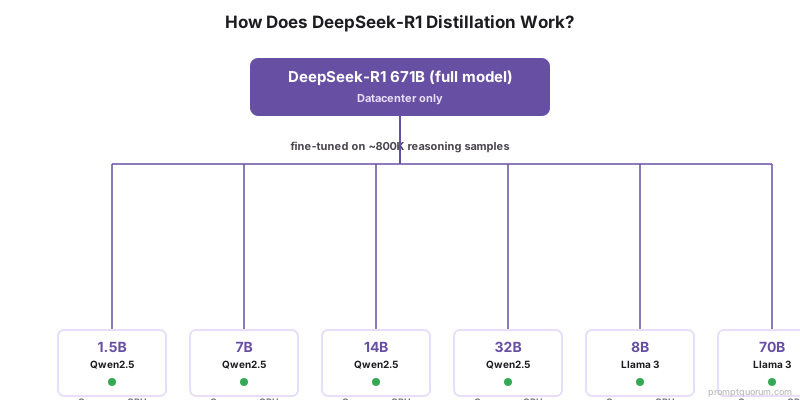
- A "distill" is a separate, smaller model (Qwen2.5 or Llama 3 base) fine-tuned on ~800K reasoning traces generated by the full R1.
- Distillation KEEPS the reasoning behavior: explicit chain-of-thought, self-verification, and reflection.
- Distillation LOSES raw capability and breadth — the full model solves the hardest problems more reliably and knows more.
- For everyday local math and logic, the gap is small; it widens on frontier-difficulty and broad-knowledge tasks.
- A stronger base narrows the gap: DeepSeek-R1-0528-Qwen3-8B leads open 8B models on AIME 2024.
- Run any distill at temperature 0.6 with no system prompt.
- DeepSeek-V3 is a chat model; DeepSeek-R1 is a reasoning model — do not confuse them.
Why People Get DeepSeek-R1 and Its Distills Confused
When you type ollama run deepseek-r1:14b, you are not running a smaller version of DeepSeek-R1 — you are running Qwen2.5 14B taught to imitate R1's reasoning. The name "DeepSeek-R1-Distill-Qwen-14B" is precise but easy to misread: the "DeepSeek-R1" part describes where the reasoning came from, and the "Qwen-14B" part is the actual model running on your GPU.
This matters because expectations follow the name. People assume a distill is "R1, but smaller and a bit worse." It is closer to "a capable open model that learned to think like R1." That framing predicts the behavior you will actually see: excellent reasoning structure, occasional gaps in raw knowledge or hardest-case reliability.
For the hardware reality behind why the full model is off-limits at home, see DeepSeek V3 Local Hardware Requirements — V3 is the chat-model sibling with the same 671B-class footprint.
Update: DeepSeek has since released DeepSeek-V4 (Flash and Pro) as its newer flagship generation, also available as open weights. The R1 distills covered here are not being discontinued and remain fully valid to run locally — if you want the newest architecture, V4 is worth evaluating alongside them.
📍 In One Sentence
A DeepSeek-R1 distill is an existing small model (Qwen2.5 or Llama 3) fine-tuned to imitate the full R1's reasoning, not a shrunken copy of R1 itself.
💬 In Plain Terms
Think of the full R1 as a master mathematician and a distill as a bright student who studied the master's worked solutions. The student reasons the same way but does not know everything the master knows.
What Is the Full 671B DeepSeek-R1?
The full DeepSeek-R1 is a 671-billion-parameter Mixture-of-Experts (MoE) model that activates roughly 37B parameters per token and needs about 376–404 GB of VRAM at Q4 — datacenter hardware only. It is the model that generates the high-quality reasoning the distills are trained to imitate.
MoE means the model routes each token through a small subset of "expert" sub-networks, so only ~37B of the 671B parameters fire per token. That keeps inference cheaper than a dense 671B model would be — but every one of the 671B parameters still has to be resident in memory, which is why it cannot fit on consumer hardware.
An Unsloth 1.58-bit build (IQ1_S, ~131 GB) exists and technically runs, but at roughly 0.3 tokens per second it is a curiosity, not a usable local setup. For practical purposes, the full R1 lives in the cloud and the distills live on your machine.
How Does DeepSeek-R1 Distillation Work?
DeepSeek generated roughly 800,000 reasoning samples with the full R1, then fine-tuned existing open base models — Qwen2.5 (1.5B, 7B, 14B, 32B) and Llama 3 (8B, 70B) — on those samples. The base models learn to reproduce R1's step-by-step reasoning pattern without ever containing R1's parameters.
This is supervised fine-tuning on high-quality reasoning traces, not reinforcement learning on the small models. The distills inherit the *form* of R1's thinking — when to expand a chain-of-thought, when to backtrack, when to verify — layered on top of whatever the base model already knew.
That is why base choice matters so much. A distill is only as knowledgeable as its base, plus the reasoning discipline copied from R1. A weak base with great reasoning traces still hits a ceiling on raw capability.
📍 In One Sentence
DeepSeek fine-tuned Qwen2.5 and Llama 3 base models on ~800,000 reasoning samples generated by the full R1, transferring its reasoning style to small models.
What Does Distillation Keep?
Distillation reliably transfers the three behaviors that make R1 a strong reasoner: chain-of-thought, self-verification, and reflection. These survive because they are patterns of token generation, and patterns are exactly what supervised fine-tuning copies well.
- Chain-of-thought: the distill writes out intermediate steps before the final answer, the core of its math and logic strength.
- Self-verification: it checks its own intermediate results and catches errors mid-reasoning, not just at the end.
- Reflection: it backtracks and reconsiders when a path looks wrong, instead of committing to the first attempt.
- Result: a 7B distill scores 55.5% on AIME 2024 — competition math no same-size chat model reaches.
What Does Distillation Lose?
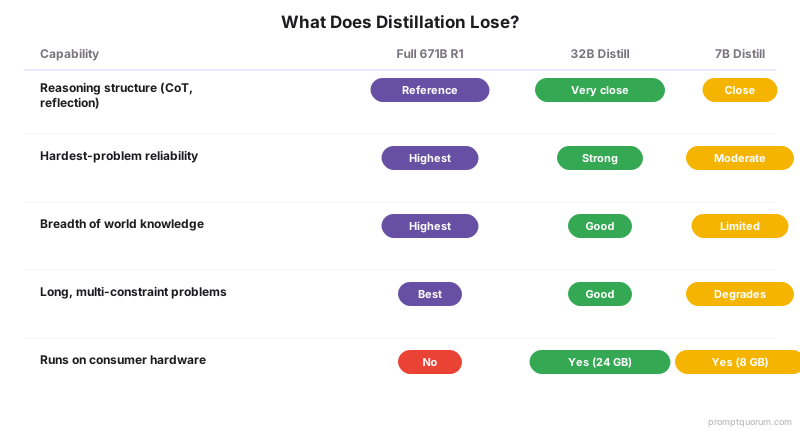
Distillation cannot transfer the full 671B model's raw capability, breadth of knowledge, or reliability on the hardest problems — a small base simply has less room to store and combine information. The smaller the distill, the larger this gap.
Capability | Full 671B R1 | 32B Distill | 7B Distill |
|---|---|---|---|
| Reasoning structure (CoT, reflection) | Reference | Very close | Close |
| Hardest-problem reliability | Highest | Strong | Moderate |
| Breadth of world knowledge | Highest | Good | Limited |
| Long, multi-constraint problems | Best | Good | Degrades |
| Runs on consumer hardware | No | Yes (24 GB) | Yes (8 GB) |
Rankings are directional, not benchmark-exact: the gap is small on common reasoning tasks and grows on frontier-difficulty or broad-knowledge work.
Does the Gap Matter for Your Use Case?
For most local reasoning the gap is small enough to ignore; it only becomes decisive on frontier-difficulty problems or tasks needing broad world knowledge. Decide by use case, not by chasing the biggest model.
Is a distill good enough?
Use a local LLM if:
- •School and competition math, logic puzzles, step-by-step planning → a distill is plenty (32B for headroom, 14B for most)
- •Private/offline reasoning where data cannot leave your machine → a distill is the only option, and a good one
- •Cost control vs a hosted API → a local distill removes per-token cost entirely
Use a cloud model if:
- •Frontier-difficulty research math or proofs at the edge of the field → the full hosted R1 is more reliable
- •Tasks needing broad, current world knowledge → a larger model or a search-augmented setup wins
- •You need the single most reliable answer regardless of cost → compare against frontier models via PromptQuorum
Quick decision:
- →If unsure, run the 32B distill and only escalate to hosted R1 when it visibly struggles.
- →Bigger base beats bigger size at the small end — see R1-0528-Qwen3-8B below.
R1-0528-Qwen3-8B: A Better Base Narrows the Gap
DeepSeek-R1-0528-Qwen3-8B shows that a stronger base shrinks the distillation gap: built on Qwen3 8B with reasoning from the updated R1-0528, it leads open 8B models on AIME 2024 and scores about 10 points higher than the base Qwen3 8B. Same size class as the original 8B distill, materially better reasoning — because the base is better and the reasoning source is newer.
The lesson for choosing a distill: at the small end, prefer the model with the stronger, newer base over an older distill of the same parameter count. Capability per gigabyte is rising faster from better bases than from raw size.
Config Pro-Tip: Temperature 0.6 and No System Prompt
Run every DeepSeek-R1 distill at temperature 0.6 (0.5–0.7 is safe) with no system prompt — put all instructions in the user prompt. This avoids the repetition-and-incoherence failure mode the R1 family is prone to when given a system prompt or a temperature near 0 or above ~0.8.
If you are comparing a distill against the full hosted R1 and the distill loops or drifts, fix the config before concluding the distill is weak — bad sampling settings mask its real quality.
Frequently Asked Questions
Is a DeepSeek-R1 distill the same model as DeepSeek-R1, just smaller?
No. A distill is a different base model (Qwen2.5 or Llama 3) fine-tuned to imitate R1's reasoning on ~800K samples. It keeps R1's reasoning style but contains none of R1's parameters.
What exactly does distillation keep from the full R1?
The reasoning behavior: chain-of-thought, self-verification, and reflection. These are token-generation patterns that supervised fine-tuning transfers reliably, which is why a 7B distill reaches 55.5% on AIME 2024.
What does a distill lose versus the full 671B R1?
Raw capability, breadth of world knowledge, and reliability on the hardest problems. The smaller the distill, the larger the gap — though it stays small on common reasoning tasks.
Why can't I run the full 671B DeepSeek-R1 at home?
It needs ~376–404 GB of VRAM at Q4 because all 671B parameters must be resident even though only ~37B activate per token. That is datacenter hardware. A 1.58-bit build runs at ~0.3 tok/s — a curiosity, not usable.
Does the gap matter for everyday use?
Usually not. For school and competition math, logic, and multi-step planning, a 14B or 32B distill is plenty. The gap matters for frontier-difficulty problems or tasks needing broad, current knowledge.
Which distill is closest to the full R1?
The 70B distill is the strongest of the six and closest in raw capability, but it needs dual-GPU. The 32B is the best single-GPU option and beats OpenAI o1-mini on several reasoning benchmarks.
Why is R1-0528-Qwen3-8B better than the original 8B distill?
It uses a stronger Qwen3 8B base and reasoning from the updated R1-0528, so it leads open 8B models on AIME 2024 — about 10 points above the base Qwen3 8B at the same size.
Is DeepSeek-V3 a distill of R1?
No. DeepSeek-V3 is a separate 671B MoE chat model, not a reasoning model and not a distill. R1 is the reasoning model; the distills imitate R1, not V3.
Update Log
- Published 2026-06-19. Next review due 2027-06-19 (annual freshness tier — evergreen explainer with year-anchored model facts).
- Covers the full 671B R1 versus the six official distills and DeepSeek-R1-0528-Qwen3-8B. Reasoning-internal comparison only; cross-model coding comparisons live in the coding guide.