Key Takeaways
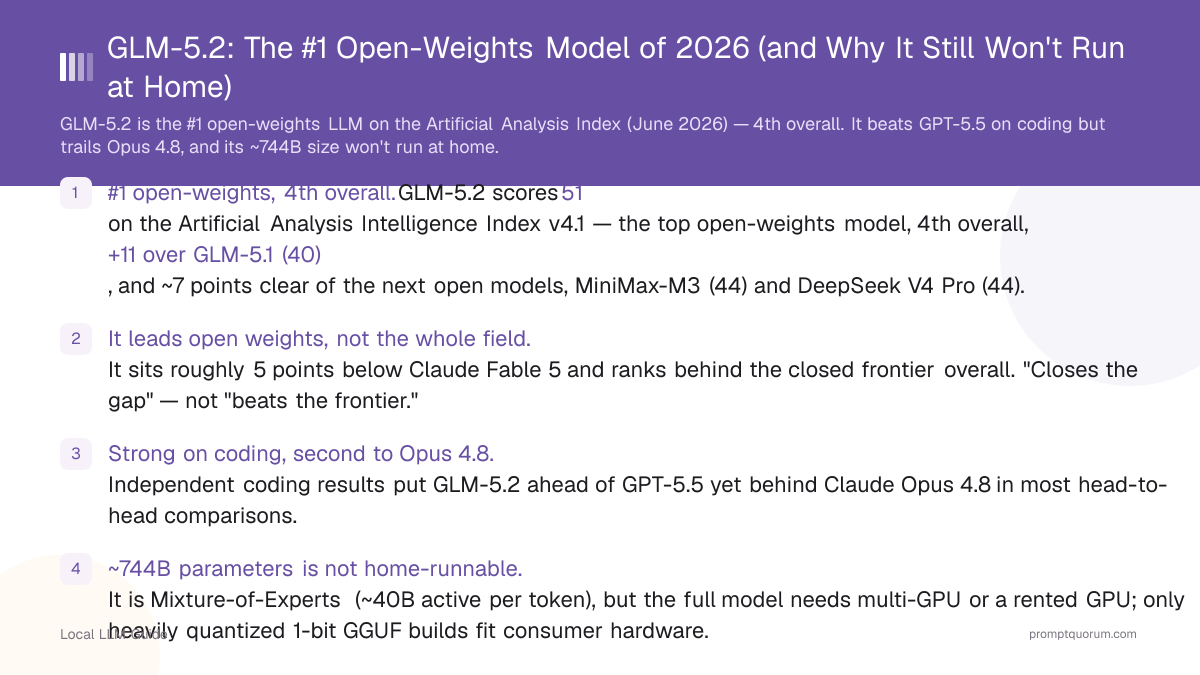
- #2 open-weights, was #1 at launch. GLM-5.2 scored 51 on the Artificial Analysis Intelligence Index v4.1 when it launched in June 2026 — the top open-weights model at the time. Moonshot AI's Kimi K3 (57, released July 27, 2026) holds the #1 open-weights spot; GLM-5.2 (now ~52.6 on the updated v4.1.1 index) is #2, still ahead of MiniMax-M3 and DeepSeek V4 Pro (44 each).
- Z.ai already shipped a follow-up, GLM-5.3. Released August 14, 2026 on the same base model as GLM-5.2 with heavier post-training, GLM-5.3 posts sharply better coding scores (Terminal-Bench 3.0 rose from 4.6 to 28.3). It is available only through Z.ai's API and Coding Plan; public weights had not shipped as of this refresh.
- Strong on coding, further behind the closed frontier now. GLM-5.2 remains ahead of GPT-5.5 on independent coding benchmarks, but Anthropic and OpenAI have both shipped newer closed models since — Claude Opus 5 and GPT-5.6 Sol — that lead GLM-5.2 in head-to-head coding results by a wider margin than their June 2026 predecessors did.
- ~744B parameters is still not home-runnable. It is Mixture-of-Experts (~40B active per token); the full model needs multi-GPU or a rented GPU. Z.ai's smaller GLM-5.3-Flash (320B total / 18B active, released August 26, 2026, MIT license) is more self-hostable, though still far from a single consumer GPU without heavy quantization.
- Self-hosted weights keep your data; the Z.ai API does not necessarily. MIT-licensed weights run inside your boundary; the first-party Z.ai API carries China data-residency considerations.
- Treat Z.ai's own benchmarks as company-reported. Reproducibility is contested — lead with the independent Artificial Analysis numbers.
What Is GLM-5.2?
GLM-5.2 is an open-weights large language model released June 13, 2026 by Z.ai (formerly Zhipu AI), under the MIT license with no regional usage limits. It was publicly benchmarked from June 16, 2026.
- ~744B total parameters (sources cite 743B–753B), using a Mixture-of-Experts architecture with ~40B active parameters per token.
- 1M-token context window with a 131,072-token maximum output.
- ~43,000 output tokens per task on average — up from GLM-5.1's ~26,000 — which raises local inference time and cost.
- MIT license: free to download, self-host, and modify, with no regional restrictions.
- Z.ai has since released two follow-ups: GLM-5.3 (August 14, 2026, same base model, heavier post-training, API/Coding-Plan-only so far) and GLM-5.3-Flash (August 26, 2026, a smaller 320B-total / ~18B-active MIT-licensed sibling). See the sections below for how they compare to GLM-5.2.
How Good Is GLM-5.2? Independent Benchmarks First
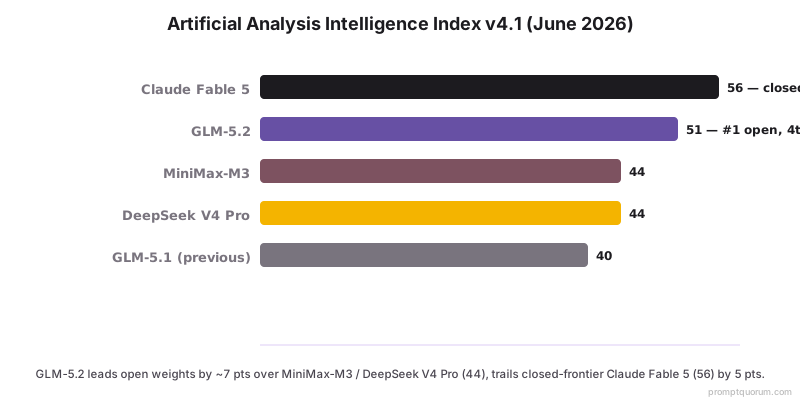
GLM-5.2 was the highest-scoring open-weights model on the Artificial Analysis Intelligence Index when it launched in June 2026 (51 points, 4th overall). Moonshot AI's Kimi K3 has taken the #1 open-weights spot; GLM-5.2 is now #2 (Artificial Analysis, July–August 2026).
Model | Index v4.1.1 | Tier |
|---|---|---|
| Claude Fable 5 | ~62 | Closed frontier |
| Kimi K3 (Moonshot AI) | 57 | #1 open weights |
| GLM-5.2 | ~52.6 | #2 open weights (was #1 at June 2026 launch) |
| MiniMax-M3 | 44 | Open weights |
| DeepSeek V4 Pro | 44 | Open weights |
Independent coding results at launch (June 2026): Terminal-Bench 2.1 — GLM-5.2 scored 81.0 vs Claude Opus 4.8 at 85.0. SWE-bench Pro — GLM-5.2 at 62.1 (Z.ai-reported point value) landed ahead of GPT-5.5's 58.6; independent coverage corroborated that ordering. Both Claude Opus 4.8 and GPT-5.5 have since been superseded by Claude Opus 5 and GPT-5.6 Sol, and GLM-5.2 trails both newer closed models by a wider margin than it trailed their predecessors. Separately, Moonshot AI's Kimi K3 (2.8T total parameters, ~104B active, released July 27, 2026 under Moonshot's modified-MIT Kimi K3 License) now leads GLM-5.2 on the Intelligence Index and on coding benchmarks including FrontierSWE (81.2) and Terminal-Bench 2.0 (88.3). Net verdict: GLM-5.2 remains a top-tier open-weights coding model, but it is no longer the strongest open-weights option available — that is now Kimi K3 — and the gap to the closed frontier has widened since launch (Artificial Analysis; VentureBeat; TechTimes, July–August 2026).
Z.ai's Own Numbers vs Independent Results: Read With Care
Several headline figures come from Z.ai's own evaluations and should be read as company-reported, not independently verified.
- Company-reported coding figures — for example MCP-Atlas 77.0 (Z.ai-reported), against GPT-5.5 at 75.3 and Opus 4.8 at 77.8 — are run by Z.ai itself and should be treated as claims pending independent replication.
- The Artificial Analysis writeup notes Z.ai's internal evaluations were reported weaker than its published benchmarks, and reproducibility is contested.
- Reproducibility is an open question. At least one prominent commentator characterizes the model as "bench-maxxed," and GLM-5.1 reportedly scored 0% on at least one benchmark that GLM-5.2 now does well on. The independent Artificial Analysis Index — not Z.ai's own suite — is what currently supports the #2-open-weights ranking.
- GLM-5.3 (August 2026) reports large jumps from post-training alone on the same base model as GLM-5.2 — for example Terminal-Bench 3.0 rising from 4.6 to 28.3 — with no retraining involved. Treat these gains with the same company-reported caution until independent evaluations confirm them.
Can You Run GLM-5.2 at Home? The ~744B Reality Check
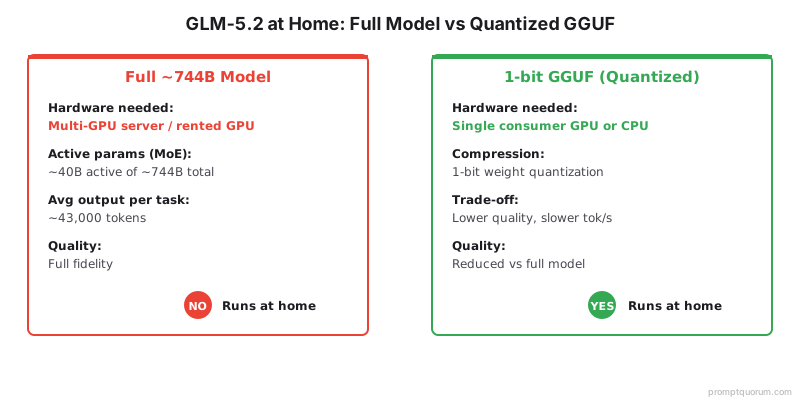
No — not the full model. "Open weights" and "self-hostable" do not mean "runs on a typical home PC."
- Full GLM-5.2 needs serious infrastructure: multi-GPU servers or a rented cloud GPU.
- On consumer hardware, only heavily quantized 1-bit GGUF builds are feasible, with quality and speed trade-offs.
- The high ~43,000-tokens-per-task output further raises local time and cost.
- Z.ai's smaller GLM-5.3-Flash (320B total / ~18B active, MIT license, released August 26, 2026) is more self-hostable than full GLM-5.2, though still well beyond a single consumer GPU without heavy quantization.
- For the hardware reality of large local models, see Running 70B Models on Consumer Hardware, Used GPUs for Local LLMs, the Local LLM Hardware Guide 2026, and Apple Silicon M5 for Local LLMs.
Self-Hosted Weights vs the Z.ai API: Where Your Data Goes
The license and the API are two different data-governance stories. Self-hosted MIT weights keep your data inside your boundary; the first-party Z.ai API does not.
- Self-hosted (MIT weights): data stays local and yours — no third-party transmission.
- Z.ai first-party API: independent coverage explicitly flags China data-residency considerations ("China data risk") on the API path (TechTimes, June 17, 2026).
- Decision framing: if data sensitivity matters, self-host the weights; if you use the hosted API, treat it as you would any third-party cloud endpoint subject to its jurisdiction.
GLM-5.2 Pricing and Cost
Via the hosted API, GLM-5.2 runs at roughly one-sixth the cost of closed-frontier models (VentureBeat, June 2026). Reported pricing is approximately $1.4 per 1M input tokens and $4.4 per 1M output tokens. Factor in the high per-task output (~43,000 tokens) when estimating real workload cost.
Should You Use GLM-5.2?
GLM-5.2 decision guide
Use a local LLM if:
- •You want a mature, independently verified #2 open-weights model with a proven track record
- •You need self-hosting and data control inside your own boundary
- •You run long-horizon coding tasks
- •You want frontier-adjacent quality at roughly one-sixth the cost
Use a cloud model if:
- •You need the top score in head-to-head coding or reasoning — check current-generation closed models like Claude Opus 5 or GPT-5.6 Sol
- •You want the single strongest open-weights model and are willing to evaluate Kimi K3 instead
- •You cannot provision multi-GPU or rented GPU infrastructure
Quick decision:
- →A strong open-weights option today, but no longer the top one — Kimi K3 now leads open weights, and Z.ai's own GLM-5.3 may supersede GLM-5.2 once its weights ship. Verify the contested benchmarks against your own tasks before committing.
GLM-5.2: Regional Context
EU / GDPR: Self-hosting GLM-5.2 under the MIT license keeps all inference data inside your own infrastructure, which satisfies data-residency expectations under the GDPR. The compliance difference between models is in supplier documentation, not data handling, when inference runs locally.
Japan (METI): For production deployments, document the model version (GLM-5.2), license (MIT), and whether inference runs on self-hosted weights or the Z.ai API, in line with METI AI governance guidance.
China / data path: GLM-5.2 is built by a Chinese lab. The key compliance lever is the deployment path, not the model: self-hosted MIT weights keep data in your boundary, while the first-party Z.ai API is subject to its home jurisdiction. Choose the path that matches your data-residency requirements.
Common Mistakes When Evaluating GLM-5.2
- Assuming "open weights" means "runs at home." The ~744B size requires multi-GPU or rented infrastructure; only 1-bit GGUF builds fit consumer hardware.
- Treating Z.ai's first-party benchmarks as verified. Lead with the independent Artificial Analysis Index; treat company-run coding numbers as claims.
- Conflating the MIT weights with the hosted API for data governance. Self-hosting keeps data local; the API is subject to its home jurisdiction.
- Assuming GLM-5.2 is still #1 open weights. Moonshot AI's Kimi K3 took that spot in July 2026; GLM-5.2 is now #2, and Z.ai's own GLM-5.3 (August 2026) already improves on some of GLM-5.2's coding scores, though its public weights have not shipped yet.
- Ignoring the ~43,000-token-per-task output when budgeting inference time and cost.
Frequently Asked Questions
Is GLM-5.2 still the best open-weights model right now?
No —, Moonshot AI's Kimi K3 (released July 27, 2026) holds the top spot on the Artificial Analysis Intelligence Index at 57 points, ahead of GLM-5.2's ~52.6. GLM-5.2 was #1 open weights when it launched in June 2026 (51 points) but is now #2, still ahead of MiniMax-M3 and DeepSeek V4 Pro (both 44).
Can I run GLM-5.2 on a normal PC or Mac?
Not the full model. At ~744B parameters it needs multi-GPU servers or a rented cloud GPU. On consumer hardware you are limited to heavily quantized 1-bit GGUF builds, which trade quality and speed. Z.ai's smaller GLM-5.3-Flash (320B total / ~18B active, MIT license) is somewhat more self-hostable but still not consumer-laptop territory. See our hardware guides for what large local models actually require.
Does GLM-5.2 beat GPT-5.5, Claude Opus 4.8, and their successors?
At launch, independent results put GLM-5.2 ahead of GPT-5.5 on coding (for example SWE-bench Pro and FrontierSWE orderings) while trailing Claude Opus 4.8 in most head-to-head comparisons — for example Terminal-Bench 2.1 (81.0 vs 85.0). Both GPT-5.5 and Claude Opus 4.8 have since been superseded by GPT-5.6 Sol and Claude Opus 5, and GLM-5.2 trails these newer closed models by a wider margin than it trailed their predecessors. The accurate summary is "a strong #2 open-weights model, further from the closed frontier than at launch."
Has GLM-5.2 been replaced by GLM-5.3 or Kimi K3?
GLM-5.2 has not been replaced, but it has been surpassed on two fronts. Z.ai released GLM-5.3 on August 14, 2026 — the same base model with heavier post-training and notably better coding scores — but its public weights had not shipped as of this refresh; it is available only via Z.ai's API and Coding Plan. Separately, Moonshot AI's Kimi K3 (July 27, 2026) overtook GLM-5.2 as the top open-weights model overall. GLM-5.2 remains a fully self-hostable, independently verified #2 open-weights option.
Is GLM-5.2 really free? What is the license?
GLM-5.2 is released under the MIT license with no regional usage limits, so you can download, self-host, and modify it for free. Running the full model still costs real infrastructure (multi-GPU or rented GPU), and the hosted Z.ai API is a paid service.
Is my data safe with GLM-5.2?
It depends on the deployment path. Self-hosted MIT weights keep all data inside your own boundary. The first-party Z.ai API carries China data-residency considerations flagged by independent coverage, so treat it as you would any third-party cloud endpoint subject to its jurisdiction.
Are GLM-5.2's benchmark numbers trustworthy?
The independent Artificial Analysis Index corroborates GLM-5.2's #2-open-weights ranking. Z.ai's own coding numbers are company-reported, and reproducibility is contested — the Artificial Analysis writeup notes internal evaluations were reported weaker than published benchmarks. This applies to GLM-5.3's reported gains too. Lead with the independent numbers and treat first-party figures as claims.
How much does GLM-5.2 cost to run via API?
Roughly one-sixth the cost of closed-frontier models. Reported pricing is approximately $1.4 per 1M input tokens and $4.4 per 1M output tokens (June 2026, unchanged as of this refresh). Because GLM-5.2 averages ~43,000 output tokens per task, estimate real cost on your own workload rather than per-token rates alone.
What hardware do I need to self-host GLM-5.2 properly?
For the full model, multi-GPU servers or a rented cloud GPU. Consumer hardware can only run heavily quantized 1-bit GGUF builds. See the Local LLM Hardware Guide 2026, Used GPUs for Local LLMs, and Running 70B Models on Consumer Hardware to size your setup.
Sources
- Artificial Analysis. (2026). "GLM-5.2 is the new leading open-weights model on the Artificial Analysis Intelligence Index." artificialanalysis.ai/articles/glm-5-2-is-the-new-leading-open-weights-model-on-the-artificial-analysis-intelligence-index — Independent Intelligence Index ranking at launch (51, #1 open / 4th overall, June 2026).
- TechTimes. (2026, June 17). "GLM-5.2 open weights live, tops coding benchmark; API use carries China data risk." www.techtimes.com/articles/318543/20260617/glm-52-open-weights-live-top-coding-benchmark-api-use-carries-china-data-risk.htm — Data-residency considerations on the Z.ai API path.
- VentureBeat. (2026). "Z.ai's open-weights GLM-5.2 beats GPT-5.5 on multiple long-horizon coding benchmarks for 1/6th the cost." venturebeat.com/technology/z-ais-open-weights-glm-5-2-beats-gpt-5-5-on-multiple-long-horizon-coding-benchmarks-for-1-6th-the-cost — Independent coding comparison and cost framing.
- LetsDataScience. (2026). "GLM-5.2 open weights beats GPT-5.5 coding." letsdatascience.com/blog/glm-5-2-open-weights-beats-gpt-5-5-coding — Independent coverage of coding results.
- TechTimes. (2026, July 24). "Kimi K3 Open Weights Drop July 27: Near-Frontier Coding, Undisclosed Hallucination Risk." www.techtimes.com/articles/321499/20260724/kimi-k3-open-weights-drop-july-27-near-frontier-coding-undisclosed-hallucination-risk.htm — Kimi K3 release, taking the #1 open-weights spot from GLM-5.2.
- VentureBeat. (2026, August 14). "GLM-5.3 is here with advanced cyber capabilities — and reportedly already found a 'serious vulnerability' in Cursor." venturebeat.com/technology/glm-5-3-is-here-with-advanced-cyber-capabilities-and-reportedly-already-found-a-serious-vulnerability-in-cursor — GLM-5.3 release, same base model as GLM-5.2, API-only at launch.
- MarkTechPost. (2026, August 26). "Z.ai Releases GLM-5.3-Flash: A 320B-A18B Natively Multimodal MoE With a 1M-Token Context." www.marktechpost.com/2026/08/26/z-ai-releases-glm-5-3-flash-a-320b-a18b-natively-multimodal-moe-with-a-1m-token-context/ — GLM-5.3-Flash specs and immediate MIT release.