Key Takeaways
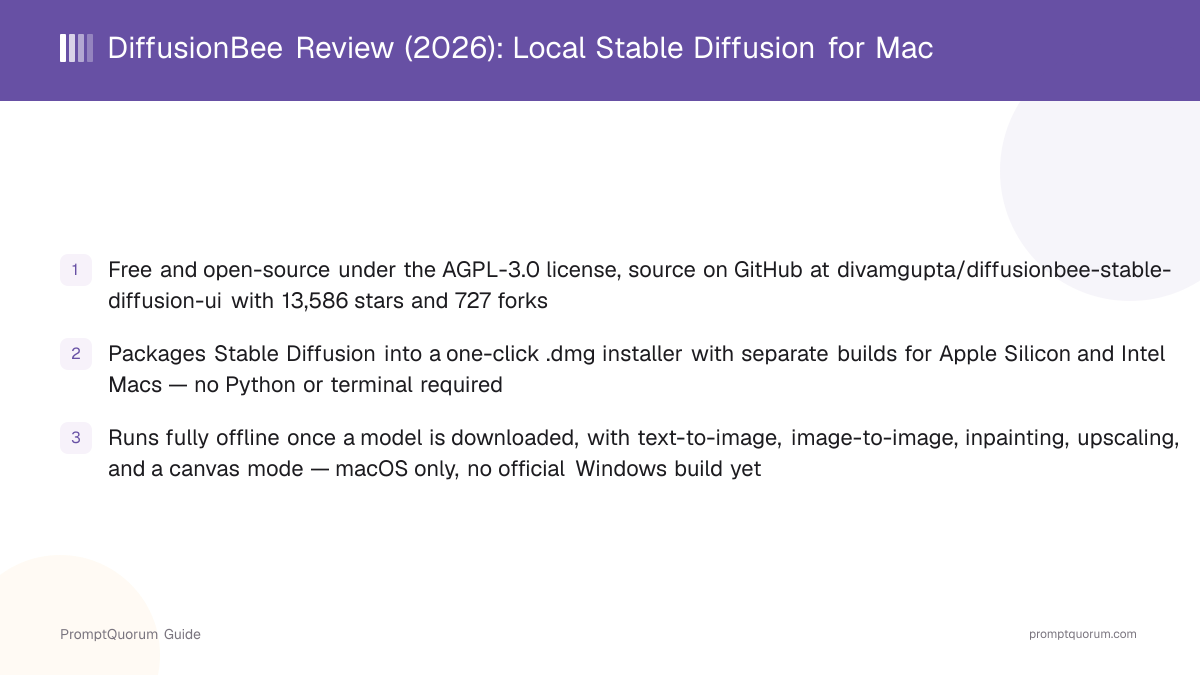
- AGPL-3.0 license — free to use and modify; the source is on GitHub
- 13,586 GitHub stars and 727 forks as of September 2026, repository created September 2022 by Divam Gupta
- macOS only — separate
.dmgbuilds for Apple Silicon and Intel; Windows is a waitlist, not a released build - Generation runs fully offline on your own Mac hardware once a model is downloaded
- Latest tagged GitHub release is 2.5.3 (August 2024); no new tagged release since, and the download page currently serves 2.5.1 build assets
- Features per diffusionbee.com: text-to-image, image-to-image, generative fill, upscaling, image variants, model training, control images, and a canvas mode
📍 In One Sentence
DiffusionBee is a free, AGPL-3.0-licensed macOS app that packages Stable Diffusion behind a one-click installer and graphical interface, trading the configurability of ComfyUI, Fooocus, or AUTOMATIC1111 for no-setup simplicity on Mac only.
💬 In Plain Terms
DiffusionBee lets you generate AI images on your Mac by downloading one app and clicking a button — you never touch Python, the terminal, or a settings file. It only works on macOS, and it does not have every advanced option that more technical tools offer.
📌Note: DiffusionBee sits in the same sub-segment as ComfyUI, Fooocus, and AUTOMATIC1111 — all four run Stable Diffusion locally, but DiffusionBee trades their configurability for a packaged, no-setup Mac app. See the Local LLM Software Directory for how it fits among other local image-generation tools.
What Is DiffusionBee?
DiffusionBee is a free, open-source macOS application (AGPL-3.0, source at github.com/divamgupta/diffusionbee-stable-diffusion-ui) that wraps Stable Diffusion image generation in a native-feeling graphical app. You download a .dmg file, install it like any other Mac application, and generate images from a text prompt without installing Python, a package manager, or any command-line dependency.
- Text-to-image: generate an image from a written prompt, the app's core function
- Image-to-image: transform an existing image using a new prompt as guidance
- Generative fill (inpainting): mask part of an image and regenerate just that region, e.g. to add or remove an object
- Image upscaling: increase the resolution of a generated or imported image
- Image variants: generate alternate versions of an existing image
- Model training: DiffusionBee's site lists a training feature for custom/fine-tuned models
- Control images: guided generation using a reference image's structure
- AI canvas: an open-ended canvas mode for combining generation and editing in one view
How Much Does DiffusionBee Cost?
DiffusionBee is free. As of this review, diffusionbee.com has no pricing page, no subscription tier, and no account requirement to download or run the app.
- The app itself: free, no purchase or subscription found on the official site or in the GitHub repository
- No account required to download the
.dmginstaller or generate images locally - Generated images: the underlying Stable Diffusion model DiffusionBee bundles carries its own separate model license (CreativeML Open RAIL-M for the Stable Diffusion checkpoints commonly distributed this way); review that license's usage terms directly rather than assuming unrestricted commercial use
- The app's own source code is licensed AGPL-3.0 — distinct from the model license above, and worth reading before redistributing a modified build of the app itself
Download DiffusionBee for Mac
This review is a companion to DiffusionBee's entry in the Local LLM Software Directory — check the directory for how it's classified alongside other local image-generation tools. Direct download links below are from the official diffusionbee.com/download page; always confirm you're on the official domain before downloading a .dmg file.
Platform | Download |
|---|---|
| macOS — Apple Silicon (M1/M2/M3) | DiffusionBee_MPS_arm64-2.5.1.dmg |
| macOS — Intel 64-bit | DiffusionBee_MPS_Intel-2.5.1.dmg |
| Windows 64-bit | Waitlist only — no direct download available (via diffusionbee.com) |
diffusionbee.com's download page currently links to build 2.5.1 installers, while GitHub's own Releases page lists 2.5.3 (August 14, 2024) as the latest tagged release. Confirm the version shown in-app after installing, and check both pages directly before downloading — build links can change between visits.
Platform Support and Hardware Requirements
DiffusionBee runs on macOS only. The official site lists macOS 13.1 or later as the minimum system version, with Apple Silicon (M1, M2, M3, and newer) recommended for speed and Intel Macs supported but noticeably slower without dedicated graphics.
macOS (Apple Silicon)
- Support level:
- Full, recommended
- Notes:
- Dedicated arm64 build; diffusionbee.com states this is the fastest configuration
macOS (Intel)
- Support level:
- Supported
- Notes:
- Dedicated Intel build; diffusionbee.com notes it runs noticeably slower without dedicated graphics
Windows
- Support level:
- Waitlist only
- Notes:
- No official direct-download build as of this review — a Google Form waitlist is the only listed option
Linux
- Support level:
- Not offered
- Notes:
- No Linux build is listed on diffusionbee.com or in the GitHub releases
diffusionbee.com's own marketing copy states an image generation takes roughly 30 seconds on an 8 GB M1 MacBook Air — that figure comes from DiffusionBee's own site, not independent testing by this review, and actual generation time depends on the image size, model, and settings you choose.
Who Should Use DiffusionBee?
DiffusionBee fits Mac users who want local Stable Diffusion generation without learning a node graph or command-line tool. It is a poor fit for anyone on Windows or Linux, or anyone who needs the deep pipeline control that ComfyUI or AUTOMATIC1111 offer.
Competitors and Alternatives
DiffusionBee competes directly with three other Stable Diffusion front-ends this site has reviewed. All four run diffusion models locally; they differ mainly in platform support, configurability, and how much setup they require.
Tool | Platforms | Interface | Best For |
|---|---|---|---|
| DiffusionBee | macOS only | Packaged GUI app | Mac users who want zero setup |
| ComfyUI | Mac/Win/Linux | Node-graph editor | Reusable, shareable pipelines |
| Fooocus | Mac/Win/Linux | Simplified web UI | Simple prompts, minimal settings |
| AUTOMATIC1111 | Mac/Win/Linux | Tab-based web UI | Largest extension ecosystem |
DiffusionBee is the only one of these four that ships as a packaged native Mac app with no Python setup required — the other three run as local web servers you start yourself and reach through a browser, and all three support Windows and Linux, which DiffusionBee does not.
Common Mistakes When Evaluating DiffusionBee
These mistakes come from expecting DiffusionBee to behave like a cross-platform, deeply configurable tool rather than the packaged, Mac-only app it actually is.
Frequently Asked Questions
Is DiffusionBee free?
Yes. DiffusionBee is free and open-source under the AGPL-3.0 license, with no pricing page, subscription, or account requirement found on diffusionbee.com as of this review.
Does DiffusionBee work on Windows or Linux?
No shipped build for either. diffusionbee.com lists Windows as waitlist-only (not yet released), and there is no Linux build listed on the official site or in the GitHub releases.
Do I need a GPU to run DiffusionBee?
DiffusionBee runs on Apple Silicon or Intel Macs using the Mac's own graphics — there is no separate discrete-GPU requirement beyond having a supported Mac, though Apple Silicon is recommended for speed and Intel Macs run noticeably slower per diffusionbee.com.
How many GitHub stars does DiffusionBee have?
The divamgupta/diffusionbee-stable-diffusion-ui GitHub repository has 13,586 stars and 727 forks, verified via the GitHub API in September 2026.
Is DiffusionBee still maintained?
The repository is not archived, but its latest tagged GitHub release is 2.5.3 from August 2024, with no newer tagged release since. Check the GitHub repository directly for current activity before relying on it for a production workflow.
What license is DiffusionBee released under?
The DiffusionBee app's source code is licensed under AGPL-3.0 (GNU Affero General Public License v3.0), per its GitHub repository. The Stable Diffusion model it runs carries a separate model license that governs generated-image usage.
How is DiffusionBee different from ComfyUI, Fooocus, and AUTOMATIC1111?
DiffusionBee is a packaged native macOS app with no setup required, while ComfyUI, Fooocus, and AUTOMATIC1111 all run as local web servers you start yourself, and all three support Windows and Linux in addition to Mac. ComfyUI adds a node-graph workflow editor; AUTOMATIC1111 has the largest extension ecosystem; Fooocus targets the simplest prompt-in, image-out workflow.
Who created DiffusionBee?
Divam Gupta created the divamgupta/diffusionbee-stable-diffusion-ui GitHub repository, first created in September 2022.