History: HuggingFace M4 and the Flamingo Reproduction
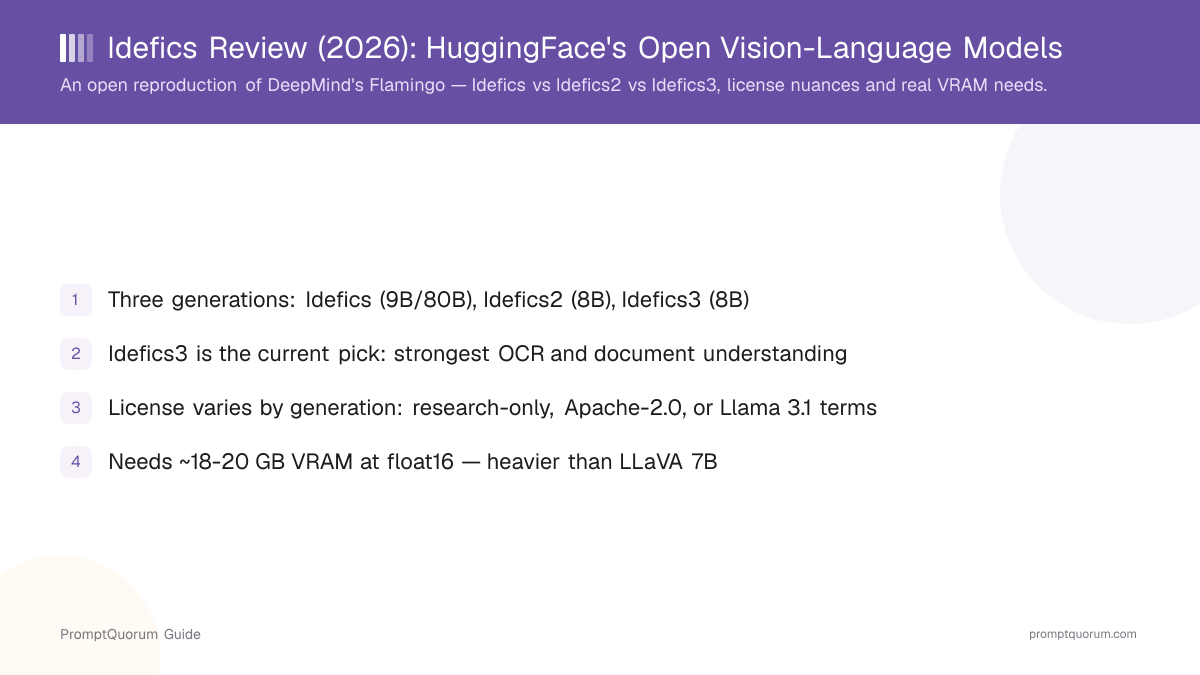
The original Idefics model card explicitly states it is "an open-access reproduction of Flamingo, a closed-source visual language model developed by DeepMind." It was released by the HuggingFace M4 team in 2023 in two sizes, 9B and 80B parameters, combining a vision encoder with a LLaMA(1) language model backbone.
The original Idefics carries a mixed license, not a single permissive one. Its vision encoder and the newly trained connecting parameters are released under MIT, but the LLaMA(1) language model backbone requires compliance with Meta's original research-only, non-commercial license for LLaMA. This makes the original Idefics unsuitable for commercial use in most cases, regardless of the MIT tag on parts of the stack.
Idefics2 (8B), released around April 2024, replaced the LLaMA(1) backbone with Mistral-7B-v0.1 and paired it with a SigLIP vision encoder. Because both parent models are Apache-2.0, Idefics2's own model card states the full model is Apache-2.0 — resolving the original Idefics' licensing problem. HuggingFace's own description credits Idefics2 with matching Idefics-80B's performance at roughly 10x smaller size, with meaningfully better OCR and document understanding.
Idefics3 (8B), released August 22, 2024, kept the SigLIP vision encoder but switched the language backbone to Meta-Llama-3.1-8B-Instruct. Its own model card demonstrates a substantial improvement over Idefics2, particularly in document understanding, OCR, and visual reasoning. It was added to Hugging Face Transformers in version 4.46.
Is Idefics a reproduction of DeepMind's Flamingo?
Yes. The original Idefics model card explicitly describes it as "an open-access reproduction of Flamingo, a closed-source visual language model developed by DeepMind." Idefics2 and Idefics3 are HuggingFace M4's subsequent, independently architected generations built on that same lineage.
Idefics vs Idefics2 vs Idefics3: What Actually Changed
The three generations are distinct models with different base architectures — not a single model with incremental version bumps. Here is what actually differs, verified against each model's own HuggingFace card.
Idefics (9B/80B)
- Released:
- 2023
- Backbone:
- LLaMA(1) + custom vision encoder
- Notes:
- Research-only license restriction from LLaMA(1); largely superseded
Idefics2 (8B)
- Released:
- April 2024
- Backbone:
- Mistral-7B-v0.1 + SigLIP
- Notes:
- Fully Apache-2.0; matches Idefics-80B at 10x smaller size
Idefics3 (8B)
- Released:
- August 22, 2024
- Backbone:
- Llama-3.1-8B-Instruct + SigLIP
- Notes:
- Best OCR/document understanding of the three; Llama 3.1 license terms apply
PromptQuorum did not find a publicly confirmed "Idefics4" as of this review. Idefics3 is the newest generation and the current recommendation for most tasks.
License Nuance: It Is Not Simply Apache-2.0
PromptQuorum's directory listing for Idefics tags its license as "Apache 2.0" — that is accurate for the model repository and code, but incomplete for the practical licensing situation, similarly to how LLaVA's Apache-2.0 code license does not automatically extend to every base-model checkpoint.
Idefics2 is the cleanest case: both its Mistral-7B-v0.1 language backbone and its SigLIP vision encoder are Apache-2.0, so the full model stack is genuinely Apache-2.0 with no additional terms.
Idefics3 is more nuanced. Its own HuggingFace repository is tagged Apache-2.0, but its language backbone, Meta-Llama-3.1-8B-Instruct, is released under Meta's Llama 3.1 Community License — which includes an acceptable-use policy and a clause requiring a separate license from Meta if a downstream product exceeds 700 million monthly active users. Anyone deploying Idefics3 commercially at scale should read Meta's Llama 3.1 license terms directly, not just the Apache-2.0 tag on the Idefics3 repository.
The original Idefics is the most restrictive. Its LLaMA(1) backbone carries Meta's original research-only, non-commercial license, which makes commercial use of the full 9B/80B model legally unclear at best and unavailable at worst — even though the vision encoder and connector weights are separately MIT-licensed.
Is Idefics free to use commercially?
It depends on which generation. Idefics2 is fully Apache-2.0 with no additional restrictions. Idefics3's own repository is Apache-2.0, but its Llama-3.1-8B-Instruct backbone carries Meta's Llama 3.1 Community License terms, including a separate-license requirement above 700 million monthly active users. The original Idefics carries a research-only, non-commercial restriction from its LLaMA(1) backbone.
Real Usage Example: Transformers Library
Idefics3 is used through Hugging Face Transformers' AutoModelForVision2Seq and AutoProcessor classes, documented in Transformers' Idefics3 model docs. Transformers version 4.46 or later is required.
- No Ollama or llama.cpp path exists today. Idefics runs through Transformers (or compatible inference servers like Text Generation Inference), not through GGUF-based runners.
- Reducing the image resolution parameter can lower GPU memory use. Idefics2/3's model cards document reducing the number of image sub-patches processed (referred to as
Nin Idefics3's documentation) as a way to trade some accuracy for lower VRAM.
# Requires transformers >= 4.46 (per Hugging Face's Idefics3 model docs)
# pip install transformers pillow torch

from transformers import AutoProcessor, AutoModelForVision2Seq
from PIL import Image
import torch

model_id = "HuggingFaceM4/Idefics3-8B-Llama3"

processor = AutoProcessor.from_pretrained(model_id)
model = AutoModelForVision2Seq.from_pretrained(
    model_id,
    torch_dtype=torch.float16,
).to("cuda")

image = Image.open("photo.jpg")

messages = [
    {
        "role": "user",
        "content": [
            {"type": "image"},
            {"type": "text", "text": "What is in this image?"},
        ],
    },
]
prompt = processor.apply_chat_template(messages, add_generation_prompt=True)
inputs = processor(text=prompt, images=[image], return_tensors="pt").to("cuda")

generated_ids = model.generate(**inputs, max_new_tokens=200)
generated_text = processor.batch_decode(generated_ids, skip_special_tokens=True)
print(generated_text[0])
VRAM and Hardware Requirements
Idefics2 and Idefics3 are meaningfully heavier than comparably-sized LLaVA or MiniCPM-V checkpoints, largely because of how they process image resolution. These figures come directly from Idefics2's own model card, which documents its VRAM range explicitly; Idefics3 (same 8B parameter count and vision encoder) is expected to be similar, though PromptQuorum did not find an equally detailed published VRAM table for Idefics3 specifically.
Configuration | Approx. VRAM | Notes |
|---|---|---|
| float16 + flash-attention | ~18-20 GB | Documented on Idefics2's model card as the standard configuration |
| Without optimizations | Up to ~55 GB peak | Idefics2's model card's upper bound for unoptimized inference |
| Aggressive quantization | ~6-7 GB | Lower bound documented on Idefics2's model card; expect an accuracy trade-off |
| LLaVA 7B (for comparison) | ~6-8 GB | See PromptQuorum's LLaVA review |
📌Note: PromptQuorum did not run its own hardware benchmarks for this article; these figures are drawn from Idefics2's published model card. Idefics is genuinely heavier than LLaVA 7B or MiniCPM-V at comparable capability tiers — be honest with yourself about available VRAM before choosing it for a resource-constrained deployment.
What Idefics Is Not Good For
Idefics3 is a capable open vision-language model, but it is the wrong choice for the following situations:
- Resource-constrained local setups. At roughly 18-20 GB VRAM in its standard float16 configuration, Idefics2/3 need meaningfully more GPU memory than LLaVA 7B (~6-8 GB) or MiniCPM-V (~5.5 GB). If your hardware budget is a single consumer GPU with 8 GB of VRAM or less, Idefics is not a realistic fit without aggressive quantization and an accepted accuracy trade-off.
- Real-time or low-latency applications. An 8B-parameter vision-language model that processes multiple image sub-patches per input is not built for the fastest possible response time. If latency is the priority, a smaller model like Moondream (1.8B) will respond faster, at reduced capability.
- A drop-in Ollama or llama.cpp workflow. Idefics is not currently packaged in Ollama's library, and GGUF conversion has open, unresolved compatibility issues tracked on Ollama's own GitHub. If your workflow depends on Ollama specifically, see PromptQuorum's Ollama vision models guide for models that are actually pullable today.
- Assuming a single, uniform license across versions. Treating "Idefics" as one product with one license is a mistake — verify which generation you are deploying and read that specific model's license terms, particularly for Idefics3's Llama 3.1 Community License obligations at scale.
Alternatives and Competitors
LLaVA
- Best fit:
- Broader tooling support, including Ollama and llama.cpp packaging; lighter VRAM footprint at 7B
- License:
- Apache-2.0 (code); base-model-dependent for checkpoints
Articles about LLaVA (9)
- LLaVA Review: The Research Model That Started Local Vision AIUpdated September 6, 2026
- Best Local Vision Models 2026: Gemma 4, Qwen3-VL, LLaVA & Ollama Multimodal SetupUpdated October 23, 2026
- MLX vs Ollama vs llama.cpp on Mac 2026: Which Framework for Apple Silicon LLMs?Updated October 20, 2026
- Multimodal Local LLMs: Vision, Audio, and Text ProcessingUpdated October 20, 2026
- Ollama Vision Models: How to Actually Run Image Models LocallyUpdated October 20, 2026
- LLaMA-Factory Review: Fine-Tune 100+ LLMs via Web UIUpdated October 19, 2026
- Local Image, Video & Vision Tools Compared (2026): Generation, Vision and OCRUpdated September 20, 2026
- MLC Chat Review: The Mobile App Built on MLC LLM, Assessed HonestlyUpdated September 7, 2026
- LLM Farm Review: Open-Source GGUF App, Off the App StoreUpdated September 6, 2026
+9 more not shown
Ollama's vision models
- Best fit:
- Simplest local setup via
ollama pull/ollama run; Idefics is not among them as of this review - License:
- Varies by model
MLC Chat
- Best fit:
- Cross-platform on-device deployment; primarily text-focused as of this review — verify current vision support before relying on it
- License:
- Apache-2.0
Articles about MLC Chat (5)
- MLC Chat Review: The Mobile App Built on MLC LLM, Assessed HonestlyUpdated September 7, 2026
- Best Local AI Apps for iPhone in 2026 (Run LLMs Without WiFi)Updated October 23, 2026
- Best Local LLM Apps for Android in 2026: 6 Apps Compared on Real PhonesUpdated October 19, 2026
- Best Mobile LLM Models for Phones in 2026: Phi-4 Mini vs Gemma 3 vs SmolLMUpdated October 19, 2026
- Mobile Local LLMs 2026: iPhone 16 Pro, iPad M4 & Snapdragon XUpdated August 28, 2026
Also mentioned in:
- Running Local AI on the Galaxy S26: On-Device AI Explained (2026)Updated October 19, 2026
- RunAnywhere Review: On-Device AI SDK for LLM, STT, TTS, and VADUpdated September 12, 2026
- Galaxy vs iPhone On-Device AI: Samsung Galaxy AI vs Apple Intelligence (2026)Updated August 29, 2026
Cloud VLM APIs (GPT-4o, Claude, Gemini vision)
- Best fit:
- Often stronger multimodal capability than local models of this size; no local hardware or setup needed, but prompts and images go to the vendor
- License:
- Proprietary (paid API)
Frequently Asked Questions
What is Idefics?
Idefics is a family of open vision-language models built by HuggingFace's M4 team, explicitly designed as an open reproduction of DeepMind's Flamingo. It exists in three generations: the original Idefics (2023, 9B/80B), Idefics2 (April 2024, 8B), and Idefics3 (August 2024, 8B).
Which version of Idefics should I use — Idefics, Idefics2, or Idefics3?
Idefics3 for most tasks today — it has the strongest OCR and document understanding of the three. Idefics2 remains relevant if you specifically need a fully Apache-2.0 stack with no Llama-derived license terms. The original Idefics is largely superseded and carries a research-only license restriction.
Is Idefics fully open-source and free to use commercially?
It depends on the generation. Idefics2 is fully Apache-2.0. Idefics3's repository is tagged Apache-2.0, but its Llama-3.1-8B-Instruct backbone carries Meta's Llama 3.1 Community License terms, including obligations above 700 million monthly active users. The original Idefics has a research-only, non-commercial restriction from its LLaMA(1) backbone.
How much VRAM does Idefics need?
Idefics2 (and likely Idefics3, at the same 8B parameter count and vision encoder) needs roughly 18-20 GB of VRAM in the standard float16-with-flash-attention configuration documented on Idefics2's model card, or as little as 6-7 GB with aggressive quantization and an accuracy trade-off. This is meaningfully heavier than LLaVA 7B or MiniCPM-V.
Can I run Idefics through Ollama?
Not as of this review. Idefics is not currently packaged in Ollama's model library, and GGUF conversion has open compatibility issues tracked on Ollama's own GitHub repository. Idefics runs through Hugging Face Transformers instead.
Is Idefics based on DeepMind's Flamingo?
Idefics is explicitly described on its own model card as "an open-access reproduction of Flamingo, a closed-source visual language model developed by DeepMind." Idefics2 and Idefics3 are independently architected successors built by the same HuggingFace M4 team.
Verdict
Idefics is a genuinely useful family of open vision-language models, and Idefics3 specifically holds up well for document-heavy OCR and multi-image reasoning work where its roughly 18-20 GB VRAM footprint is affordable. It is not, however, a drop-in replacement for lighter local vision models: it needs meaningfully more GPU memory than LLaVA 7B or MiniCPM-V, it has no Ollama or llama.cpp packaging as of this review, and its license situation genuinely differs by generation — Idefics2's clean Apache-2.0 stack is a different legal proposition from Idefics3's Llama 3.1 Community License obligations. Choose Idefics3 for document understanding and OCR quality when you have the GPU memory to spare; choose Idefics2 specifically if a pure Apache-2.0 stack matters; and choose LLaVA, via PromptQuorum's LLaVA review, or one of the models in the Ollama vision models guide, for lighter local hardware or Ollama-based workflows.
Sources
- Idefics-80B model card — Flamingo reproduction statement, license structure, model sizes.
- Idefics2-8b model card — base models, Apache-2.0 license, documented VRAM range.
- Idefics3-8B-Llama3 model card — base model, license tag, release details.
- Idefics3 Transformers documentation — usage example, minimum Transformers version.
- Meta Llama 3.1 Community License — license terms inherited by Idefics3's language backbone.
- Ollama GitHub issue #2183 and issue #3677 — open feature requests confirming Idefics is not currently packaged in Ollama's library.