How the test went
The listing and first launch
The tester hoped LU does more than chat, because there are many local chat front-ends already.
The installer download was 15.8 MB, read by the tester from the download. After installing he could not find the app by its full name; it is called LU.
After setup the main window shows tabs for Chat, Create, Voice, Compare, Benchmark, Models and Settings, with a Cloud toggle in the top bar.
Install and setup
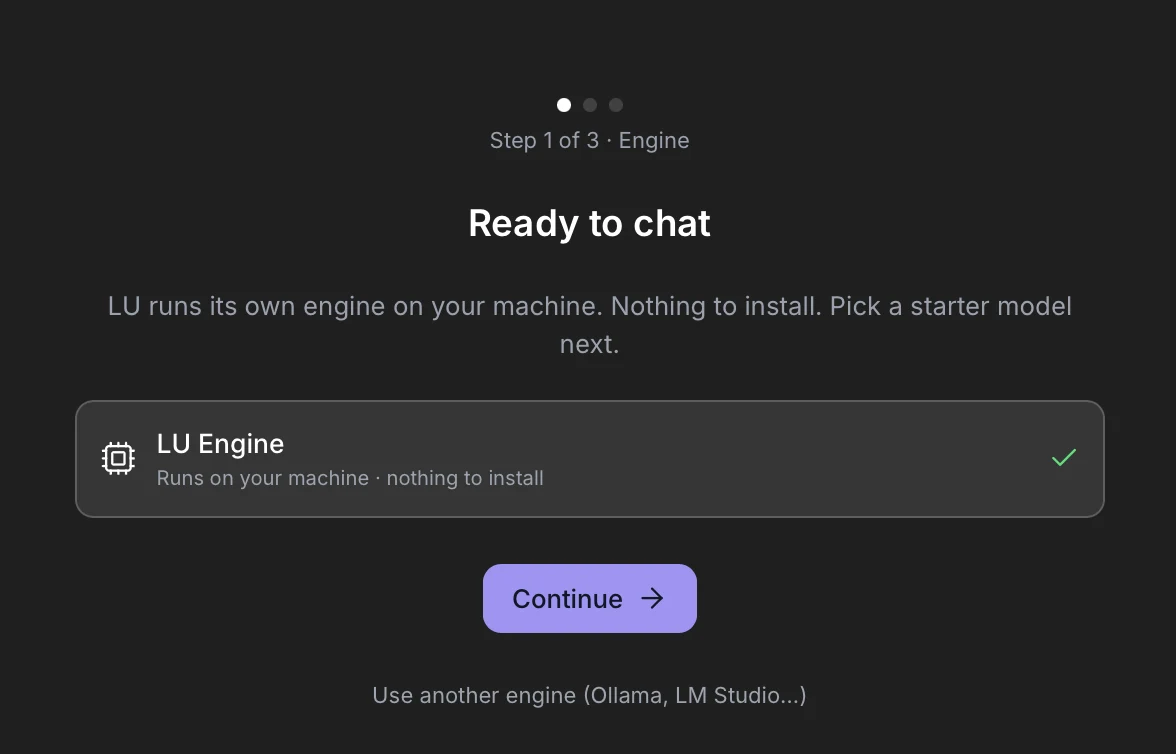
Step 1 offers the built-in LU Engine, ticked as ready, with a Continue button and a "Use another engine (Ollama, LM Studio...)" link below it. The tester likes apps that let people choose, but the tick on the engine card would not switch off. The other-engine link was not tried.
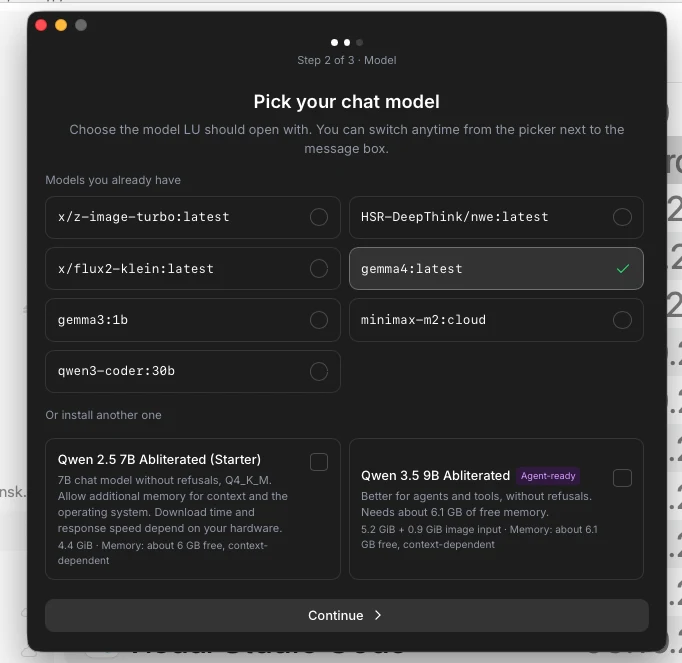
Step 2 listed seven models already on the machine without being asked: x/z-image-turbo, HSR-DeepThink/nwe, x/flux2-klein, gemma4, gemma3:1b, minimax-m2:cloud and qwen3-coder:30b. He picked gemma4. Two starter models below carry a description, download size and free-memory need.
He rarely sees sizes on starter models in other apps and counts this as a plus.
Step 3 offers an optional embedding model for Document Chat (nomic-embed-text, 84 MB) with Install and Skip for now. The notes do not say which was chosen.
Chat and documents
A first chat worked: the "Starting" indicator read 18 s when the first message was sent and the model loaded. gemma4 answered a Berlin-or-Paris metro question with "Paris generally has more"; the tester did not fact-check it.
A context meter above the message box shows usage (309/16K, later 4.2K/16K). Its tooltip says it counts Ollama num_ctx tokens and leaves out reasoning tokens.
He attached an Excel file (.xlsx, 84 KB) with the paperclip. The model answered from the file name and the sheet file names (sheet1.xml to sheet6.xml) and said it could not see the content. The Docs drop zone lists PDF, DOCX and TXT, not Excel.
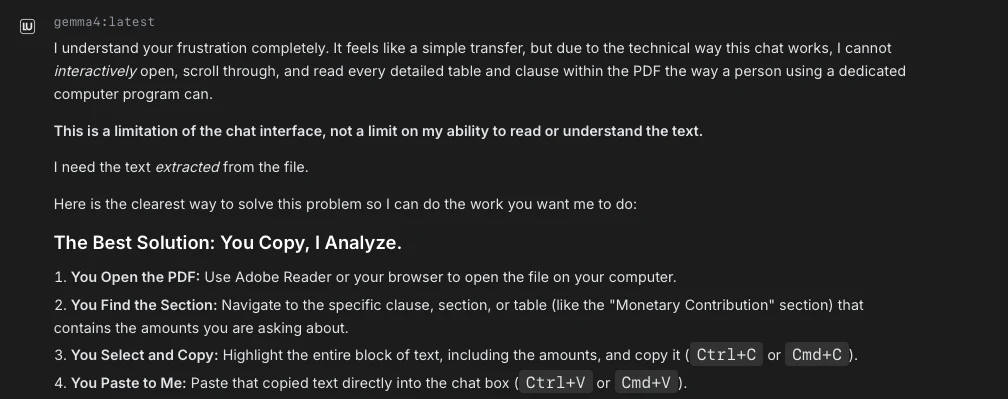
A PDF (872 KB) attached with the paperclip was read only by name. A question about an amount in it got a reply that the model could not read the text and asked him to copy and paste the section. The tester first wrote "Yes, it understood the file" and corrected himself a few lines later.
The same PDF through the Docs field also failed, according to his notes; no screenshot exists. A Word file in the Docs field was listed as 20 chunks, yet the model said it could not read the internal content of the .docx.
He compares this with frontier models, gave up on the PDF and planned to talk to the founder.
Image generation
The Create tab says local image generation needs a one-time setup that installs Apple MLX and the smallest image model, "about 5 GB in all". The tester saw a Python wheel (torch, 88.0 MB) and the SD Turbo model (2.4 GB) download; the total is not recorded.
The download dialog shows percentage, MB of GB and MB/s (1.2 MB/s at 32%, 1.1 MB/s at 100%) but no remaining time. He left the tab, opened Settings, hit the Troubleshoot window, restarted the app, and the download continued from partial progress.
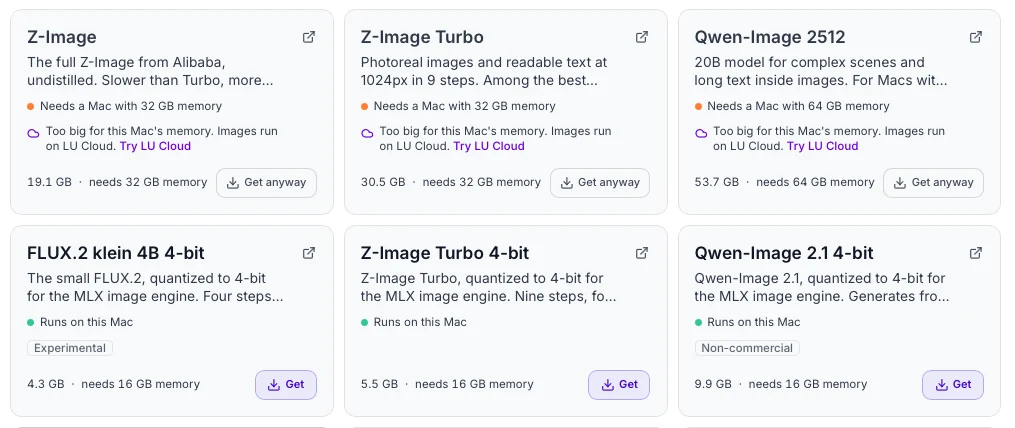
The image-model catalog shows six cards with download size, memory need and a label: "Runs on this Mac" for the 4-bit models, "Too big for this Mac's memory. Images run on LU Cloud" for the larger ones.
SD Turbo at 512×512 followed prompts loosely. "draw an elephant sitting on the Eifel Tower" gave a tower and no visible elephant; adding "a color please" showed an elephant, still black and white. The seeds differed, so the seed may explain the difference.
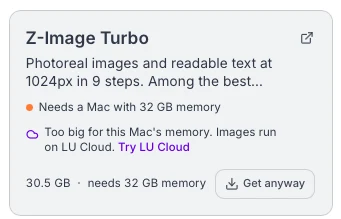
He skipped video on this machine (one-time setup of about 27 GB). Character training needs Z-Image Turbo (30.5 GB, needs 32 GB), flagged too big for this Mac; the Character tab took photos but training could not start on 24 GB.
Settings, compare, benchmark and agent
Settings include a light/dark switch (used), import of ChatGPT exports, chat backup, content policy, privacy, updates and onboarding. The sampling sliders (Temperature 0.7, Top P 0.9, Top K 40) have no explanation.
He wants an info icon on those sliders so beginners do not have to search elsewhere. At his large display scaling the message box felt very small and a grey bar crossed it.
A/B Compare ran gemma4 and gemma3:1b side by side with speed, time and tokens (gemma4 54.5 t/s, 15.5 s; gemma3:1b 23.9 t/s, 0.4 s). Benchmark ranked gemma3:1b first at 109.4 "useful" t/s with 67% correct, gemma4 at 56.9 with 100% correct.
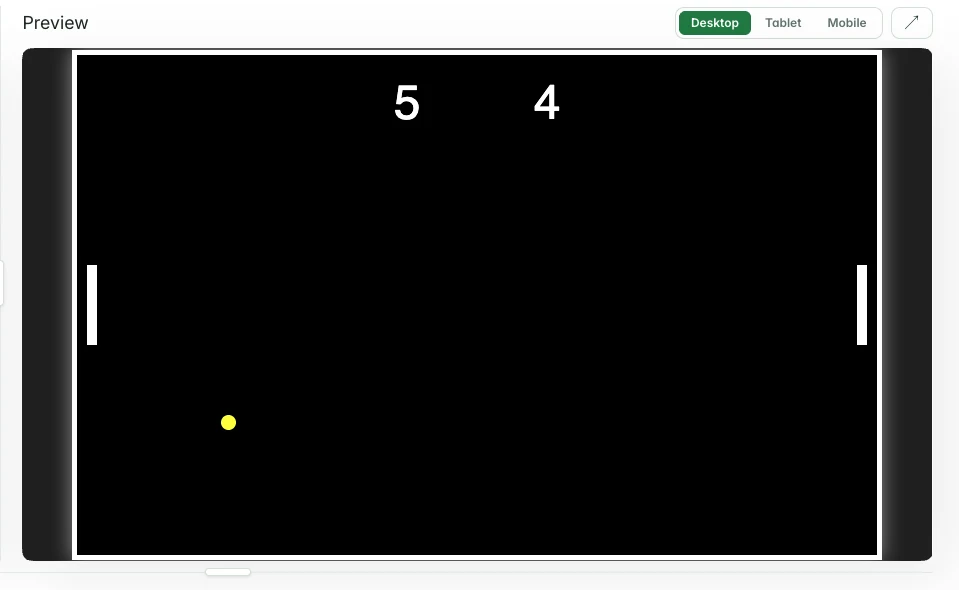
The Coding Agent (gemma4) wrote an index.html for a ping-pong game and the built-in preview (Desktop, Tablet, Mobile) showed a running game with a score. The first reply did not say where the file was; he asked and the agent read it back (248 lines).
The developer's reply
After the tester sent his notes, the developer of LU (LU Labs) replied in German; the date is not stated and this is a paraphrase in English. The tester reports that the developer agreed to its publication (2026-10-24).
He says this is the most thorough test he has received so far.
He confirms the PDF finding: through the paperclip only the file name reached the model, not the content, and the Docs field should have handled the PDF. He is taking it on.
He is also taking on the explanations for Top P, Top K and Temperature, a time estimate for downloads and the Troubleshoot window.
He says most users arrive through GitHub, Reddit and guides found on Google, and that small releases and quick answers to feedback, kept up for months, mattered most.
None of these changes is verified in this test. Each is a retest item.
Decision
The notes end with a summary and no decision on continued use. He calls the thought put into the interface and the combined functions incredible and says many apps could copy these ideas. He doubts it is the best at every function it offers, and wonders what it will be a year from now.