Quick Facts
- Core paper: Arditi et al., "Refusal in Language Models Is Mediated by a Single Direction" (arXiv 2406.11717, 2024), 13 chat models from 1.8B to 72B parameters.
- Heretic: created by Philipp Emanuel Weidmann (p-e-w); 2.0.0 published on 2026-11-01, 2.1.0 on 2026-11-08; uses Optuna to search parameters and scores refusals and KL divergence.
- Hugging Face tag counts (2026-11-13): abliterated 13,279; uncensored 16,629; heretic 7,058 repositories, including quants and duplicates.
- Typical sizes (Q4_K_M GGUF): 8B about 5 GB; 12B about 7.6 GB; 24B about 14 GB; 27B about 16.6 GB; 31B about 18.7 GB.
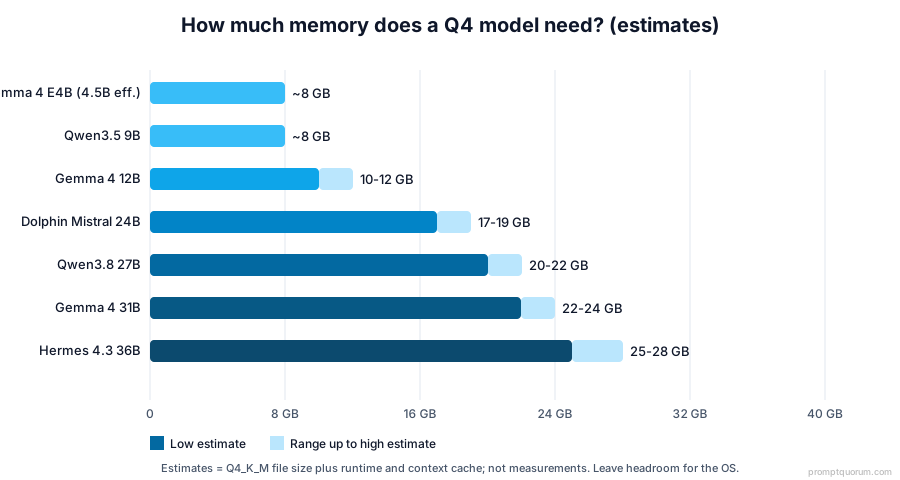
- Memory estimate: a 31B Q4 model wants roughly 22-24 GB of VRAM or 32 GB of RAM; these are estimates, not measurements.
- Lower-risk file formats: prefer safetensors and GGUF over pickle-based .bin, .pt or .ckpt files.
What Are Uncensored AI Models?
Two people download the same open-weight model. The first asks it a borderline question and gets a polite refusal. The second downloaded a modified copy of the same base model, asks the identical question, and gets an answer. Same architecture, same knowledge, different behavior. That gap is the whole story of uncensored AI.
It is possible because open-weight models are files. A hosted chatbot keeps its weights, system prompt and filters on someone else's servers, so you can only talk to it. An open-weight model gives you the weights. Anyone can fine-tune, merge, quantize or edit them, then publish the result. Refusal behavior is something the model learned, so it can be unlearned or suppressed.
Local AI makes this practical. A 12B or 24B model now runs on a laptop or a single GPU, offline, inside apps you already trust. Hugging Face tag pages on 2026-11-13 listed 13,279 repositories tagged abliterated, 16,629 tagged uncensored and 7,058 tagged heretic, though these counts include quantizations and duplicates. Two specialized indexes exist as well: abliter.cn showed 921 models from 25,796 scanned repositories, and abliteration.org describes a catalog of more than 19,000 models. They use different inclusion rules, so the numbers do not describe the same thing.
The topic is also in the news. Heretic 2.0 shipped on 2026-11-01 and replaced the classic single-direction technique as the tool's default. WIRED published a profile of the community on 2026-11-10 (we could only read reposts of it, so we cite it as reported). A Gemma 4 31B modified model published on 2026-11-05 claims a large drop in refusals; we examine its numbers below.
This guide starts with the phenomenon and then explains the terms, the science and the tools. One idea runs through it: think of these models as a swappable component in local apps. The app provides documents, voice, agents and a usable interface; the model decides what it will answer. Combining them gives flexibility that no hosted service offers, and it also removes the safety net a hosted service provides.
📍 In One Sentence
Uncensored AI models are open-weight language models modified, by fine-tuning or by editing weights, so that they refuse fewer requests than the original.
💬 In Plain Terms
Think of a model as a file you own. Someone can edit that file so it says yes more often, and you can run the edited file in your own apps.
What Does Uncensored Actually Mean?
The words are used loosely, which is how people end up downloading something that does not behave as advertised. Here is what each term means technically.
📍 In One Sentence
"Uncensored" describes an outcome (fewer refusals), while "abliterated" describes a method (weight editing), so a model can be one without the other.
💬 In Plain Terms
Uncensored is what you hope for, abliterated is how it was made, and jailbroken is a trick you play on an unchanged model.
Term | What it means | Technical guarantee? |
|---|---|---|
| Uncensored | Fewer or no content refusals | No |
| Unfiltered | Less restrictive output filtering | No |
| Unaligned | Reduced or different alignment training | No |
| Abliterated | Weights edited with an ablation technique | Method only |
| Jailbroken | Behavior bypassed by prompting | No, weights unchanged |
| Unrestricted | Marketing term | No |
Jailbreaking is the odd one out: it changes the prompt, not the model, so the next conversation starts clean. The other terms describe something done to the weights.
⚠️Warning: A model with "uncensored" in its name has not necessarily lost its refusals. Check whether the model card shows a measured refusal rate and how it was measured.
💡Tip: Two different things are often mixed up: a steerable model (Hermes, Dolphin) lets the system prompt define behavior, while an abliterated model has had the refusal behavior removed from its weights.
How AI Models Learn to Refuse Requests
Pretraining teaches a model to predict text from a huge corpus. It produces a capable but undirected system that will continue almost anything. Instruction tuning and supervised fine-tuning (SFT) then train it on example conversations so that it answers questions in a helpful format.
Preference training adds the safety layer. In RLHF (reinforcement learning from human feedback), human raters compare answers, a reward model learns their preferences, and the model is optimized toward them. DPO (direct preference optimization) reaches a similar result without a separate reward model. Safety datasets pair harmful requests with refusals, so the model learns that certain request types should be declined: that is refusal training.
Where does the behavior live? In two places. A system prompt is text prepended at run time, and you can change it. Model-weight behavior is baked in during training, and you cannot change it without touching the weights. That is why a system prompt alone sometimes fails to make a model answer, and why weight edits can.
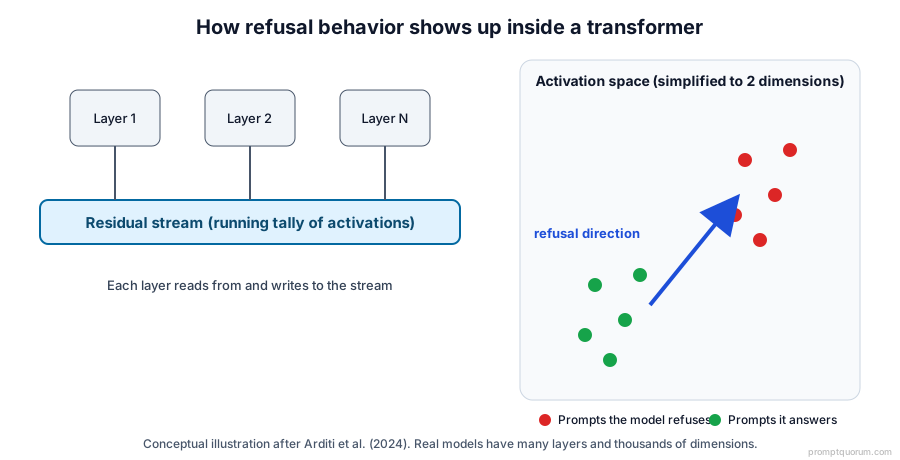
The diagram shows the idea that makes abliteration possible. Inside a transformer, every layer reads from and writes to a shared running tally called the residual stream. Research suggests that, for refusals, much of the signal sits along one direction in that stream.
What Is Abliteration?
The scientific foundation is Arditi et al. (2024), "Refusal in Language Models Is Mediated by a Single Direction" (arXiv 2406.11717). The authors tested 13 open chat models between 1.8B and 72B parameters. Their finding: for these models, refusal is mediated by a single direction in the residual stream.
How the direction is found. Run the model on a set of harmful prompts and a set of harmless prompts, record the internal activations at a chosen layer and token position, and compute the difference of the two averages. That difference-in-means vector is the candidate refusal direction.
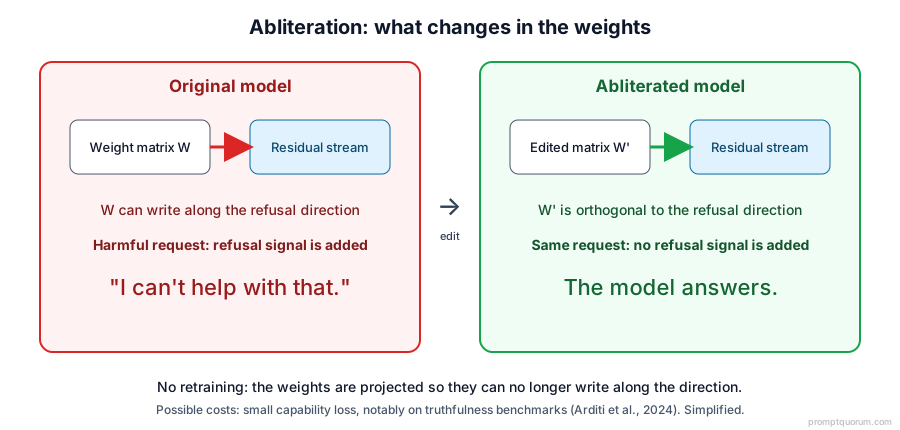
How it is removed. Directional ablation projects that direction out of the activations at run time. Weight orthogonalization achieves the same effect permanently: the weight matrices that write into the residual stream are modified so they can no longer write along the direction. The edited model needs no retraining, and its file looks like any other model.
What is lost. The authors report small capability drops on most benchmarks, with TruthfulQA the exception: it fell consistently, by roughly 1 to 3.5 points. They also describe their direction-selection method as heuristic. Maxime Labonne's practical guide found that abliteration lowered every benchmark he measured, that a DPO "healing" step recovered most but not all of it, and that choosing the layer takes judgment.
A caution on the numbers. Security vendor Alice published a report that tested five models and reported 98.0% compliance after abliteration (539 of 550 prompts) versus 5.8% before, and a blog post reporting 96-100% across six model families. These figures are company-reported, were scored by an LLM judge, are not peer-reviewed, and measure willingness to answer rather than real-world capability uplift. Treat them as a data point, not proof.
📍 In One Sentence
Abliteration estimates a refusal direction from activation differences and edits the weights so the model can no longer write along it.
💬 In Plain Terms
If refusing is a dial inside the model, abliteration finds the dial and removes it, without teaching the model anything new.
Heretic 2.0: The Next Generation of Abliteration
Who and what. Heretic is an open-source command-line tool created by Philipp Emanuel Weidmann (GitHub handle p-e-w). Instead of asking a human to pick layers and strengths, it automates the search.
The original approach. Heretic uses Optuna, a hyperparameter optimization library with a TPE sampler, to try many abliteration settings. Pluggable scorers judge each trial. By default it counts refusals with a keyword scorer and measures KL divergence from the original model on harmless prompts, so the search looks for settings that remove refusals while changing everything else as little as possible. Modifiers are the components that actually edit the weights.
What changed in 2.0. Version 2.0.0 was published on 2026-11-01 (2.1.0 followed on 2026-11-08). The default modifier is now Arbitrary-Rank Ablation (ARA); classic directional ablation, with projected abliteration and norm preservation options, remains available. The release also adds a plugin system, headless operation and a BERT-based refusal scorer as a plugin (the default scorer is still keyword-based). Heretic 1.x config files do not work with 2.x.
What ARA is. According to the author's own pull request, ARA does not use refusal directions. It learns per-module matrix edits with an L-BFGS optimizer against three goals: leave outputs for harmless prompts alone, make outputs for harmful prompts match harmless ones, and push them away from the old harmful outputs. A single direction is a rank-one edit; ARA allows edits of higher rank, so it can capture refusal behavior that is not one-dimensional. The full write-up is still described as a preprint "soon", so the quality claims are the author's own and not independently verified.
Hardware and trade-offs. The tool loads the full model and runs many trials, so you need enough memory to run the model you are modifying, plus time. Quality trade-offs follow the pattern of other methods: a comparative study of four tools on 16 models (Young, arXiv 2512.13655, abstract read) reports GSM8K changes from +1.5 to -18.8 points and Heretic KL values from 0.04 to 1.65, so results depend heavily on the model.
⚠️Warning: Several 2.0 details appear in third-party blog posts that we could not match to the repository. We only state what the repository, release notes or the author's pull request say, and we label the rest as reported.
Other Ways to Create Uncensored Models
Abliteration is not the only route. The table compares the main approaches. The merging row is deliberately cautious: we found no primary source documenting merges as a method for removing refusals.
Method | What it changes | Needs training? | Main trade-off |
|---|---|---|---|
| Uncensored fine-tuning | Weights, via new data | Yes | Compute and data quality |
| Abliteration | Weights, one direction | No | Some capability loss |
| Automated abliteration | Weights, searched settings | No | Trial time and memory |
| Model merging | Blends several models | No | Unverified for refusals |
| Preference optimization | Weights, via preferences | Yes | Needs paired data |
The best-known fine-tuning approach is Eric Hartford's Dolphin line, which filters refusal-style answers out of the training data and relies on the system prompt for behavior. Fine-tuning can also be done with LoRA adapters, and published research reports that safety training can be undone with small amounts of harmful fine-tuning (Qi et al., Lermen et al.). Newer weight-editing variants such as norm-preserving biprojected abliteration try to reduce collateral damage, and DPO "healing" is used to recover quality after an edit.
The Most Important Uncensored AI Model Families
Dolphin (cognitivecomputations and the newer dphn organization) is the best-known fine-tuned line. The current verified entry is Dolphin-Mistral-24B-Venice-Edition. Its card says the system prompt sets the behavior, so it is steerable rather than guaranteed to have no refusals.
Hermes (NousResearch) is not an uncensored family. Hermes 4 models are neutrally aligned and steerable. Nous's own RefusalBench, as reported on the Hermes 4.3 36B card, shows that the model answered about 72-75% of its test prompts, so roughly a quarter are still refused. Do not classify every Hermes model as uncensored.
Qwen abliterated variants dominate downloads. The most-downloaded verified entry is Huihui-Qwen3.8-27B-abliterated, with about 4 million downloads. Search: Qwen abliterated on Hugging Face.
Gemma abliterated variants are the newest area. Gemma 4 modified models appear with plain abliteration and with Heretic and ARA. Search: Gemma abliterated. One of them, a Gemma 4 31B ARA model, claims a large refusal reduction, examined below.
Llama abliterated variants are mostly older. Nothing newer than Llama 3.1 and 3.3 has large download counts in our 2026-11-13 check, and the most-downloaded 8B entry is from 2024. Search: Llama abliterated.
Mistral, DeepSeek and GLM. A Mistral Small 3.2 24B abliteration exists. For DeepSeek and GLM, abliterated versions of the newest models exist but are roughly 284 GB and 321 GB, which is outside consumer hardware; only an older DeepSeek R1 distill at 32B is practical.
A critical read of the Gemma 4 31B claim. The model card reports refusals falling from 99 of 100 prompts to 28 of 100 (Heretic v2.0.0 ARA, KL divergence 0.0845). That is a 72% relative reduction, and it also means 28 of 100 test prompts still tripped the detector. The detector is a list of about 34 keywords such as "sorry" and "illegal", applied to responses truncated at 100 tokens, so a helpful answer with a disclaimer counts as a refusal and a non-answer without those words counts as compliance. The test set is 100 prompts from one dataset, the original scored 99/100, and the KL figure is measured on harmless prompts only, so it says nothing about capability. The card promises reproducibility, but its own reproduce file warns that an uncommitted local Heretic build was used. We found no independent evaluation. A different 31B repack on the same base reports 10/100 at KL 0.054, but results from different authors, runs and settings are not comparable.
💡Tip: Read refusal numbers like benchmark numbers: ask what counted as a refusal, how many prompts, how long the response was allowed to be, and who ran the test.
Where Can You Download Uncensored AI Models?
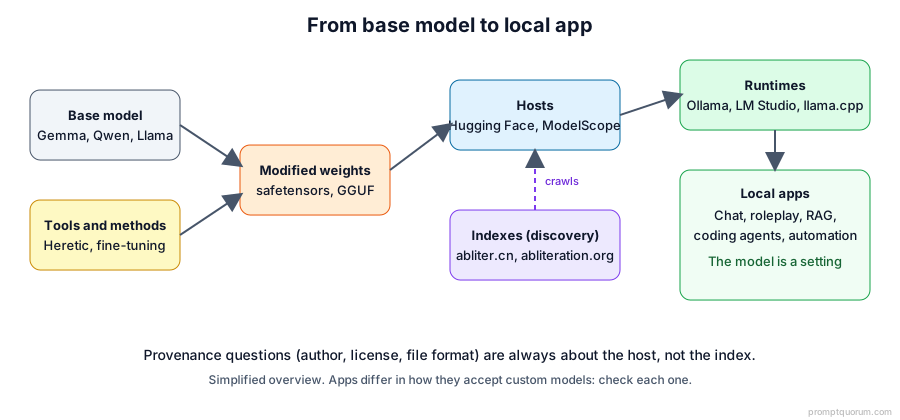
A hosting platform stores and serves the files themselves. A specialized index only crawls hosting platforms and adds a layer of discovery. An index can help you find candidates, but the file you download still comes from the host, so provenance questions are always about the host and the author.
Platform | Role | Website |
|---|---|---|
| Hugging Face | Weights and model cards | huggingface.co |
| Ollama | Run and distribute locally | ollama.com |
| ModelScope | Alternative repository | modelscope.cn |
| GitHub | Tools and source code | github.com |
| Abliter.cn | Model discovery index | abliter.cn |
| Abliteration.org | Catalog and analytics | abliteration.org |
Verify before you run. Prefer safetensors and GGUF files. Pickle-based formats (.bin, .pt, .pkl, .ckpt) can execute code when loaded, and the Hugging Face documentation recommends trusted authors and safetensors. Never enable trust_remote_code on an unfamiliar repository. Check that the model card names the base model and method and that the base-model chain resolves to the official repository, compare file hashes where the author publishes them, and read the license. Hugging Face runs a malware scan on repository files under 2 GB, so large weight files may fall outside it (our reading of the docs). Quantized copies from reputable quantizers vouch for the file format, not for the original author's claims. Ollama namespaces such as huihui_ai and richardyoung are user uploads, not library-vetted models.
Which Uncensored Models Are Worth Downloading?
We checked ten current repositories on 2026-11-13 against the Hugging Face API and model cards, not against older articles. Sizes are Q4_K_M GGUF file sizes where a repository publishes them; memory figures are our estimates (file size plus runtime and cache), not measurements. Download counts and dates change constantly, so this table is a snapshot and should be refreshed independently of the article.
Gemma 4 31B ARA Heretic
- Base:
- Gemma 4 31B-it
- Method:
- Heretic 2.0 ARA
- Params:
- 30.7B
- Q4 size:
- 18.7 GB
- Memory (est.):
- 22-24 GB VRAM
- Context:
- 262K
- License:
- Apache-2.0
- Known limits:
- No independent test found
Gemma 4 E4B Heretic
- Base:
- Gemma 4 E4B-it
- Method:
- Heretic ARA
- Params:
- 4.5B eff.
- Q4 size:
- 5.3 GB
- Memory (est.):
- ~8 GB
- Context:
- 131K
- License:
- Apache-2.0
- Known limits:
- Repackager's own tests
Huihui Gemma 4 12B
- Base:
- Gemma 4 12B-it
- Method:
- Abliteration
- Params:
- 12.0B
- Q4 size:
- 7.6 GB
- Memory (est.):
- 10-12 GB
- Context:
- 128-256K
- License:
- Apache-2.0
- Known limits:
- Card: "proof-of-concept"
Huihui Qwen3.8 27B
- Base:
- Qwen3.8 27B
- Method:
- Abliteration
- Params:
- 27.3B
- Q4 size:
- 16.6 GB
- Memory (est.):
- 20-22 GB
- Context:
- 262K
- License:
- Apache-2.0
- Known limits:
- May add disclaimers
Huihui Qwen3.5 9B
- Base:
- Qwen3.5 9B
- Method:
- Abliteration
- Params:
- 9.7B
- Q4 size:
- 5.6 GB
- Memory (est.):
- ~8 GB
- Context:
- 262K
- License:
- Apache-2.0
- Known limits:
- No refusal data on card
Dolphin Mistral 24B Venice
- Base:
- Mistral Small 24B
- Method:
- Fine-tune
- Params:
- 24.0B
- Q4 size:
- 14.3 GB
- Memory (est.):
- 17-19 GB
- Context:
- 131K
- License:
- Apache-2.0
- Known limits:
- Prompt sets behavior
Hermes 4.3 36B
- Base:
- Seed-OSS 36B
- Method:
- Post-training
- Params:
- 36.2B
- Q4 size:
- 21.8 GB
- Memory (est.):
- 25-28 GB
- Context:
- 524K
- License:
- Apache-2.0
- Known limits:
- Not uncensored
Hermes 4 14B
- Base:
- Qwen3 14B
- Method:
- Post-training
- Params:
- 14.8B
- Q4 size:
- 9.0 GB
- Memory (est.):
- 11-12 GB
- Context:
- 41K
- License:
- Apache-2.0
- Known limits:
- Not uncensored
Llama 3.1 8B abliterated
- Base:
- Llama 3.1 8B
- Method:
- Abliteration
- Params:
- 8.0B
- Q4 size:
- 4.9 GB
- Memory (est.):
- 7-8 GB
- Context:
- 131K
- License:
- Llama 3.1 terms
- Known limits:
- Dated 2024
R1 Distill Qwen 32B
- Base:
- R1-Distill-Qwen-32B
- Method:
- Abliteration
- Params:
- 32.8B
- Q4 size:
- 19.9 GB
- Memory (est.):
- 23-26 GB
- Context:
- 131K
- License:
- Not tagged
- Known limits:
- Dated 2025, no license tag
How to read the table. The Qwen3.8 27B abliteration has by far the most downloads (about 4 million), but its card says output may still carry a small disclaimer warning, a reminder that "abliterated" does not mean "will answer anything". For small machines, the Gemma 4 E4B and Qwen3.5 9B entries fit in about 8 GB. Verified Ollama tags exist for some: ollama run huihui_ai/gemma-4-abliterated:12b, ollama run huihui_ai/qwen3.5-abliterated:9b and huihui_ai/Qwen3.8-abliterated (about 18 GB); the Gemma 4 31B model has an Ollama page under the author's namespace. Hermes 4.3 36B appears so you can see a steerable, neutrally aligned model next to the modified ones: Nous's own benchmark leaves about a quarter of prompts refused. The Llama 3.1 terms require a "Built with Llama" notice and a "Llama" prefix on derivative model names, and the R1 distill has no license tag, so do not assume one. A Mistral Small 3.2 abliteration (24B) and a Llama 3.3 70B abliteration (about 42.5 GB at Q4, for 64 GB-class machines) also exist but are dated.
Use Uncensored Models Inside Local Apps
The reason this matters is the architecture of local AI. Most local apps do not ship a fixed model. They connect to a backend, usually Ollama, llama.cpp or an OpenAI-compatible server, or load GGUF files you choose.
Our own reviews confirm the pattern across categories. SillyTavern connects to KoboldCpp, text-generation-webui, Ollama or LM Studio. Open WebUI fronts Ollama or any OpenAI-compatible API. LM Studio runs GGUF models with a built-in Hugging Face browser. AnythingLLM, Msty and Cline connect to Ollama or LM Studio. n8n has a dedicated Ollama node, and KoboldCpp runs GGUF files directly. When the model is a setting, you can swap a neutral model for an unrestricted one per task.
What you gain. You get the app's features and the model of your choice, offline, with no hosted provider reading the conversation. The table shows how that plays out by category. Confirm that the version of an app you use accepts custom models before you rely on it; this list is a starting point, not a guarantee.
📍 In One Sentence
Because most local apps treat the model as a swappable setting, pairing them with an unrestricted model changes what the whole app will do without changing the app.
💬 In Plain Terms
The app is the car and the model is the driver: swap in a driver who says yes more often and the same car goes places it would not before.
App category | Example apps | What an unrestricted model adds |
|---|---|---|
| Chat clients | LM Studio, Msty, Open WebUI | Fewer refused questions |
| Roleplay and fiction | SillyTavern, KoboldCpp | Dark themes, no mid-scene refusals |
| Document RAG | AnythingLLM, Open WebUI | Inference stays on your device |
| Coding agents | Cline, Aider, Continue | Security-testing code help |
| Automation | n8n with Ollama node | Custom pipelines, own policy layer |
| Personal agents | Hermes Agent, nanobot | More autonomy, needs safeguards |
Concrete examples of the extra flexibility. A novelist can run an abliterated or steerable model behind SillyTavern for morally complex fiction without mid-scene refusals, which our creative-writing guide covers in depth. A lawyer, journalist or researcher can point AnythingLLM at a folder of sensitive documents and ask questions about content a hosted model might decline to discuss, with inference running on your machine. Check each app's telemetry and update settings, because apps and model downloads can still use the network. A security professional can use a coding agent with a model that does not balk at exploit-adjacent questions inside an authorized test environment. A developer can build an n8n workflow whose model is a setting, then change it without rewriting anything. A power user can run two models in one app, a neutral one for everyday work and an unrestricted one for tasks the first declines.
⚠️Warning: The flexibility has a price. In a chat window, an unrestricted model only produces text. Connected to an agent with file, shell or web access, the same model can act on what it generates. Pair such setups with sandboxing, least privilege and human approval.
💡Tip: Not sure which app can load your model or fits your hardware? Filter the Local LLM Software Directory by use case, OS and RAM, or describe your machine to Ask Hans.
How to Run Uncensored AI Locally
Ollama (ollama.com) is the simplest route for command-line users: pull a model by name and it serves an API that many apps understand. LM Studio (lmstudio.ai) is the graphical route, with a built-in Hugging Face browser and a local OpenAI-compatible server. llama.cpp (github.com/ggml-org/llama.cpp) is the engine underneath many of these tools and runs GGUF files directly. Transformers (huggingface.co/docs/transformers) loads full-precision safetensors weights in Python, which suits research and anyone who intends to evaluate or modify models.
GGUF and quantization. GGUF is the single-file format used by llama.cpp-based tools. Quantization stores weights with fewer bits: Q4_K_M is the usual compromise, giving roughly a quarter of the full-precision size with a modest quality cost. Lower quants save memory but can hurt reasoning and instruction following, so test the specific file you use.
Hardware. On Apple Silicon, unified memory is shared between the CPU and the GPU, so a 32 GB Mac can hold a Q4 model of around 24-27B parameters plus context; leave several gigabytes for the system. On NVIDIA GPUs the model should fit in VRAM: a 24 GB card suits the 24-31B models above, and 8 GB suits 4-9B models. If the model does not fit, layers spill to system RAM and speed drops sharply. For exact numbers, see how much VRAM a local LLM needs.
Offline operation. Once the weights are on disk, none of these tools needs the internet to generate text. That is the main privacy argument, and also the reason no provider can enforce usage rules on a local copy.
Can You Create Your Own Abliterated Model?
Conceptually, yes, and it is more approachable than it used to be. We describe the workflow at a high level only.
- 1Select an open-weight model
Why it matters: Pick one whose size fits your memory, because the tool must load it. - 2Check the license
Why it matters: Some licenses and use policies restrict circumventing safety filters (the earlier Gemma terms did); read the exact base-model license before you modify or redistribute. - 3Check architecture compatibility
Why it matters: Tools support specific architectures; a new model may not work yet. - 4Choose a method
Why it matters: Classic directional ablation, or an automated tool such as Heretic with ARA. - 5Run the modification
Why it matters: Automated tools search many settings; classic methods rely on your layer choice. - 6Evaluate the result
Why it matters: Measure refusals and quality loss on prompts the tool did not tune on. - 7Compare with the original
Why it matters: Capability can drop even when refusals fall. - 8Document and publish responsibly
Why it matters: State the method, the numbers, the base model and the license chain.
What Are the Risks of Uncensored AI?
We describe the risks at the level needed to understand them, and we give no operational detail.
- Cybercrime and malware assistance. A model with fewer refusals lowers the effort needed to get help writing malicious code. Whether it adds capability beyond what is already available is debated.
- Phishing and fraud. Fluent, personalized scam text is easy for any capable model; refusals were one friction point, and it is weaker here.
- Dangerous biological and chemical information. This is the highest-stakes concern in the policy debate. Reported refusal-rate numbers measure willingness to answer, not real-world uplift, so they are not proof of either danger or safety.
- Weapons-related misuse. The same caution applies: measured compliance is not demonstrated capability.
- Harassment and abusive content. Local models can generate abusive material at scale. Child sexual abuse material is a criminal offense in the jurisdictions we are aware of. In Germany, § 184b StGB also covers realistic depictions, so assume that realistic AI-generated material can be punishable. Do not generate, request or store it.
- Misinformation. Fewer refusals also means fewer barriers to producing persuasive false content.
- Privacy and data security. Local inference keeps your prompts on your machine, but downloads are a separate risk: unfamiliar repositories can contain malicious files, and apps can still make network calls.
- Malicious model files. Pickle-based formats can run code when loaded, and scanning is not a guarantee (see the Hugging Face pickle-scanning docs). Use safetensors or GGUF from known authors.
- Autonomous agents with tool access. This is the biggest shift: an unrestricted model connected to files, a shell or the web can act. OWASP lists prompt injection (LLM01) and excessive agency (LLM06) among the top risks for LLM applications.
Why Are Some People Against AI Guardrails?
The strongest arguments for less restrictive models deserve a fair statement.
- Freedom of expression. Proponents argue that a tool should not decide what an adult may read or write.
- Scientific research. Studying model behavior, including refusals, needs models that can be modified; the abliteration research itself depends on open weights.
- Security testing. Red teams need models that discuss attacks in order to test defenses.
- Creative writing. Fiction needs villains, violence and moral complexity that over-cautious models can flatten.
- User autonomy. Some argue the user, not the vendor, should set the limits for a local tool.
- Privacy and local execution. Sensitive material is processed on your machine, so no hosted provider receives the prompt; check each app's telemetry settings.
- Avoiding excessive restrictions. Critics of commercial models cite refusals of harmless questions. Eric Hartford's essay on uncensored models makes this argument.
Why Are AI Safeguards Important?
The counterarguments are just as real. Safeguards reduce the chance that a model helps with serious harm, protect vulnerable users, and make deployment in products defensible.
The key distinction is between a model that generates text and an agent that can execute commands, read files, browse the web or interact with other systems. If a chat model writes something harmful, a person still has to act on it. If an agent with the same model acts, the gap between output and consequence closes.
Safeguards in open models are hard to make tamper-resistant: the abliteration research above shows that a single weight edit can suppress refusal behavior. That is a core argument for stronger model-level protections and for external controls around the model.
Can You Build Your Own Safeguards?
Yes. Because a local model has no provider-side layer, you add your own around it.
- Moderation layers. Run a classifier such as Llama Guard or ShieldGemma on inputs and outputs.
- Input and output filtering. Block or review categories you do not want in your workflow.
- Sandboxing. Run agents in containers or virtual machines with no access to anything you cannot afford to lose.
- Permission restrictions. Give agents the least privilege they need: read-only folders, no network, no shell unless required.
- Human approval. Require confirmation before an agent writes files, runs commands or sends messages.
- Logging and monitoring. Keep a record of what the agent did and why.
- Agent security. Treat every document, web page or email the agent reads as untrusted input that may contain instructions (prompt injection).
Is It Legal to Download and Use Uncensored AI Models?
There is no single answer, and this is not legal advice. The questions to separate are possession, distribution and use, and the answer can differ by country and by what the model is used for.
EU AI Act. Regulation (EU) 2024/1689 imposes obligations on providers of general-purpose AI models, with a partial exemption for open-source models that does not apply to models with systemic risk. Obligations for general-purpose AI models apply from 2025-08-02, and Commission enforcement powers from 2026-08-02. The 2025 Commission guidelines say a downstream modifier becomes a provider only above an indicative compute threshold; we read abliteration as far below that, but the criterion is non-binding. We could not confirm from the text whether the 2026 Digital Omnibus changed the general-purpose AI dates, so check the current text.
Possession versus use. Owning a model file is a different matter from using it to commit an offense. Criminal law attaches to specific acts: producing prohibited content, fraud, harassment, or tools designed for computer crime. We reviewed German provisions only partially, so do not rely on this guide for them.
Licenses and contracts. Licenses add rules on top of law. The Gemma 4 model cards list Apache-2.0 and link a Gemma 4 license page, while earlier Gemma generations used the Gemma Terms and Prohibited Use Policy, which forbid circumventing safety filters; check the license page of the exact base model. The Llama 3.1 license requires a "Built with Llama" notice and a model-name prefix on derivatives, with an acceptable-use policy that restricts uses but, in our reading, has no explicit anti-circumvention clause. The Qwen3.5 and Qwen3.8 cards listed in the table show Apache-2.0. Always read the license of the base model, not just the derivative.
Data protection and copyright. Processing personal data locally still falls under data protection law, and copyright questions about the training data of the underlying models are unresolved. Neither changes when refusals are removed.
Is Uncensored AI Becoming a Permanent Part of the AI Ecosystem?
Several trends point to yes. Community modification is large and growing: the Hugging Face tag counts above run to thousands of repositories. Tools are getting more automatic: Heretic searches settings for you, and ARA moves beyond a single direction. New techniques for removing refusals will keep arriving, and so will techniques that make safeguards harder to remove.
Other developments pull in different directions: configurable safety architectures that let deployers choose a policy, commercial services that offer less restricted models, local AI that increasingly puts control with the user, and regulation that is still taking shape. Expect continued argument over whether open weights can ever be made tamper-resistant.
Conclusion. Open-weight AI is giving users greater control over model behavior, and the app layer makes that control practical. But removing safeguards does not remove responsibility: it transfers it to the person who runs the model.
Sources
- Arditi et al., Refusal in Language Models Is Mediated by a Single Direction — arXiv 2406.11717
- Heretic repository and releases — github.com/p-e-w/heretic
- Maxime Labonne, Uncensor any LLM with abliteration — Hugging Face blog
- Young, Comparative Analysis of LLM Abliteration Methods — arXiv 2512.13655 (abstract only)
- Alice, One Pass to Break Them All (2026 report) — report PDF, vendor research, not peer-reviewed
- WIRED, Tear Down Those Guardrails! (2026-11-10/11) — we read reposts only and cite it as reported
- Abliter.cn — abliter.cn; Abliteration.org — abliteration.org (site returned an access error; README mirror used)
- Hugging Face tag pages — abliterated, uncensored, heretic
- Ollama library — ollama.com/library
- Regulation (EU) 2024/1689 (AI Act), Art. 2(12) and 53; Commission guidelines for general-purpose AI models (2025)
- Gemma Prohibited Use Policy and Terms; Llama 3.1 license and acceptable use policy; Qwen3 model card
- Hugging Face documentation: Pickle Scanning and Malware Scanning; OWASP Top 10 for LLM Applications
Frequently Asked Questions
What is an uncensored AI model?
An uncensored AI model is an open-weight language model whose refusals have been reduced or removed, either by fine-tuning or by editing its weights. The result is rarely total: published tests of well-known modified models still show residual refusals.
What is the difference between uncensored and abliterated AI?
Uncensored describes an outcome, fewer refusals. Abliterated describes a method, editing the weights to suppress refusal behavior. An abliterated model is usually less restricted, but "uncensored" in a model name proves nothing without a measured result.
What is the best uncensored LLM?
There is no single best. For small machines, 4-9B Gemma and Qwen abliterations fit in about 8 GB. For 24 GB GPUs, 24-31B models such as Dolphin Mistral 24B or the Qwen3.8 27B abliteration fit. Check the model card for evidence, license and recent activity, and test it on your own tasks.
Are uncensored AI models free?
The weights are usually free to download, under licenses such as Apache-2.0 or the Llama community license. You still pay for hardware and electricity, and some licenses carry conditions on use and redistribution.
Where can I download uncensored models?
Hugging Face is the main host for weights and model cards, and Ollama distributes many as ready-to-run tags. ModelScope is an alternative host. Abliter.cn and Abliteration.org are indexes that help you discover models but do not host the files.
Can I run uncensored AI locally?
Yes. Download a GGUF file or an Ollama tag and run it in Ollama, LM Studio or llama.cpp. A 7-9B model needs about 8 GB of memory, and a 24-31B model needs roughly 20-28 GB at Q4.
What is Heretic?
Heretic is an open-source tool by Philipp Emanuel Weidmann that automatically searches for settings that remove refusals while changing the model as little as possible. Version 2.0, published on 2026-11-01, made Arbitrary-Rank Ablation its default method.
Does abliteration remove all AI safeguards?
No. It targets refusal behavior and does not guarantee that every refusal disappears. Published tests show residual refusals, and quality can decrease, particularly on truthfulness benchmarks in the original research.
Are uncensored models dangerous?
They can be misused, and the risk grows when a model is connected to tools such as a shell, files or the web. In a plain chat window it only generates text. Use sandboxing, least privilege, human approval and logging for agents.
Is it legal to use uncensored AI in Europe?
It depends on possession, distribution and use. Owning a model is different from using it to commit an offense. The EU AI Act mainly obliges providers, and licenses such as Llama's add contractual limits. This is not legal advice; consult a lawyer for your case.
Which local apps can use uncensored models?
Any app that lets you choose the model, which includes LM Studio, Open WebUI, SillyTavern, AnythingLLM, Msty, KoboldCpp, Cline and n8n through Ollama or OpenAI-compatible connections. Check that the version you use accepts custom models.