Key Takeaways
- Version reviewed: 2.2.0, as shown on the App Store listing.
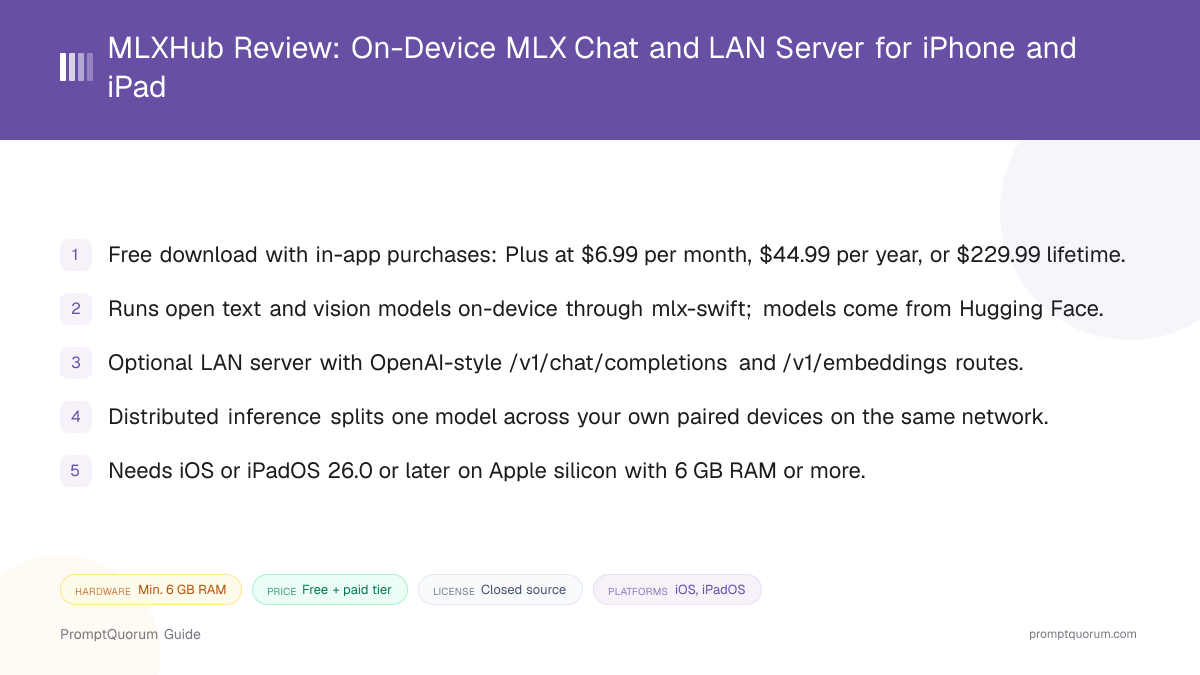
- Price: free to download; MLXHub Plus is listed at $6.99 per month, $44.99 per year and $229.99 lifetime.
- Platform: iOS and iPadOS 26.0 or later; the official site asks for Apple silicon and 6 GB of RAM or more.
- Standout features: LAN server, multi-device model splitting, tools and skills, Hugging Face mirrors.
- Openness: closed source; no public repository was found.
📍 In One Sentence
MLXHub, by developer Juan Colilla, is a freemium iPhone and iPad app that runs open models offline on Apple's MLX framework, serves them to your network, and can split a model across several of your devices.
💬 In Plain Terms
Think of it as a model runner that lives in your pocket: chat works with no internet once a model is downloaded, and the same device can act as a small private AI server for other apps at home.
Get MLXHub
MLXHub is distributed through the Apple App Store. The download is 73 MB and the app is a free download with in-app purchases.
This review is a companion to PromptQuorum's Local LLM Software Directory, which lists MLXHub alongside other mobile and desktop local AI tools.
Channel | Get It |
|---|---|
| Apple App Store | MLXHub: Local AI & LLM Server on the App Store |
| Official site | mlxhub.app |
| Privacy policy | MLXHub privacy policy |
No public source repository was found. There is no Android build; the listing covers Apple platforms only.
MLXHub at a Glance
Attribute | MLXHub |
|---|---|
| Platform | iOS, iPadOS (26.0+) |
| Price | Free, in-app purchases |
| License | Closed source |
| Runs fully offline | Yes, after a model is downloaded |
| In-app model downloads | Yes, from Hugging Face |
| Image input | Yes, vision-language models |
| Local API server | Yes, OpenAI-compatible on your LAN |
| Voice input / output | Not stated in the listing |
Attributes follow the mobile-chat comparison used in the Local LLM Software Directory. They come from the App Store listing and official site, which do not cover every feature.
What MLXHub Is
MLXHub is an on-device model runner first and a chat client second. The listing pitches "private offline chat & tools" and says it lets you "run supported larger models and serve chat and embeddings across your local network". The official site says it is built natively in Swift on mlx-swift, Apple's MLX framework for Apple silicon.
It is published by Juan Colilla, with the copyright line "DreamFoundries EU". Do not confuse it with mlxhub.ai, a separate macOS-only app by a different developer that shares the name.
This review draws on the App Store listing and the official site only. It does not include hands-on testing, so speed, stability and answer quality are not rated here.
How to Get Started
Setup is an App Store install, then a model download from Hugging Face. The listing does not document the first-run flow, so the steps below follow what the listing and site state.
- 1Check device and OS
Why it matters: The listing requires iOS or iPadOS 26.0 or later, and the official site asks for an Apple silicon device with 6 GB of RAM or more. - 2Install MLXHub
Why it matters: Get it from the [App Store](https://apps.apple.com/us/app/mlxhub-local-ai-llm-server/id6766485144); the download is 73 MB. - 3Download a model
Why it matters: Pick an open model from the in-app Hugging Face catalog. The app indicates whether it fits, but Hugging Face metadata is sometimes inconsistent. - 4Chat, then optionally turn on the LAN server
Why it matters: Once a model is downloaded, chat works with no connection. The LAN server is optional and lets other apps on your Wi-Fi use the loaded models.
Features
MLXHub's selling point is breadth around the model runner. Everything below comes from the App Store listing and the official site.
- Models. Downloads open text and vision-language models from Hugging Face; the listing names Qwen3.6 35B-A3B, Bonsai 2 27B and Gemma models. Text-only chats load vision components only when needed, to save memory.
- Memory and skills. A memory system keeps facts from conversations, and you can create reusable custom skills.
- Native tools. Predefined tools reach Apple frameworks such as Calendar, Reminders, Health, Photos and the music library; the listing gives no detail on what each tool can do.
- Speed and fit. KV caching speeds up multi-turn chats, and a RAM stress test benchmarks your device's memory headroom before you load a model.
- Model switching and mirrors. Switch between text and vision models mid-conversation, and use a community Hugging Face mirror when Hugging Face is blocked.
- Large-model streaming. The listing mentions NAND expert streaming for larger models such as Qwen3.6 35B-A3B, without further detail.
- Languages. The interface is available in English plus 11 other languages.
LAN Server and Distributed Inference
The LAN server turns your device into a small OpenAI-compatible endpoint. The listing names the /v1/chat/completions and /v1/embeddings routes. Per the official site it also serves a lightweight chat page that anyone on the same Wi-Fi can open in a browser to talk to the loaded models, and it binds to local interfaces only, with no port forwarding.
Distributed inference pools several of your own devices. One device hosts and the others join, each taking a slice of the model's layers, so a model that none of them fits alone can load. The site says the devices are paired and the traffic encrypted, and that nothing leaves the network. Throughput over Wi-Fi is not published, so expect it to be slower than a single device that fits the model.
Device Requirements
MLXHub requires iOS or iPadOS 26.0 or later, an Apple silicon device and 6 GB of RAM or more. The official site recommends an A17 Pro or M1 chip, or newer. The App Store listing also shows macOS 26.0 (Apple M1 or later) and visionOS 26.0 availability for the same app, without describing a separate desktop version.
RAM is the real limit. Apple enforces stricter app memory limits on iPhone than on iPad, so larger models fit more often on an iPad. The site warns that a model that does not fit can occasionally still be downloaded, and that the app tries to stop it loading before iOS shuts the app down, without a guarantee.
Pricing and Privacy
MLXHub is free to download, with MLXHub Plus listed at $6.99 per month, $44.99 per year and a $229.99 lifetime purchase. Neither the listing nor the site says which features Plus unlocks, so check the paywall in the app before relying on a feature. Models are downloaded free from Hugging Face, with no per-token fees.
The official site says inference is fully on-device, there are no accounts and nothing identifies you. It also states that since version 2.0.0 the app sends anonymous analytics and diagnostics, covering which features you use, device class and whether a model loaded, and that you can switch them off in Settings.
The app is closed source and this review did not inspect network traffic, so the privacy claims are the developer's own. If you enable the LAN server, the data on it is as private as your Wi-Fi network.
Trade-Offs: Benefits vs. Limitations
Offline MLX inference
- What it means in real use:
- Chat with open models with no connection, using Apple's own framework.
- Limitation / caveat:
- Needs iOS 26 and 6 GB of RAM; iPhone memory limits cap model size.
LAN server
- What it means in real use:
- Other apps and browsers on your Wi-Fi can use the loaded models.
- Limitation / caveat:
- The device must stay awake and on the network; no throughput figures are published.
Multi-device splitting
- What it means in real use:
- Load a model that no single device of yours can hold.
- Limitation / caveat:
- Speed over Wi-Fi is undocumented and needs several compatible devices.
Tools, memory and skills
- What it means in real use:
- Reach Calendar, Reminders and Health from a chat.
- Limitation / caveat:
- The listing gives no detail on what each tool does.
Free to start
- What it means in real use:
- No per-token fees; models are free from Hugging Face.
- Limitation / caveat:
- Plus costs up to $229.99 lifetime, and what it unlocks is not stated.
MLXHub vs. Alternatives
MLXHub
- Platforms:
- iOS, iPadOS
- Price and license:
- Freemium, closed source
- Model source:
- Hugging Face (MLX)
- Key difference:
- LAN server and multi-device model splitting; not open source
Locally AI
- Platforms:
- iOS, Mac
- Price and license:
- Freemium, closed source
- Model source:
- In-app model catalog
- Key difference:
- Simpler on-device chat; no LAN server is listed
Articles about Locally AI (4)
- Locally AI Review: Private Offline LLMs on iPhone, iPad and MacUpdated September 4, 2026
- Oscilla Review: Free On-Device AI Chat for iPhoneUpdated October 4, 2026
- Local Chat Apps & Assistants Compared (2026): Desktop, Mobile, Self-Hosted, Assistants and RoleplayUpdated September 20, 2026
- Best Local LLM Apps for iPhone in 2026 (Run AI Without WiFi)Updated September 1, 2026
Also mentioned in:
- Tina Review: iPhone Client for Ollama, llama.cpp and ComfyUIUpdated October 4, 2026
- Private LLM Review: On-Device AI Chat for iPhone, iPad, and MacUpdated September 5, 2026
Private Mind
- Platforms:
- iOS, Android
- Price and license:
- Free, MIT
- Model source:
- Hugging Face downloads
- Key difference:
- Open source and on Android too; no LAN server is listed
Articles about Private Mind (1)
- Private Mind Review: Open-Source Offline AI Chat for iPhone and AndroidUpdated October 3, 2026
Also mentioned in:
- Local AI: Offline Chat & Image Review: Free Android App with Stable Diffusion and Prompt ToolkitsUpdated October 9, 2026
- TokForge Review: Offline Android AI Chat with Roleplay and Image GenerationUpdated October 9, 2026
- LLM Hub Review: On-Device AI Suite for Android and iPhoneUpdated October 3, 2026
Oscilla
- Platforms:
- iOS
- Price and license:
- Free, closed source
- Model source:
- 40+ in-app models
- Key difference:
- Larger fixed catalog; runtime not named
Articles about Oscilla (1)
- Oscilla Review: Free On-Device AI Chat for iPhoneUpdated October 4, 2026
PocketPal AI
- Platforms:
- iOS, Android
- Price and license:
- Free, MIT
- Model source:
- GGUF models
- Key difference:
- Open source, llama.cpp-based, cross-platform
Articles about PocketPal AI (10)
- PocketPal AI Review: Free, Open-Source On-Device ChatUpdated September 5, 2026
- PAIOS Review: Offline Gemini Nano Chat for AndroidUpdated October 5, 2026
- Oscilla Review: Free On-Device AI Chat for iPhoneUpdated October 4, 2026
- Local Chat Apps & Assistants Compared (2026): Desktop, Mobile, Self-Hosted, Assistants and RoleplayUpdated September 20, 2026
- OlliteRT Review: Turn an Android Phone Into a Local LLM ServerUpdated September 19, 2026
- AI on Device Review: A $4.99 Apple Intelligence-Only AppUpdated September 12, 2026
- Google AI Edge Gallery Review: Gemma 4 On-Device Chat for iPhoneUpdated September 12, 2026
- Noema Review: Multi-Format Local AI for iPhone, iPad, and MacUpdated September 12, 2026
- AnythingLLM Mobile Review: On-Device Chat + RAGUpdated September 6, 2026
- Chapper Review: AI & LM Studio Client for iPhone, iPad, and MacUpdated September 6, 2026
+20 more not shown
Platform, price, and feature details for third-party apps change frequently. Verify current specifics on each app's own listing before deciding.
Who Should Use MLXHub
- iPad and recent iPhone owners who want the largest models their device can hold. MLX, streaming and device pooling all target that limit.
- Tinkerers who want a pocket AI server. The OpenAI-compatible LAN endpoint lets scripts and other apps on your network use the device.
- People with several Apple devices. Multi-device splitting is the feature that most alternatives do not list.
Who Should Not Use MLXHub
- Anyone who needs open source. The code is not public; Private Mind and PocketPal AI are open source.
- Android users. Only Apple platforms are listed; PocketPal AI and Private Mind both run on Android.
- Devices below iOS 26 or under 6 GB of RAM. The listing and site set those floors.
- Anyone who wants a stated feature list for the paid tier. What MLXHub Plus unlocks is not documented; try the free tier first.
Frequently Asked Questions
Is MLXHub free?
It is free to download with in-app purchases: MLXHub Plus at $6.99 per month, $44.99 per year, or $229.99 lifetime, as shown on the App Store listing.
Who makes MLXHub?
Juan Colilla, with the copyright line "DreamFoundries EU". The mlxhub.ai app is a different, macOS-only product.
Does MLXHub send my chats anywhere?
The site says inference is fully on-device. Anonymous usage and diagnostics data is sent since version 2.0.0 and can be switched off in Settings.
Does MLXHub work on Android?
No. The listing covers iPhone, iPad and, per the store, Apple M1 Macs and Apple Vision Pro compatibility only.
Which models can I run?
Open MLX-format text and vision models from Hugging Face. The listing names Qwen3.6 35B-A3B, Bonsai 2 27B and Gemma models.
Verdict
MLXHub is a good fit on paper for someone with a recent iPad or iPhone who wants offline MLX chat plus the option to use the device as a local endpoint or to pool several devices for a bigger model.
The caveats are transparency and age: it is closed source, the Plus features are undocumented, speed over multi-device splitting is unpublished, and the listing showed only seven ratings at the time of review.
If you want open source, start with Private Mind. If you want the LAN server or multi-device splitting, try MLXHub's free tier first.
Sources
- MLXHub: Local AI & LLM Server on the App Store — version, price, requirements, features and developer.
- MLXHub official site — feature descriptions, device requirements and FAQ, including the analytics statement.
- MLXHub privacy policy — policy page linked from the official site.