What Is Layla?
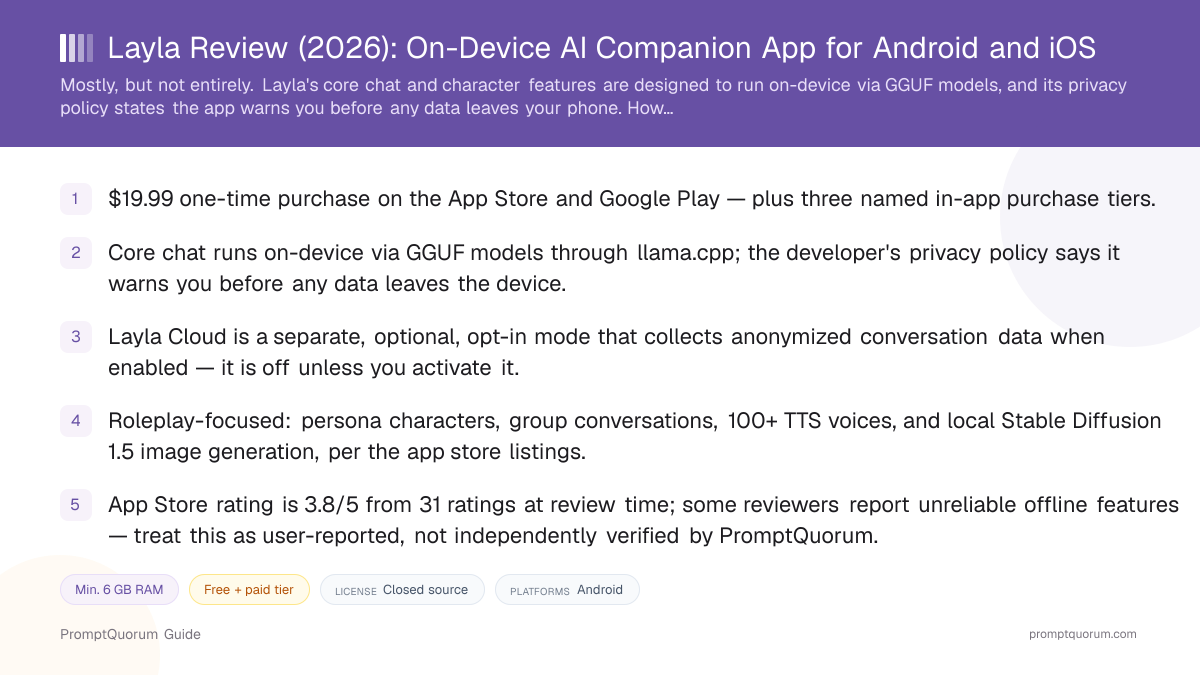
Layla is a mobile app for Android and iOS built around a persona-driven AI companion that runs primarily on-device, using llama.cpp to execute GGUF-format open-weight language models locally. Rather than framing itself as a general-purpose chat client, Layla leans into character and roleplay features: users can create or download customizable AI personalities, hold group conversations with multiple characters, and generate images locally via a bundled Stable Diffusion 1.5 pipeline.
Per its own privacy policy, "the core functionality of our App is designed to run offline on your device," and the policy states the app shows a warning and confirmation message before any action that sends data outside the device. Separately, the developer also publishes an optional cloud-based mode — Layla Cloud — described on its own store listing as "the cloud version of the premium app 'Layla,'" aimed at less technical users who want character chat without managing local models. That optional cloud path, covered in detail in the Privacy section below, is the single most important nuance for a privacy-focused reader to understand before buying.
Who Built Layla?
Layla is published by Layla Network Pty Ltd, a company registered in Southport, Queensland, Australia, and the app first appeared publicly around August 2023. The technical model work behind the app is attributed on GitHub and Hugging Face to a developer using the handle l3utterfly, who has published dozens of "Layla"-branded fine-tuned open-weight models — including Llama2 7B Layla and OpenLLaMA 3B v2 Layla — described in their own model cards as base models used by the Layla app.
The same GitHub account also maintains adjacent infrastructure projects: Layla-Server, a wrapper that proxies OpenAI-compatible requests through WebRTC so the mobile app can connect to a more powerful PC running its own local model, and a Layla SDK for building custom mini-apps that run inside Layla. This points to an actively maintained technical ecosystem around the app rather than a single static release, though — unlike PocketPal AI's fully open-source repository — Layla's own client app source code is not published, so its internal behavior cannot be independently audited the way an MIT-licensed app's can.
- Publisher: Layla Network Pty Ltd, registered in Southport, Queensland, Australia.
- Public launch: around August 2023, per third-party app-directory listings.
- Model development: Layla-branded open-weight fine-tunes published on Hugging Face under the GitHub account l3utterfly.
- Related projects: Layla-Server (connect the app to a self-hosted PC backend over WebRTC) and Layla SDK (build mini-apps inside Layla).
- Client app source code is not public — unlike PocketPal AI or Maid, Layla's app itself is closed source even though some of its underlying models are open-weight.
How to Get Started
Setting up Layla for local chat takes a few steps after purchase, based on the app's own store description and technical blog posts. There is no account required to use the core local features.
- 1Buy and install the app
Why it matters: Download Layla from the [App Store](https://apps.apple.com/us/app/layla/id6456886656) ($19.99) or [Google Play](https://play.google.com/store/apps/details?id=com.layla) ($19.99). A separate, more limited free version has reportedly been distributed via direct APK download from the developer's own site — check [layla-network.ai](https://www.layla-network.ai) directly for current availability of that option before assuming it applies to your platform. - 2Let the app download its default model
Why it matters: On first launch, Layla downloads a language model (reported at around 4 GB in past versions) before you can start chatting; this is a one-time download for that model. - 3Pick or customize a persona
Why it matters: Choose a built-in character or create your own with a name, personality, and voice — Layla's interface is organized around characters rather than a single generic chat thread. - 4Optionally import a custom GGUF model
Why it matters: Advanced users can load their own GGUF-format model file instead of, or alongside, the app's default models. - 5Chat offline, or opt into Layla Cloud
Why it matters: Local chat and image generation do not require a network connection once a model is downloaded. Layla Cloud is a separate, optional mode you must explicitly install or enable — it is not part of the default local experience described above.
Which Models Does Layla Support?
Bundled default model
- Access method:
- Downloaded automatically on first launch
- Typical use case:
- General companion chat out of the box, no configuration required
Layla-branded fine-tunes
- Access method:
- Published on Hugging Face by developer l3utterfly (e.g. Llama2 7B Layla, OpenLLaMA 3B v2 Layla)
- Typical use case:
- Roleplay- and persona-oriented chat tuned for the app's character format
Custom GGUF import
- Access method:
- Manual import of any GGUF-format file from device storage or Hugging Face
- Typical use case:
- Users who already have a preferred open-weight model in GGUF format
LiteRT-LM and PTE (ExecuTorch) models
- Access method:
- Alternative on-device runtime backends, per the developer's technical blog posts
- Typical use case:
- Device- or backend-specific optimized inference beyond plain llama.cpp/GGUF
Stable Diffusion 1.5
- Access method:
- Runs locally on-device for image generation, per the developer's technical blog posts
- Typical use case:
- Local character or scene image generation without a cloud image API
Exact bundled-model identities and default download sizes have changed across app versions; confirm the current default model and its size in-app before downloading on a limited data plan.
Is Layla Available on Android and iPhone?
iPhone / iPad
- Availability:
- Available on the App Store, requires iOS 16.4 / iPadOS 16.4 or later
- Notes:
- App Store listing also shows Mac (macOS 13.0, Apple M1 or later) and Apple Vision (visionOS 1.0 or later) compatibility for the same app.
Android
- Availability:
- Available on Google Play
- Notes:
- A direct APK distribution channel has also reportedly been offered from the developer's own site, separate from Google Play — verify current availability directly before relying on it.
Windows / Linux
- Availability:
- No native Windows or Linux desktop release confirmed at review time
- Notes:
- The Layla-Server project lets the mobile app connect to a PC running its own local backend over WebRTC, which is a bridge rather than a native desktop client.
How Much Does Layla Cost?
Layla costs $19.99 as a one-time purchase on both the Apple App Store and Google Play. On top of that base purchase, the App Store listing shows three named in-app purchase tiers — Monarch ($4.99), Birdwing ($19.99), and Blue Morpho ($29.99) — but the public store listing does not fully spell out what each tier unlocks (for example, whether they cover cloud usage credits, premium characters, or additional voices). Confirm exactly what a given tier includes inside the app before purchasing it.
A separate, more limited free version of the app has reportedly been distributed via direct APK download from the developer's own site, according to the developer's own blog content — this is distinct from the paid App Store and Google Play listings, and its current availability and feature set should be checked directly on layla-network.ai rather than assumed from this review.
Layla Cloud, the separate optional cloud-chat mode, is listed as free to download as its own app on the stores; whether ongoing use of Layla Cloud requires a subscription or credits beyond the free tier is not detailed in the public listing reviewed for this article.
- Base app: $19.99 one-time purchase on the App Store and Google Play — no subscription required for the base purchase itself.
- In-app purchase tiers: Monarch ($4.99), Birdwing ($19.99), Blue Morpho ($29.99) — named on the App Store listing; exact inclusions not fully detailed publicly.
- Free/limited version: Reportedly available via direct APK download from the developer's own site, separate from the paid store listings — verify current status directly.
- Layla Cloud: A separate, free-to-download companion app for cloud-based character chat; its own cost structure beyond the free tier is not detailed in the public listing.
Privacy: Local Chat vs. Layla Cloud
Layla's own privacy policy states that "the core functionality of our App is designed to run offline on your device," and that the app will show you a warning and a confirmation message before taking any action that sends your data outside the device. The policy names specific triggers for outbound data: uploading a character to the Personality Hub, using the in-app "Report a Bug" feature, and enabling optional cloud features.
That last item — optional cloud features — is Layla Cloud, described by the developer as a distinct, separate mode: per the policy, "Layla Cloud is only enabled if you install the 'Layla Cloud' mini-app within Layla," and if it is not installed or activated, "no features related to Layla Cloud are enabled." When Layla Cloud is active, the developer's own documentation states it collects conversation history — your messages, character responses, and data from auxiliary features such as Long-Term Memory, PDF Digest, and Dream — and that this data is anonymized and not linked to your account, though it may be used for debugging or to improve the service. The policy also states Layla Cloud does not retroactively collect conversations from before it was enabled.
Taken together, this is a materially different privacy design from an app whose core functionality has no cloud component at all: Layla's default local mode is designed to stay on-device with an explicit consent gate before any transmission, but the product itself ships an optional, separately activated cloud path that does collect anonymized conversation data when a user turns it on. Readers who want the strongest possible guarantee — a product with no cloud mode to opt into in the first place — should compare this against PocketPal AI, whose entire codebase is open source and MIT-licensed with no built-in cloud chat feature to activate.
- Local mode: Per the developer's policy, designed to run offline; the app is stated to warn and ask for confirmation before any data leaves the device.
- Layla Cloud: A separate, opt-in mode (installed as a mini-app or a distinct app) that collects anonymized conversation history, including auxiliary feature data, when activated.
- Not retroactive: Per the policy, enabling Layla Cloud does not pull in conversation history from before it was turned on.
- Closed source: Unlike PocketPal AI or Maid, Layla's client app code is not published, so the no-transmission-by-default claim rests on the developer's own privacy policy rather than independent code audit.
📌Note: This review has not independently audited Layla's network traffic or source code. The description above reflects the developer's own published privacy policy and store listings, not an independent security assessment by PromptQuorum.
Companion and Roleplay Features
Layla's feature set is built around persona and roleplay use cases more than a plain question-and-answer chat interface, per its own app store descriptions. Named features include:
- Customizable personalities. Users can create or download AI characters with distinct personas rather than talking to one fixed assistant identity.
- Group conversations. Multiple characters can participate in the same conversation thread, per the app's listing.
- 100+ voices. The app lists a large voice library for text-to-speech character responses.
- Live2D character animation. Visual, animated character representations rather than a plain text interface.
- Local image generation. A bundled Stable Diffusion 1.5 pipeline runs on-device for character or scene images, per the developer's technical blog posts.
- Programmable agents (Python). Advanced users can script agent-style behaviors using Python, per the app's own description.
- No built-in content filter on local inference. Because local generation runs entirely on the device's own hardware, the developer's own materials describe it as having no server-side content moderation layer for that mode — a deliberate design choice, and one that shifts responsibility for appropriate use onto the individual user rather than a hosted moderation system.
What Hardware Do You Need to Run Layla?
The App Store listing recommends a minimum of 8 GB of RAM, and Layla's own marketing has historically described the app as targeting recent flagship phones rather than budget or older hardware. This is a stricter baseline than some competing local-chat apps that support smaller 2–4B parameter models comfortably on 4 GB of RAM — Layla's companion features (larger default models, local image generation, and character animation) push the practical hardware floor higher.
As with any GGUF-based app, the specific model loaded — not the app itself — is the real determinant of memory needs: a smaller quantized model needs less RAM than a 7B+ parameter model, and running local Stable Diffusion image generation alongside chat adds additional memory and processing overhead beyond text-only inference.
- Minimum recommended: 8 GB of RAM, per the App Store listing — meaningfully higher than the 4 GB floor common among plainer local-chat apps in this category.
- Recent flagship-tier phones (roughly the last few generations) are recommended over older or budget devices, per the developer's own marketing materials.
- Storage: the default first-launch model download has been reported at around 4 GB in past versions; custom GGUF models and Stable Diffusion checkpoints add further storage requirements.
- Local image generation (Stable Diffusion 1.5) adds processing and memory overhead beyond text-only chat — expect slower performance on lower-RAM devices when using this feature.
Trade-Offs: Benefits vs. Limitations
Companion and roleplay depth
- What it means in real use:
- Persona characters, group chat, 100+ voices, and Live2D animation go beyond a plain chat interface.
- Limitation / caveat:
- Readers who just want a straightforward assistant-style chat app may find PocketPal AI or Private LLM simpler to use.
Local text and image generation
- What it means in real use:
- Both chat and Stable Diffusion 1.5 image generation can run entirely on-device.
- Limitation / caveat:
- Requires meaningfully more RAM and storage than text-only local chat apps; the App Store lists an 8 GB minimum.
Explicit consent gate before outbound data
- What it means in real use:
- Per the privacy policy, the app warns before sending data outside the device for features like character uploads or bug reports.
- Limitation / caveat:
- The app also ships an optional Layla Cloud mode that does collect anonymized conversation data once a user opts in — it is not a no-cloud-component product by design.
Active model and infrastructure development
- What it means in real use:
- Layla-branded fine-tunes on Hugging Face and adjacent projects like Layla-Server show ongoing technical work.
- Limitation / caveat:
- The client app's own source code is closed, so behavior cannot be independently code-audited the way PocketPal AI's or Maid's can.
One-time $19.99 purchase
- What it means in real use:
- No subscription required for the base app on either store.
- Limitation / caveat:
- Three additional named in-app purchase tiers exist whose exact inclusions are not fully detailed in the public listing — confirm what you are buying in-app.
Cross-platform: Android and iOS
- What it means in real use:
- Available on both major mobile platforms, unlike Apple-only apps such as Private LLM.
- Limitation / caveat:
- Public App Store reviews report crashes and unreliable offline features on some devices — user-reported, not independently verified by PromptQuorum.
Who Should Use Layla
- Users who want a companion/roleplay-style local AI, not a plain assistant. If persona characters, group conversations, and voice output matter more than a minimal chat UI, Layla's feature set is built specifically for that use case.
- Users who want local image generation alongside chat. The bundled Stable Diffusion 1.5 pipeline lets a single app handle both text and image generation on-device.
- Users comfortable buying a paid app once rather than using a free tool. $19.99 buys the base app outright on both major mobile platforms.
- Users who read privacy policies carefully and are comfortable with an opt-in cloud mode. Layla's local-by-default design with an explicit warning before any data leaves the device may be an acceptable middle ground for readers who do not need a product with zero cloud capability whatsoever.
Who Should Not Use Layla
- Readers who need a guaranteed zero-cloud-component product. Because Layla ships an optional cloud mode (Layla Cloud) that collects anonymized data once activated, readers who specifically want an app with no cloud feature to ever opt into should choose PocketPal AI, whose entire open-source codebase has no built-in cloud chat path.
- Readers who want a free or fully open-source app. Layla is a $19.99 paid, closed-source app; PocketPal AI (free, MIT-licensed) and Maid (free, MIT-licensed) both cover that need instead.
- Readers who want a simple, minimal assistant-style chat interface. Layla's character- and persona-first design adds complexity that users who just want a straightforward Q&A chat may not want; Private LLM or PocketPal AI are more assistant-shaped.
- Readers on lower-RAM or older devices. The App Store lists 8 GB of RAM as a minimum recommendation, higher than several competing apps that run smaller models comfortably on 4 GB.
- Readers who need enterprise or team features. Layla is a single-user consumer app with no admin console, shared licensing, or team billing; organizations should look at self-hosted, server-side local-LLM infrastructure instead.
- Readers who want to independently audit the app's source code. Layla's client app is closed source; readers who need that level of assurance should use an MIT- or AGPL-licensed alternative like PocketPal AI, Maid, or ChatterUI.
Layla vs. Alternatives
Layla
- Platforms:
- Android, iPhone/iPad (also Mac/Vision Pro per App Store listing)
- Price:
- $19.99 one-time, plus named IAP tiers
- Local vs. cloud:
- Local by design; optional opt-in Layla Cloud mode
- Key difference:
- Companion/roleplay focus: personas, group chat, voices, local image generation
Articles about Layla (3)
- Best Local LLM Apps for Android in 2026: 6 Apps Compared on Real PhonesUpdated October 19, 2026
- PAIOS Review: Offline Gemini Nano Chat for AndroidUpdated October 5, 2026
- Build a Local Voice Assistant on Your Phone: Whisper + Local LLM (No Cloud) — 2026Updated August 29, 2026
Also mentioned in:
- Local Chat Apps & Assistants Compared (2026): Desktop, Mobile, Self-Hosted, Assistants and RoleplayUpdated September 20, 2026
- ToolNeuron Review: Open-Source Encrypted Android AI AppUpdated September 12, 2026
PocketPal AI
- Platforms:
- iPhone/iPad, Android
- Price:
- Free, open source (MIT)
- Local vs. cloud:
- Fully local; no built-in cloud chat feature
- Key difference:
- Free, fully open source, plain-chat-focused rather than roleplay-focused
Articles about PocketPal AI (10)
- PocketPal AI Review: Free, Open-Source On-Device ChatUpdated September 5, 2026
- Best Local AI Apps for iPhone in 2026 (Run LLMs Without WiFi)Updated October 23, 2026
- Loci AI Review (2026): Offline AI for iPhone, Android, iPad, Mac and WindowsUpdated October 23, 2026
- Private LLM Review: On-Device AI Chat for iPhone, iPad, and MacUpdated October 23, 2026
- Run a Local LLM on Your Tablet: iPad Pro M5, Galaxy Tab S10, OnePlus Pad 2 (2026)Updated October 23, 2026
- Best Local LLM Apps for Android in 2026: 6 Apps Compared on Real PhonesUpdated October 19, 2026
- Best Mobile LLM Models for Phones in 2026: Phi-4 Mini vs Gemma 3 vs SmolLMUpdated October 19, 2026
- Local AI Chat Pocket Review: Offline LLM and Image Chat for iPhone and iPadUpdated October 6, 2026
- PAIOS Review: Offline Gemini Nano Chat for AndroidUpdated October 5, 2026
- Oscilla Review: Free On-Device AI Chat for iPhoneUpdated October 4, 2026
+36 more not shown
Private LLM
- Platforms:
- iPhone/iPad/Mac (Apple only)
- Price:
- $4.99 one-time
- Local vs. cloud:
- Fully local; no cloud fallback, per App Store privacy label
- Key difference:
- 140+ curated models with OmniQuant/GPTQ quantization; assistant-style, not roleplay-first
Articles about Private LLM (10)
- Private LLM Review: On-Device AI Chat for iPhone, iPad, and MacUpdated October 23, 2026
- Best Local AI Apps for iPhone in 2026 (Run LLMs Without WiFi)Updated October 23, 2026
- Loci AI Review (2026): Offline AI for iPhone, Android, iPad, Mac and WindowsUpdated October 23, 2026
- Local Chat Apps & Assistants Compared (2026): Desktop, Mobile, Self-Hosted, Assistants and RoleplayUpdated September 20, 2026
- AI on Device Review: A $4.99 Apple Intelligence-Only AppUpdated September 12, 2026
- Google AI Edge Gallery Review: Gemma 4 On-Device Chat for iPhoneUpdated September 12, 2026
- Liquid Apollo Review: On-Device LFM2 Chat, Plus Optional CloudUpdated September 12, 2026
- Noema Review: Multi-Format Local AI for iPhone, iPad, and MacUpdated September 12, 2026
- Off Grid AI Review: Cross-Platform Local AI for iOS, Android, macOS, and WindowsUpdated September 12, 2026
- Pocket AI Review: Offline On-Device AI Chat for iPhoneUpdated September 11, 2026
+12 more not shown
Enclave AI
- Platforms:
- See full review for current platform support
- Price:
- See current listing
- Local vs. cloud:
- See full review
- Key difference:
- Apple-focused on-device assistant with Siri/Shortcuts integration
Articles about Enclave AI (3)
- Enclave AI Review: On-Device AI for iPhone, iPad, MacUpdated October 17, 2026
- Local Chat Apps & Assistants Compared (2026): Desktop, Mobile, Self-Hosted, Assistants and RoleplayUpdated September 20, 2026
- Liquid Apollo Review: On-Device LFM2 Chat, Plus Optional CloudUpdated September 12, 2026
Also mentioned in:
- On Device AI Review: 200+ Local Models for iPhone, iPad, MacUpdated September 12, 2026
- Maid Review: Open-Source Local LLM Chat App for AndroidUpdated September 6, 2026
- RikkaHub Review: Multi-Provider AI Chat for AndroidUpdated September 6, 2026
Backyard AI
- Platforms:
- Windows/Mac desktop (Backyard Cloud adds mobile/web sync)
- Price:
- Free desktop app; optional Backyard Cloud $7–$35/month
- Local vs. cloud:
- Local by default; explicit paid cloud tier for hosted inference
- Key difference:
- Desktop-first roleplay app with a much larger Character Hub; cloud tier is a clearly priced, separate product rather than a free opt-in mode
Articles about Backyard AI (4)
- Backyard AI Review: Local AI Character Chat and RoleplayUpdated September 2, 2026
- Swerve Review: AI Story and Character Chat for iPhoneUpdated October 17, 2026
- Agnai Review: Self-Hostable AI Roleplay ChatUpdated September 12, 2026
- SillyTavern in 2026: The Free Frontend for AI Character Roleplay and Long-Form ChatUpdated September 5, 2026
Also mentioned in:
- Asiden Review: Windows 11 AI Desktop Companion With Local and Optional Cloud AIUpdated October 24, 2026
- Local Chat Apps & Assistants Compared (2026): Desktop, Mobile, Self-Hosted, Assistants and RoleplayUpdated September 20, 2026
- RisuAI Review: Open-Source Roleplay Chat ClientUpdated September 12, 2026
- Chapper Review: AI & LM Studio Client for iPhone, iPad, and MacUpdated September 6, 2026
LLM Farm
- Platforms:
- iOS/Mac (open source, GitHub: guinmoon/LLMFarm)
- Price:
- Free, open source
- Local vs. cloud:
- Fully local
- Key difference:
- Was pulled from the App Store and TestFlight per its own GitHub README — verify current availability before relying on it
Articles about LLM Farm (4)
- LLM Farm Review: Open-Source GGUF App, Off the App StoreUpdated September 6, 2026
- Best Local AI Apps for iPhone in 2026 (Run LLMs Without WiFi)Updated October 23, 2026
- Run a Local LLM on Your Tablet: iPad Pro M5, Galaxy Tab S10, OnePlus Pad 2 (2026)Updated October 23, 2026
- Build a Local Voice Assistant on Your Phone: Whisper + Local LLM (No Cloud) — 2026Updated August 29, 2026
Also mentioned in:
- Best Mobile LLM Models for Phones in 2026: Phi-4 Mini vs Gemma 3 vs SmolLMUpdated October 19, 2026
Maid
- Platforms:
- Cross-platform Flutter app (Android primary)
- Price:
- Free, open source (MIT)
- Local vs. cloud:
- Local via GGUF/llama.cpp; can also connect to remote APIs if the user configures them
- Key difference:
- Fully open source and not roleplay-first; remote API use is opt-in and user-configured
Articles about Maid (4)
- Maid Review: Open-Source Local LLM Chat App for AndroidUpdated September 6, 2026
- Private LLM Review: On-Device AI Chat for iPhone, iPad, and MacUpdated October 23, 2026
- Best Local LLM Apps for Android in 2026: 6 Apps Compared on Real PhonesUpdated October 19, 2026
- Local Chat Apps & Assistants Compared (2026): Desktop, Mobile, Self-Hosted, Assistants and RoleplayUpdated September 20, 2026
Also mentioned in:
- Tina Review: iPhone Client for Ollama, llama.cpp and ComfyUIUpdated October 4, 2026
- Ollama Local AI Review: Android LLM Runner and LAN API ProxyUpdated October 2, 2026
- Chapper Review: AI & LM Studio Client for iPhone, iPad, and MacUpdated September 6, 2026
- LLM Farm Review: Open-Source GGUF App, Off the App StoreUpdated September 6, 2026
ChatterUI
- Platforms:
- Android (build from source)
- Price:
- Free, open source (AGPL-3.0)
- Local vs. cloud:
- Local via GGUF/llama.cpp, or connects to remote APIs if configured
- Key difference:
- Character Card v2 support for roleplay, fully open source, more technical setup
RikkaHub
- Platforms:
- Android
- Price:
- Free, open source
- Local vs. cloud:
- Multi-provider client; local inference via a LiteRT provider
- Key difference:
- Positions itself as a multi-provider client rather than a local-first companion app
Articles about RikkaHub (2)
- RikkaHub Review: Multi-Provider AI Chat for AndroidUpdated September 6, 2026
- LocalAI Review: ApexCreator's Offline Android AI Chat AppUpdated September 12, 2026
Also mentioned in:
- Private LLM Review: On-Device AI Chat for iPhone, iPad, and MacUpdated October 23, 2026
- AnyLLM Review: BYOK AI Chat Client for AndroidUpdated October 17, 2026
- Local Chat Apps & Assistants Compared (2026): Desktop, Mobile, Self-Hosted, Assistants and RoleplayUpdated September 20, 2026
- ToolNeuron Review: Open-Source Encrypted Android AI AppUpdated September 12, 2026
- Chapper Review: AI & LM Studio Client for iPhone, iPad, and MacUpdated September 6, 2026
- LLM Farm Review: Open-Source GGUF App, Off the App StoreUpdated September 6, 2026
AnythingLLM Mobile
- Platforms:
- Android (iOS planned)
- Price:
- Free, open source
- Local vs. cloud:
- On-device via Cactus Compute, or pairs with a self-hosted server
- Key difference:
- Designed to pair with a self-hosted AnythingLLM workspace, not a standalone companion app
Articles about AnythingLLM Mobile (2)
- AnythingLLM Mobile Review: On-Device Chat + RAGUpdated September 6, 2026
- AnythingLLM Review: Open-Source RAG and Document ChatUpdated September 11, 2026
Also mentioned in:
- Liquid Apollo Review: On-Device LFM2 Chat, Plus Optional CloudUpdated September 12, 2026
- Chapper Review: AI & LM Studio Client for iPhone, iPad, and MacUpdated September 6, 2026
Platform, price, and feature details for third-party apps change frequently — verify current specifics on each app's own listing before deciding. LLM Farm's App Store availability in particular should be re-checked, since its own GitHub README described it as pulled from the App Store.
Frequently Asked Questions
Is Layla free?
No, the main Layla app is a $19.99 one-time purchase on both the App Store and Google Play. The App Store listing also shows three named in-app purchase tiers (Monarch $4.99, Birdwing $19.99, Blue Morpho $29.99). A separate, more limited free version has reportedly been distributed via direct APK download from the developer's own site — check layla-network.ai for current availability. Layla Cloud, a separate companion app for cloud-based chat, is free to download as its own app.
Does Layla run completely offline, with no cloud component at all?
Not entirely. Per Layla's own privacy policy, the core app is designed to run offline and warns you before sending data outside the device. However, Layla also ships an optional, separately activated mode called Layla Cloud that does collect anonymized conversation data when a user turns it on. Layla is not a strictly local-only product the way an app with no cloud feature at all would be — readers who want that stronger guarantee should compare it with PocketPal AI.
Who develops Layla?
Layla is published by Layla Network Pty Ltd, a company registered in Southport, Queensland, Australia. Layla-branded fine-tuned open-weight models used by the app are published on Hugging Face under the GitHub account l3utterfly.
Which models can Layla run?
Layla downloads a default model on first launch and can also load Layla-branded fine-tunes published on Hugging Face, or any custom GGUF-format model file, via llama.cpp. The developer's technical blog posts also describe support for LiteRT-LM and PTE (ExecuTorch) model backends, plus local Stable Diffusion 1.5 for image generation.
Does Layla work on both Android and iPhone?
Yes. Layla is available on Google Play for Android and on the App Store for iPhone and iPad; the App Store listing also shows Mac and Apple Vision compatibility for the same app. No native Windows or Linux desktop release was confirmed at review time.
How much RAM does Layla need?
The App Store listing recommends a minimum of 8 GB of RAM, which is higher than the roughly 4 GB floor common among plainer text-only local-chat apps, reflecting Layla's larger default models, local image generation, and character animation features.
What is Layla Cloud, and is it the same as the main Layla app?
No. Layla Cloud is a separate, optional mode or mini-app that provides cloud-based character chat for users who do not want to manage local models. Per the privacy policy, it is only active if a user installs or enables it, and when active it collects anonymized conversation history for debugging or service improvement. It does not retroactively collect data from before it was enabled.
Is Layla reliable? Do users report problems?
Layla holds a 3.8/5 rating from 31 ratings on the App Store at review time. Some public App Store reviewers report crashes and unreliable offline features, particularly around custom model import on iOS. This review has not independently verified current app stability — treat these as user-reported observations, and test the app within your platform's refund window before relying on it.
Is the "Layla" AI companion app the same company as the "Layla" AI travel planner acquired by Expedia?
No. This review covers the on-device AI companion app published by Layla Network Pty Ltd (App Store ID 6456886656, Google Play package com.layla). It is unrelated to the separate "Layla" AI travel-planning company, based in Berlin, that Expedia Group announced acquiring in 2026, and unrelated to other same-named apps such as "Layla – Voice Chat & Party Rooms."
How does Layla compare to PocketPal AI or Private LLM?
Layla is a $19.99 paid, closed-source, companion/roleplay-focused app with an optional opt-in cloud mode, available on both Android and iOS. PocketPal AI is free, open source, and has no built-in cloud chat feature at all. Private LLM is a $4.99 paid, closed-source, Apple-only, assistant-style app with a larger curated model library and no cloud fallback per its App Store privacy label. Choose Layla for companion/roleplay depth across both mobile platforms; choose PocketPal AI for a free, fully local, open-source option; choose Private LLM for a polished Apple-only assistant experience.
Verdict
Layla is a genuinely distinctive entry in the mobile local-AI category: it leans into companion and roleplay features — personas, group chat, 100+ voices, and local image generation — that plainer chat apps like PocketPal AI or Private LLM do not attempt, and its $19.99 one-time price covers both Android and iOS from a single purchase. The privacy story is more nuanced than a simple "fully offline" claim: the developer's own policy describes a local-by-default core with an explicit warning before any data transmission, but the app also ships an optional Layla Cloud mode that does collect anonymized conversation data once a user turns it on — a meaningfully different design from an app with no cloud path built in at all. Combined with a closed-source client, three in-app purchase tiers whose exact contents are not fully public, and user reports of reliability issues with offline and custom-model features on iOS, Layla suits readers who specifically want its persona/roleplay feature set and are comfortable with that privacy trade-off. Readers who want the strongest available local-only guarantee, full source-code transparency, or the lowest cost should start with PocketPal AI instead.
Sources
- Layla on the App Store — price, in-app purchase tiers, platform requirements, ratings, and version history.
- Layla on Google Play — Android availability and pricing.
- Layla official site — product overview and developer-published feature descriptions.
- Layla privacy policy — local-vs-cloud data handling, Layla Cloud scope, and data collection disclosures.
- Layla (Cloud) on the App Store — the separate optional cloud-mode app listing.
- l3utterfly on GitHub and l3utterfly on Hugging Face — Layla-branded model releases and related infrastructure projects (Layla-Server, Layla SDK).